


Volta a Valenciana ended with a huge upset from veteran Rui Costa who not only won the final stage but also the overall thanks to his exploits in a cat and mouse final few kilometres. In this article, we will analyse in particular the decisive climb, La Frontera (5.1 km, 9.22%), where the best climbers rode away from the peloton after an hour of racing, doing great watts for early February and maybe even setting their all-time bests.
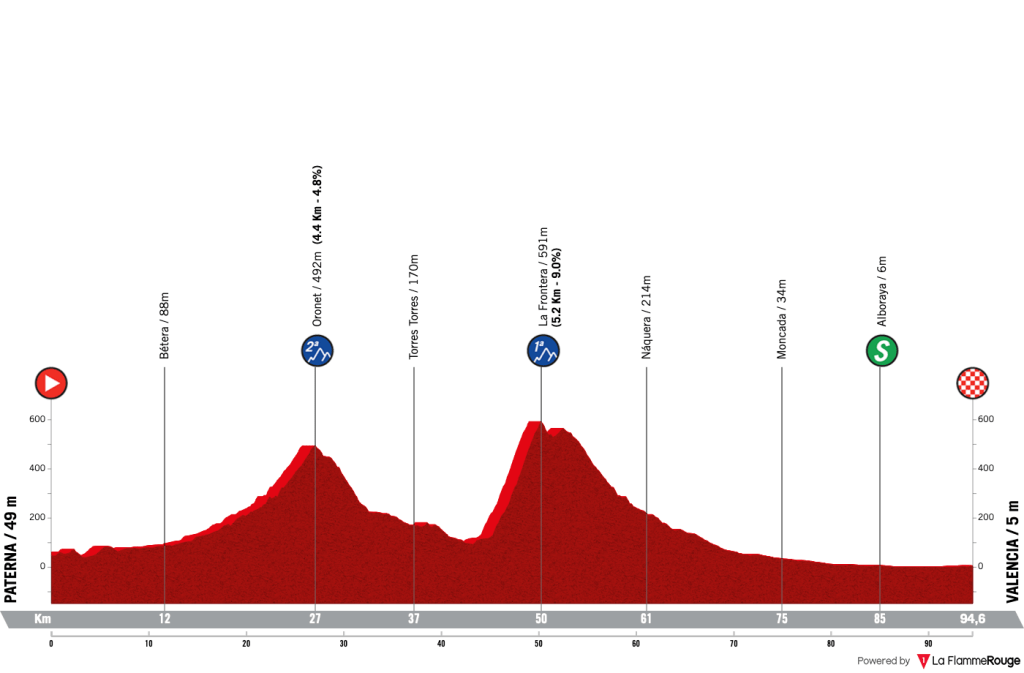
It was a short stage with only 94.6 kilometres and the pivotal climb cresting with 45 kilometres remaining, almost all of which then comprised of a descent and flat roads. The GC riders had been riding for only around 70 minutes before they started climbing up La Frontera, bringing fresh legs after barely spending 1000 kilojoules before the steep climb – always a recipe for high watts.

Bora-Hansgrohe lit up the climb with Bob Jungels and Matteo Fabbro. They were riding for the defending champion Aleksandr Vlasov who would probably have preferred a hard uphill finish like Maigmo Tibi, which featured in last year’s Valenciana. After his teammates emptied their tanks, Vlasov was pulling the GC group up the steep La Frontera for quite a while, which is why he pushed 6.7 w/kg for 15 minutes and 7 seconds based on our estimations. That is 0.09 w/kg more than Ciccone, Bilbao, Geoghegan Hart and Soler, who largely sat in the draft.

This is a great performance for February as it is slightly below the yellow Grand Tour winner trend-line. All the climbing efforts from this edition of Valenciana are the red dots in the graph below, and you can see that La Frontera is way above the rest. As mentioned previously, the riders had fresh legs after a fairly easy first hour of the stage and Bora-Hansgrohe did their best from the base of the climb, holding a high steady tempo, which is crucial for high w/kg performances.
Teams that use shimano power meters if they are serious about training to power should also use another power meter like the assioma shimano pedals. I’m sure they all go out with their phone so it wouldn’t be hard to record one on the head unit the other on the phone and compare to see if they are accurate.
My Dura Ace crank PM and older Quarq over read 4-5% vs my Assiomas, so sounds like that is the case here. Battery life, humidity, temperature all factor in as well so even 5-8% higher power than actual could be common.
Arensman at 500 for the climb is just silly.
Last year at Roubaix (or maybe Flanders), V. Avermaets avg power according to Strava was well over 400. 🙂
Han de ser errores, aunque con tanto billete resulta improbable que no tengan equipos confiables. Querrán Cañar?