Latest News

Ganna Makes it 2/2 | Tour de la Provence Prologue

As expected, double World Individual Time-Trial champion Filippo Ganna won in dominant fashion in the Tour de la Provence prologue, on a parcours perfect for the powerful Italian.

Tour de la Provence 2022 Prologue Profile By La Flamme Rouge

Second best in the seven kilometre flat prologue with few turns was his INEOS Grenadiers teammate, and British ITT champion, Ethan Hayter, who lost 12 seconds the best of all the GC contenders (yes we are calling Hayter a GC contender for this race). This was the 16th prologue or ITT win in Ganna’s pro career. Italian already showed his incredible form last week in Etoile de Besseges time-trial, which included a 2.5km climb. He has not lost on an ITT bike since World Championships in Flanders.

Filippo Ganna (Italy / Team INEOS Grenadiers) pictured during 7th Tour de la Provence (2.Pro) – Prologue between Berre-lÕÉtang and Berre-lÕÉtang (7.1Km) – Photo: William Cannarella/Cor Vos © 2022

Ethan Hayter finished second, beating Swedish short ITT specialist Tobias Ludvigsson by one second. It was not a surprise that Ludvigsson came so close to Hayter, given his solid performances in 2020 and 2021 at the Tirreno-Adriatico 10 kilometre San Benedetto del Tronto flat ITT, which is very similar to this Provence prologue. For INEOS, this puts Hayter in a decent position heading into the road stages and, given Carapaz not looking like he is in top shape either today or at Besseges, means that Hayter should be their protected GC leader.

Ethan Hayter (GBR / Team INEOS Grenadiers) pictured during 7th Tour de la Provence (2.Pro) – Prologue between Berre-lÕÉtang and Berre-lÕÉtang (7.1Km) – Photo: William Cannarella/Cor Vos © 2022

How much time GC favorites lost to Filippo Ganna in the prologue:

  • +0:12 Ethan Hayter
  • +0:15 Pierre Latour
  • +0:17 Julian Alaphilippe
  • +0:20 Ilan Van Wilder
  • +0:24 Mattias Skjelmose Jensen
  • +0:24 Matteo Jorgenson
  • +0:28 Florian Stork
  • +0:30 Gorka Izagirre
  • +0:31 Nairo Quintana
  • +0:35 Michael Storer
  • +0:38 Richard Carapaz
  • +1:04 Ivan Sosa

Evidently, the biggest loser of today was last year’s Provence overall winner Ivan Sosa. The new Movistar recruit lost an incredible amount of time in such a short time trial, going over 12.5% slower than Ganna and ruling out a possibility for him to win GC this year. Sosa lost seconds to riders on continental teams who were just trying to get through the day’s stage and were riding on a road bike with no aero extensions.

Andrea Mifsud (FRA – Nice Metropole Cote dÕAzur) pictured during 7th Tour de la Provence (2.Pro) – Prologue between Berre-lÕÉtang and Berre-lÕÉtang (7.1Km) – Photo: Roberto Bettini/Cor Vos © 2022

Conversely, His countryman Nairo Quintana, the winner of this race in 2020, performed above expectations, only losing 19 seconds to Ethan Hayter. Considering Quintana’s recent ITT results and historical weakness in the discipline, either he is in top shape or Arkea have improved his set up (or both). Quintana before this race told the media that he wants to podium the Tour de France this year and to do that he will need both his February 2020 thermonuclear climbing legs plus a much improved time trial. We will definitely be watching to see if Nairoman shows such form on the Queen stage that will end on Montagne de Lure, where he will need to gain back all the time lost to Hayter.

As mentioned in our preview of Tour de la Provence 2022, Julian Alaphilippe was sick with a cold and missed Quick-Step Alpha Vinyl’s pre-season camp in Portugal, his prologue performance 5 seconds behind Hayter shows that his form is better than he suggested before the race.

Julian Alaphilippe (France / Team Quick-Step Alpha Vinyl) pictured during 7th Tour de la Provence (2.Pro) – Prologue between Berre-lÕÉtang and Berre-lÕÉtang (7.1Km) – Photo: William Cannarella/Cor Vos © 2022

Quick-Step did not bring a sprinter to Provence because Davide Ballerini tested positive with Covid-19, so in tomorrow’s first road stage Alaphilippe probably will likely go up against Arnaud Demare, Elia Viviani and other sprinters in the flat stage. INEOS will be the team to watch to see how they manage Hayter’s GC expectations and Viviani’s role as their sprinter. Will Hayter provide a leadout like Evenepoel did in Valenciana or will he also be allowed to sprint himself? They are near the coast line in parts of this stage, where the wind can sometimes blow, so if there are any crosswinds expect INEOS to try and take advantage.

Tour de la Provence 2022 Stage 1 Profile By La Flamme Rouge

UAE Emirates lead-out perfection | Tour of Oman Stage 1

Sprint stars Fernando Gaviria and Mark Cavendish battled it out for a victory in the opening stage of Tour of Oman, a 139 kilometre stage that was made for sprinters despite the slight 3% rise in the last kilometre.

Tour of Oman Stage 1 2022 Profile By La Flamme Rouge

As expected the breakaway was caught with 10 kilometers to go. The longest survivor of the three men breakaway was Euskaltel – Euskadi rider Peio Goikoetxea who also had to contend with a stray plastic bag.

Peio Goikoetxea avoiding a plastic bag

After that DSM, who did not bring a sprinter, started to pace for some time on the front for no immediately evident reason until their rider Søren Kragh Andersen attacked. A surprising move given the hilly stages that should suit a move from him in latter stages, and he was caught by the sprint trains very quickly.

Quick-Step Alpha Vinyl Team, who were working for Mark Cavendish, saved some energy in the peloton in the run-in, only moving to the front with 2 kilometres to go in their typical fashion.

Quick-Step Alpha Vinyl riders saving energy before the finish

Despite this, Quick-Step did not bring much firepower to this race and could not assemble a functional lead-out train for Cavendish with Steels, Van Tricht and Keisse. This was a far cry from the lead-outs for Cavendish in last year’s Tour de France, with him having to fight for other sprinters wheels at the end of this race. UAE-Team Emirates however, did everything by the book.

The best lead-out for Gaviria this year

38-year-old Maximialiano Richeze proved that he is still a capable last lead-out man, at least at this level. Before this season he did not have a contract for a long time and he considered retirement, before UAE extended him for six months until after the Giro d’Italia. Gaviria was able to finish off Richeze’s work fairly comfortably, taking his 48th career pro win. Cavendish appeared to be faster than Gaviria but he began the sprint out of position and needed to overtake Australian Kaden Groves, costing him time and energy.

UAE Team Emirates) pictured during 11th Tour of Oman (2.Pro) – stage 1 from Al Rustaq Fort to Muscat (138km) – Photo: Ilario Biondi/LB/RB/Cor Vos © 2022

Stage 2 should be another bunch sprint affair, subject to the ever present threat of crosswinds in this part of the world. We should see Gaviria, Groves and Cavendish go head to head again, with Quickstep hoping to put Cavendish in a much better position than in today’s stage.

The Return Of The World Champion | Tour de la Provence Preview

High level climbers will clash in Tour de la Provence 2022, which features Nairo Quintana and Ivan Sosa, who both performed at a very high level on Chalet Reynard in the 2020 and 2021 editions respectively. This year the Queen stage will finish on the mighty Montagne de Lure, a 13.4 kilometre long climb at a consistent 6.5% gradient. The race runs from the 10th to the 13th of February.

Provisional Startlist – Procyclingstats.com

Due to the abundant Covid-19 situation in Europe, the virus has also taken its toll in the pro peloton. Many teams will race with incomplete squads, including AG2R Citroën, DSM and Quick-Step Alpha Vinyl who will participate with only five out of seven maximum allowed riders. Riders who were scheduled to participate, such as INEOS’ talent Magnus Sheffield and Quickstep’s sprinter Davide Ballerini, were withdrawn late after both testing positive for COVID. Ballerini began his magic February here last year, where he won two stages, including this well timed sprint to beat Arnaud Demare and Nacer Bouhanni.

Demare loses to Ballerini in a sprint – Tour de la Provence 2021

Prologue

The opening stage will be a seven kilometre flat prologue.

Tour de la Provence 2022 Prologue Profile By La Flamme Rouge

The ITT World Champion, Filippo Ganna will be by far the biggest favourite to clean up this stage, after opening his account for the season at the Etoile de Besseges time-trial last week which included a 2.5km climb.

GANNA Filippo (ITA) of INEOS GRENADIERS during stage 5 of 51st edition of the Etoile de Besseges cycling race, a time trial of 10,7 km with start in Ales and finish in Ales LÕErmitage on February 07, 2021 in Ales, France – photo: NV/PN/Cor Vos © 2021

Perhaps Ganna’s biggest competition coming from within his own team, in the form of young Brit Ethan Hayter. Other solid time trial riders such as Maciej Bodnar, Patrick Bevin, Tobias Ludvigsson will also try to challenge for stage podium placings.

Stage 1

Stage 1 is made for pure sprinters. It’s pancake flat in the last 115 kilometres.

Tour de la Provence 2022 Stage 1 Profile By La Flamme Rouge

Arnaud Demare last year in Provence lost to Davide Ballerini in the first sprint, with Bauhaus taking out the second. This year is one of the rare occasions that Quick-Step Alpha Vinyl will race practically without a sprinter. Their best option is … Julian Alaphilippe. Other sprinters that might challenge Demare include Elia Viviani (who looked ok at Valenciana), Bryan Coquard, Pierre Barbier, Rudy Barbier and Andrea Vendrame. With this level of competition even St Michel – Auber93 French continental team sprinter Jason Tesson might finish on podium.

Stage 2

Stage 2 profile reminds me of something from the Ardennes or Bretagne. A lot of small climbs and the finish ends on a slight rise.

Tour de la Provence 2022 Stage 2 Profile By La Flamme Rouge

The stage can end with a sprint between the big guys if it is raced passively. If the tempo is hard enough, then Coquard and Cofidis might try and put pressure on Arnaud Demare. INEOS also have a difficult decision to make in choosing whether to go for Ethan Hayer, who is very strong on a hilly stage with a slight uphill finish or their bunch sprinter Viviani. Alaphilippe will be the key for this stage, as he raced aggressively on late climbs in Stage 1 of Provence last year but here he might fancy himself in the uphill drag to Manosque. Due to incomplete squads it might be harder for teams to control attacks and set up a group sprint, so there might be more attempts later in the stage from climbers/puncheurs such as Paret-Peintre or Gilbert.

Stage 3

Tour de la Provence will end with a different mountain top finish to the previous two years, changing from Chalet Reynard to the longer Montagne de Lure of 13.4 km at 6.5%.

Tour de la Provence 2022 Stage 3 Profile By La Flamme Rouge

Steeper sections are at the end of the climb, with the last four kilometres averaging just over 7%. We would expect Movistar to pace the climb as hard as possible for Sosa as well as Arkea for Quintana if he is feeling good. Early attacks on the climb from these favourites are unlikely given the ease of the stage beforehand and the early shallow gradients. The last four kilometres are where it will kick off.

GC Favorites

Nairo Quintana in the 2020 edition of Provence dropped a thermonuclear bomb on Chalet Reynard doing 6,67 w/kg for 28:12, which is one of the greatest climbing performances since the 1998 Festina Scandal. If Nairoman can get his early 2020 pre-covid form then anything can happen.

Mont Ventoux/Chalet Reynard – France – wielrennen – cycling – cyclisme – radsport – Samsic) pictured during Tour de la Provence 2020 stage 3 from Istres to Mont Ventoux/Chalet Reynard (140.2KM) – photo Luca Bettini/Cor Vos © 2020

The winner of the 2021 edition of Provence, Ivan Sosa will also line up for his first stage race in a Movistar jersey here. In the previous year, while riding for INEOS, the Colombian attacked on the slopes of Chalet Reynard, winning both the stage and the general classification. His performance on Chalet Reynard was great for an early season attempt – 6,31 w/kg for 29:15, but he failed to show anything near that level for the remainder of the year.

Sosa destroys everyone on Chalet Reynard – Tour de la Provence 2021

In 2022 Sosa warmed up with three Mallorcan one-day races and now he has got the first big chance to prove himself this year. Movistar have sent Gorka Izagirre, Matteo Jorgenson, Antonio Pedrero and Oscar Rodriguez to accompany him, all of whom on their day are good enough climbers to top 10 this Montagne de Lure stage – they are by far the strongest climbing team.

Ivan Ramiro Sosa (Colombia / Team INEOS Grenadiers) pictured during the 6th Tour de la Provence – stage 3 – from Istres to Mont Ventoux/Chalet Reynard 153.9KM – photo William Cannarella/Cor Vos © 2021

Double World Champion Julian Alaphilippe’s preparation was influenced by a cold and he did not go to a team camp in Portugal before Provence. Clearly, he will not be in his best shape. Probably in this form he cannot reach the level of his Chalet Reynard 2021 performance (6.23 w/kg for 29:30), but taking into consideration the prologue and hilly sprint stage, where he actually might get some bonus seconds, Alaphilippe even not at his best, might still do something in GC if he tries.

Alaphilippe vs Bernal on Chalet Reynard – Tour de la Provence 2021

Egan Bernal had planned to ride Provence before he severely crashed during training camp in Colombia. In 2021 the Colombian sat on Alaphilippe’s wheel on Chalet Reynard, while his then teammate Sosa was going after a victory. INEOS’ main GC hope this year is Richard Carapaz, who crashed hard in Etoile de Besseges last week but avoided serious injury and continued the race. It is hard to predict how well Ethan Hayter will do at this race. He should take time on all other GC contenders in the prologue, as well as possible bonus seconds on at least one of the sprint stages. The big question mark is on Montagne de Lure, which will be the longest climb he has done against such competition as a possible leader. Despite winning frequently (including GC) in 2021, he did not race on a climb that is anything as long and hard or with a team as strong as Movistar. This question mark similarly applies to new Quickstep signing Ilan van Wilder, who should be in a strong position after the TT and punchy stage 2, but suffered on longer climbs throughout 2021.

02/06/2021 – Criterium du Dauphine 2021 – Etape 4 – Firminy / Roche-la-Moliere (CLM – 16 km) – Ilan VAN WILDER (Team DSM), maillot blanc

21-year-old Danish climber Mattias Skjelmose Jensen surprised everyone with a great result in the UAE Tour in 2021 where he finished 6th on GC in a high level World Tour stage race. The podium is possible for Skjelmose Jensen, and would be an expected progression, as he has a competent time trial paired with a history of high level performances on climbs in recent races.

Two time Vuelta a Espana stage winner Michael Storer will also debut for Groupama – FDJ in Provence. He is the only GC option for the French World Tour team who signed him for this express purpose, after his success in the similar race Tour de l’Ain last year. It will be interesting to see whether the Australian can replicate his dominant level from the Vuelta a Espana in this early season race.

Michael Storer (Australia / Team DSM) pictured during 76th La Vuelta ciclista a Espana (2.UWT) stage 18 from Salas to Altu de El Gamoniteiru (162.6KM) – photo Luis Gomez/Cor Vos © 2021

Quick-Step Learn From their Mistakes | Valenciana Stage 5

Not to be denied three consecutive times, Quick-Step Alpha Vinyl Team learned from yesterday’s lead-out mistakes and delivered Dutch sprinter Fabio Jakobsen perfectly to win the final stage of Volta a la Comunitat Valenciana.

Volta a la Comunitat Valenciana Stage 5 2022 Profile By La Flamme Rouge

Despite stage 5 being completely flat, Remco Evenepoel and Matej Mohorič tried to form a breakaway with four more riders before the live coverage started. Of course, the attempt was not successful because no one wants to let go away a breakaway with such strong riders, especially not Bora-Hansgrohe who’s priority was to defend Aleksandr Vlasov’s lead in the general classification. Eventually the day’s break formed which included Vincenzo Nibali, only to be caught after the intermediate sprint with 13 kilometres to go.

Vincenzo Nibali (ITA – Astana Qazaqstan Team) pictured during the Volta a la Comunitat Valenciana 2022 – stage 5 from Paterna to Valencia (92KM) – Photo: Luis Angel Gomez/Cor Vos © 2022

If in stage 4 Quick-Step failed with their sprint lead-out setup, then today they did everything by the textbook. Evenepoel showed incredible stamina with an impressive pull from 3.5 kilometers to 1.1 kilometers to go, however this time he had Lampaert and the rest of the train on his wheel.

Remco doing his thing

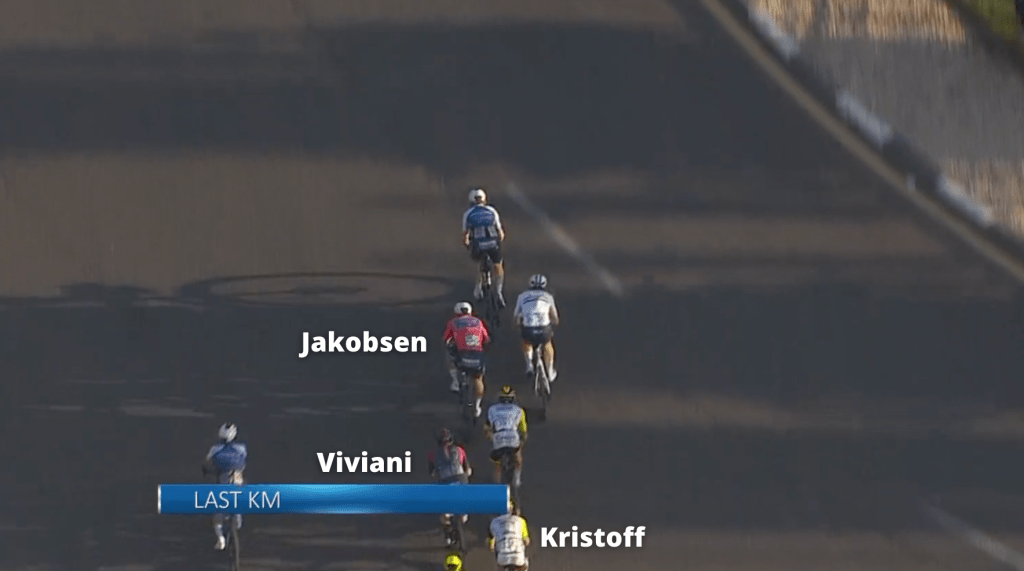
The most exciting thing was to see the fight for Fabio Jakobsen’s wheel, which was the best position for every non-Quick-Step sprinter. The winner of this battle was Elia Viviani, thanks to the great work by British champion Ben Swift. Alexander Kristoff was forced to take a step back and ride behind Viviani after Swift had moved him up.

Riders fight for Jakobsen’s wheel

With Mørkøv beginning his pull with only 500 metres remaining and Jakobsen on his wheel, the conclusion of this stage became a formality.

Riders position after Jakobsen launches his sprint

Jakobsen won his second stage of Valenciana 2022 and must be happy that the lead-out came together so well on the final stage. Interestingly, after Jakobsen launched, the riders behind him, Viviani, Kristoff and Dupont, finished in the same sequence as they started.

Viviani, who finished second, sprinted erratically. He took a lot of risks to stay in Jakobsen’s draft and in the end nearly chopped Kristoff’s front wheel by moving sharply to the left side of the road.

Viviani deviation

Nothing changed in the general classification, with Russian Aleksandr Vlasov taking his first and biggest overall win of his career yet. He secured the lead after a great performance on the queen stage, which included a steep gravel section at the end of the Maigmo Tibi climb.

Aleksandr Vlasov (RUS – Bora – Hansgrohe) pictured during the Volta a la Comunitat Valenciana 2022 – stage 3 from Alicante to Antenas del Maigm— (155.1KM) – Photo: Luis Angel Gomez/Cor Vos © 2022

Although Evenepoel finished second, he showed a great climbing performance on stage 1 and later did powerful turns late in the sprint stages to help his teammates. 21-year-old Carlos Rodriguez performed above all expectations and secured the last spot on the podium – by far the biggest result in the promising Spanish climber’s career and the top spot of any Spanish rider in this race.

As always, make sure to check out Lanterne’s and Benji recap of all the races on this Sunday.

Moschetti Launches Early – Valenciana Stage 4

Despite the presence of boss Patrick Lefevere in the team car, today was the second consecutive unsuccessful day for Quick-Step Alpha Vinyl Team in Valenciana. This time in a sprint stage the team’s lead-out failed to deliver Fabio Jakobsen in a good position, whilst inconsistent Trek-Segafredo sprinter Matteo Moschetti seized the opportunity to sprint early whilst Jakobsen was boxed in, landing his first win at .Pro level or above since Burgos in 2018.

After the tough gravel climb yesterday, stage 4 was made for the sprinters. There were a few rises before the finish, but nothing too big to seriously influence the race.

Volta a la Comunitat Valenciana Stage 4 2022 Profile By La Flamme Rouge

Before the stage started Jumbo-Visma and DSM announced that they had pulled out of the race due to multiple positive Covid-19 test results in their teamsteams. Mikkel Honoré (Quick-Step), an important part of Jakobsen’s sprint train, and Giacomo Nizzolo (Israel – Premier Tech), who would have been one of the favourites, also did not start for various reasons.

The five man TV exposure breakaway was caught by the peloton with 20 kilometres to go, with little wind of any description despite being near the coast line. The sprint trains of Quickstep, Intermarché and UAE asembled and with 2,2 kilometers to go, Remco Evenepoel moved up and started to pace at the front. It was easy to see that Intermarché – Wanty – Gobert Matériaux rider behind the aero Belgian was struggling. Evenepoel multiple times looked back because his team riders were not behind him. Matteo Trentin of UAE sat amongst the Quick-Step train, disrupting it and stopping Lampaert from moving up. clashed.

Intermarche train. Evenepoel on the right, but Quick-Step riders weren’t behind him because UAE rider Matteo Trentin intervened.

Evenepoel proved again that he is strong on the flat, but his work at the front did not help Quick-Step that much. When the Belgian took a right hand turn with under 1500 metres to go it opened a little gap between him and the Intermarché riders but instead of attacking he waited for them to catch back up and continued pacing.

Evenepoel opens a little gap between him and Intermarche train

With 1 kilometer to go Jakobsen was 7-8 riders deep and at this moment it was almost impossible to change the situation. His position was horrible considering the left hand turn coming up with only 200 metres remaining. Evenepoel did not make this easier by continuing to pace hard despite the rest of the Quick-Step train needing to move up.

Evenepoel looks back to see where his teammates are

Andrea Pasqualon was the first one who took over after Evenepoel finished his job. Pasqualon lead-out Intermarché leader Alexander Kristoff. At the same time, Michael Mørkøv had tried to move Jakobsen up the long way around the left hand bend, but could not bring Jakobsen into clear air.

Situation with ~250 meters to go

The first leader to launch their sprint was Matteo Moschetti. His position was not perfect either, having to jump early, but this ensured he had clear air on the left hand side whilst Jakobsen, who had chosen to move to the left, was boxed in behind him.

Jakobsen boxed in

Jakobsen seemed disinclined to take too many risks for the minor placings, with Burgos-BH rider Manuel Penalver finishing second, and Kristoff finishing third despite a solid leadout. Another unsuccessful day for Quick-Step, but it is impossible to win everything. Better to make mistakes in early season races than in important ones whilst they are ironing out who will be in their sprint train in the Tour de France.

Tomorrow the Volta a la Comunitat Valenciana five day stage race will end with another flat sprint stage. At this moment, only bad luck or crosswinds might influence the GC standings, but given this stage is held mostly inland of Valencia, it should be a regulation sprint.

Volta a la Comunitat Valenciana Stage 5 2022 Profile By La Flamme Rouge

As always, make sure to check out LR’s recap of all the races on this Saturday triple header down below.

Vlasov Rewards Bora as Evenepoel’s Legs Explode | Valenciana Stage 3

The queen stage of Valenciana did not disappoint. The extremely steep and tough Maigmo Tibi climb that included a rough gravel section was a difficult test for everyone, but some more than others. Favourite of the day Remco Evenepoel could not replicate his dominant climbing performance on Stage 1 on these steeper slopes, suffering badly in the last kilometre of the stage and losing his hold on the leader’s jersey to the victorious Aleksandr Vlasov.

Stage 3 of Volta a la Comunitat Valenciana included the first serious mountain top finish of the 2022 season, promising a spectacular fight between the high class climbers lining up for this early February race. The 155 kilometre long stage ended with the new climb to Maigmo Tibi of 9.8 km at 7.5 %.

Volta a la Comunitat Valenciana Stage 3 2022 Profile By La Flamme Rouge

The most challenging part of the climb was a 1.7 km gravel section that was very rough indeed, something typically tackled on a mountain bike rather than a road bike.

Maigmo Tibi rough gravel section

Quick-Step Alpha Vinyl would likely be in charge of controlling any breakaway that formed, and their job was slightly harder than expected as a large group of 11 riders got away including Jan Tratnik, Attila Valter, Jan Polanc. With Valter relatively close on the general classification, Quickstep did not allow the breakaway to gain too much of an advantage at any point whilst Evenepoel sat in the yellow jersey in the group.

Torrent – Spain – cycling – Remco Evenepoel (BEL – Quick-Step Alpha Vinyl Team) pictured during the Volta a la Comunitat Valenciana 2022 – stage 2 from BŽtera to Torrent (171.5 – Photo: Luis Angel Gomez/Cor Vos © 2022

The Wolfpack had won the first two stages of Valenciana with Remco Evenepoel and Fabio Jakobsen and seemed eager for another victory, pacing harder than would have been strictly required to protect Evenepoel’s GC lead. The last survivor of the breakaway was Jan Tratnik, the Slovenian dropping Attila Valter from his wheel on the 3.9 kilometer long Tibi climb that was the last climb before the mountain top finish.

Jan Tratnik drops Attila Valter

Tratnik gained a two minute lead over the peloton before Maigmo Tibi and despite his bulky appearance, has been very powerful on 2-4km climbs in the last few years, including in his breakout Giro stage win against O’Connor in 2020.

Jan Tratnik (Slovenia / Team Bahrain – McLaren) pictured during 103rd Giro dÕItalia (2.UWT) stage 16 from Base Udine > San Daniele del Friuli (229KM) – photo Miwa iijimai/LB/RB/Cor Vos © 2020

Movistar also appeared to be interested in the stage victory and sent their men to help Quick-Step chase Tratnik, who was looking strong. As they reached the steep section of the final climb (5km at 10%), Movistar attacked early with 41-year-old Alejandro Valverde, in a similar way to his move last year in the first mountain stage of Catalunya. Movistar had Enric Mas as their other GC option sitting in the group, who also slid in front to block Evenepoel and Rodriguez from being able to instantly react to Valverde. A few moments later, Valverde was caught by compatriots Juan Ayuso and Pello Bilbao, while Evenepoel and Vlasov continued to draft in the wheels of INEOS who had Sivakov to pace.

Alejandro Valverde attacks

After Valverde’s attack, the peloton was reduced to 10-15 riders, however Mas did not counter attack and the group containing Vlasov, Evenepoel Fuglsang, Tolhoek and Rodriguez entered the gravel section together. The gap to Tratnik was melting fast and disappeared once Fuglsang accelerated at the start of the gravel, perhaps hoping to lean on his Strade Bianche experience and handling compared to the other GC contenders. In fact, in 2007 the Dane won the U23 World Champs at in cross-country mountain bike, so is more than at home off-road.

Jakob Fuglsang sets tempo on gravel section

Vlasov countered Fuglsang’s move once, with Evenepoel sitting in his wheel looking relatively comfortable, with Valverde, Mas and Rodriguez being put on a gap initially. The Belgian even went to the front of the group for a brief moment after Vlasov’s first attack. Perhaps sensing this as a bluff show of strength from Evenepoel, Vlasov attacked again a second time. He looked back multiple times to see where his competition was, saw no reaction and then put the hammer down in the saddle.

Vlasov looks back before his attack

On rough gravel sections like this, it is almost impossible to get out of the saddle due to less grip, and the Russian seemed comfortable attacking seated. Vlasov rode with a very high cadence on the steep gravel, and he quickly gained a big gap.

Aleksandr Vlasov (RUS – Bora – Hansgrohe) pictured during the Volta a la Comunitat Valenciana 2022 – stage 3 from Alicante to Antenas del Maigm— (155.1KM) – Photo: Luis Angel Gomez/Cor Vos © 2022

Behind him Evenepoel was struggling, and with 1 km to go, as they turned off the gravel onto the final paved section, his legs completely exploded. He had tried to close Vlasov rather than ride to his own limit and paid the price. His cadence dropped to a slow grind and his form on the bike suffered. His last teammate left to help, Mikkel Honoré, was long gone, with Quickstep bringing a more sprinter based team to this race.

Evenepoel with Fuglsang

Spaniards Carlos Rodriguez, Enric Mas, Alejandro Valverde (riding with a fully punctured rear wheel) and Pello Bilbao caught the Belgian and quickly dropped him, leaving him to grind away to the finish with Fuglsang.

Meanwhile Vlasov took an incredible win and perhaps his best victory to date given the level of competition here. In his first few races with Bora-Hansgrohe he has already shown a lot of promise, particularly in respect of his punchy climbing, which is more akin to his late 2020 climbing which likely landed him this contract.

Aleksandr Vlasov (RUS – Bora – Hansgrohe) pictured during the Volta a la Comunitat Valenciana 2022 – stage 3 from Alicante to Antenas del Maigm— (155.1KM) – Photo: Luis Angel Gomez/Cor Vos © 2022

In 2021 Russian massively improved his time-trial ability whilst on Astana, so if he maintains that with Bora-Hansgrohe and brings his 2020 climbing, he will have definitely increased his chances for a tilt at the podium of the Tour de France, which he is aiming for this season.

Rodriguez finished second beating Mas, Bilbao and Valverde. If the young Spaniard continues to progress there is a chance the INEOS Grenadiers might even send him to Tour de France knowing their complex situation with Egan Bernal, who crashed hard in training in Colombia, and Richard Carapaz who was previously aiming for the Giro d’Italia and also crashed hard today in Etoile des Besseges.

After a great performance on stage 1 this was a disappointing day for Evenepoel, but it’s only the start of the season. After the stage he expressed some disappointment with the inclusion of such a gravel section. In the 2021 Giro d’Italia Montalcino Stage he also struggled, but today there were not gravel descents but rather a steep gravel climb with an even rougher surface. Vlasov takes the lead in GC ahead of two remaining stages that are made for sprinters, with only bad luck or crosswinds might influence the situation in GC.

Make sure to check out LR’s recap of Valenciana and all the other races around the world in the video below.

The Most Dominant Sprint of the Early Season | Valenciana Stage 2

The Wolfpack is on fire in Valenciana. Dutch sprint star Fabio Jakobsen demonstrated in Volta a la Comunitat Valenciana Stage 2 a fantastic level, gapping the entire sprint field with 200 metres to go to win by over seven bike lengths – sitting up with 50 metres remaining.

Stage 2 was made for sprinters, but there was a chance that some of the bigger sprinters (like Jakobsen) might get dropped on climbs before the finish.

Stage 2 Profile – La Flamme Rouge

This would have been possible if a strong team had paced hard on the middle climbs, but according to Ben Zwiehoff’s Strava data, no team tried to set a tempo. Everyone, including Bora-Hansgrohe with a good climbing sprinter in Matthew Walls, was conservative – content to ride together to the finish without trying to drop Jakobsen. The only climb where the pace was set somewhat high was on the last little rise, Calicanto, but it was not anything nuclear – around 6 w/kg for 6 minutes with the sprinters perhaps doing less by slipping backwards in the field knowing there was plenty of time to the finish.

The non-threatening breakaway of the day was caught before that Calicanto climb, where Bahrain-Victorious rider Dylan Teuns tried his luck and attacked, having lost nearly two minutes after his curious pacing for Sanchez the day before.

Dylan Teuns (right) attack on Calicanto

Teuns rode the following descent full gas, with the scariest moment of the race happening with 14 kilometers to go when Jumbo-Visma sprinter David Dekker rode straight off the road trying to avoid an Euskaltel Euskadi rider that had slid out just before him.

There was a steep drop into hard surfaces off the road and we could not immediately see where Dekker had fallen, going at high speed. Fortunately, we saw Dekker get back up onto the road some time later under his own power, but he did not finish the stage. According to his team’s twitter account, the consequences from the crash are not too serious and are only scrapes and bruises.

Meanwhile, Teuns was brought back by the sprint trains with 9 kilometres remaining as the road flattened out. It was the most serious attempt of the day to rob a victory from sprint teams and perhaps if he had been joined by some other riders they could have made it to the finish.

The sprint teams assembled at the front but again, with 4 kilometers to go, there was another crash that split the peloton and affected chances of getting a victory for many riders, including perhaps Giacomo Nizzolo who ended 32nd. Quick-Step had paced hard as a team on the front up to this point, and benefitted from that front position while the peloton was in shambles due to crash. The Belgian team’s sprint train for Fabio Jakobsen is incredibly strong for a hilly stage race like this with Mattia Cattaneo, Mikkel Honoré, Josef Černy, Remco Evenepoel, Yves Lampaert and the best lead-out man in the business Michael Mørkøv. For a brief moment even the yellow jersey wearer Evenepoel was on the front smashing pedals hard, with just a few kilometres to go.

Quick-Step pacing hard on the front. Peloton split due to crash

In the last kilometer Intermarché-Wanty-Gobert-Materiaux was seen on the front, working for Norwegian Alexander Kristoff. Despite Quickstep’s leadout strength on paper, Mørkøv and others were not around Jakobsen with 600 metres to go, and Pasqualon was doing a terrific job for Intermarché on the front. However after he ended his lead-out duties, he would have been disappointed to see that it was Fabio Jakobsen, not his teammate Alexander Kristoff, sitting in his wheel, with Jakobsen launching with 150 metres to the finish.

Andrea Pasqualon doing his lead-out duties for Alexandre Kristoff. After he finished Fabio Jakobsen launched his might sprint

Considering that the finish was going up a slight false flat hill, this was a bit early from Jakobsen, but he gapped Kristoff immediately off the wheel and put almost 10 bike lengths into the entire group – none of whom could be seen in the overhead finishing shot.

Torrent – Spain – cycling – Fabio Jakobsen (NED – Quick-Step Alpha Vinyl Team) pictured during the Volta a la Comunitat Valenciana 2022 – stage 2 from BŽtera to Torrent (171.5 – Photo: Luis Angel Gomez/Cor Vos © 2022

This sprint is already one of the candidates for the most impressive sprints of the young 2022 season and is a good reminder of why Jakobsen rather than Cavendish is on Quickstep’s provisional Tour de France startlist.

Stage 1 winner and GC leader, Evenepoel finished 7th on a stage that was made for sprinters, a curious performance for the young Belgian considering that he was a part of Jakobsen’s powerful sprint train and is not particularly punchy.

Stage 3 will be the most toughest day of this five day stage race, with a finishing climb on Maigmo Tibi of 9.8 km at 7.5 %. However this does not tell the full story, as the last 5km average 10% and include a gravel section that, according to Evenepoel after his reconnaissance of the climb on Quickstep’s camp, is of such poor surface quality that Quickstep turned around when they saw it as they could not believe it was included in the race.

Volta a la Comunitat Valenciana Stage 3 2022 Profile By La Flamme Rouge

Regardless, the clear favourite for the stage win will be Evenepoel, who was flying in Stage 1 on the easier climb there. It will be interesting to see if Aleksandr Vlasov or some of Spanish climbers, Alejandro Valverde, Carlos Rodriguez and Enric Mas, will be able to challenge Evenepoel or if he will run away with the general classification in Valenciana.

Make sure to check out Lanterne’s recap of the stage as well as Saudi Tour and Etoiles des Besseges below.

Remco Mania Lifts Off | Valenciana Stage 1

In nonchalant fashion, Belgian supertalent Remco Evenepoel started a new racing season with a comfortable win on Stage 1 of the Volta a la Comunitat Valenciana. After some curious pacing by Bahrain-Victorious and Movistar, he skipped away from the peloton (featuring strong climbers such as Valverde and Mas) on Torralba del Pinar climb – possibly achieving his best climbing performance to date.

It was clear that the first stage of this five day stage race would be a day for the climbing specialists. Quite close to the finish was Torralba Del Pinar, a 4.6 kilometer long 6.9% gradient climb. This climb is neither particularly steep nor long (a sub 12 minute effort), but is difficult enough for a top climber to create a gap if the pace was high.

Volta a la Comunitat Valenciana Stage 1
Profile by La Flamme Rouge

However, the 3km rolling ridge line from the crest of the climb meant that creating separation on the climb would not be enough and presumably the home team Movistar would want to keep things together for a reduced bunch sprint for Alejandro Valverde.

Alejandro Valverde (Movistar Team), fresh off a win in Challenge Mallorca, pictured during the Volta a la Comunitat Valenciana 2022 – stage 1 from Les Alqueries to Torralba del Pinar (166.7km) – Photo: Luis Angel Gomez/Cor Vos © 2022

Little action of note before the major climbs of the day, except for a crash involving ex-Movistar rider Hector Carretero, Tour de France stage winner Nans Peters and new UAE Emirates recruit Marc Soler with around 17 km remaining.

The race started to heat up when Quick-step Alphy Vinyl Team began to set a pace with 15 kilometers to go for their leader, Remco Evenepoel, on the penultimate climb of the day, the 4km, 5.4% Collada de Ayodar. Yves Lampaert did a fantastic job on this climb and ensured that Evenepoel would be safe at the front of the race for the short descent before the final climb.

Later, Bahrain-Victorious surprised on the major climb of the day pacing very hard with Pello Bilbao, a man one would think would be riding for his own general classification ambitions in a race such as this without a very deep GC field.

Bilbao stringing it out with 5km remaining in the climb

Bahrain did not bring their strongest climbers like Mikel Landa, Jack Haig, Gino Mäder or Damiano Caruso to Valenciana and yet Bilbao appeared to be initating the pace for their new transfer, the veteran Luis Leon Sanchez. After Bilbao pulled off, Dylan Teuns paced so hard that he dropped his teammate Matej Mohorič, despite Mohorič being a contender to win a small group sprint in the flat finish if the race was kept together. Knowing that on the start list there were better climbers than Luis Leon Sanchez benefitting from the heavy pace, such as Mas, Valverde and Evenepoel, and Bahrain used two of their best climbers to pace as domestiques, Teuns and Bilbao, we cannot think of a reason for them pacing from the base of the climb.

Movistar also have one of the strongest overall teams and they took over from Bahrain once they ran out of domestiques. Austrian Gregor Muhlberger increased the tempo for teammates Enric Mas and Alejandro Valverde. However Muhlberger pulled to exhaustion rather than to keep the group together, despite Evenepoel and others having few domestiques to pull themselves, with Mas softly attacking straight afterwards. Valverde could not follow his teammate, who then stopped his action shortly afterwards and with just over a kilometre left in the climb, there was no one left to control the pace after what had been a hard climb up to that point.

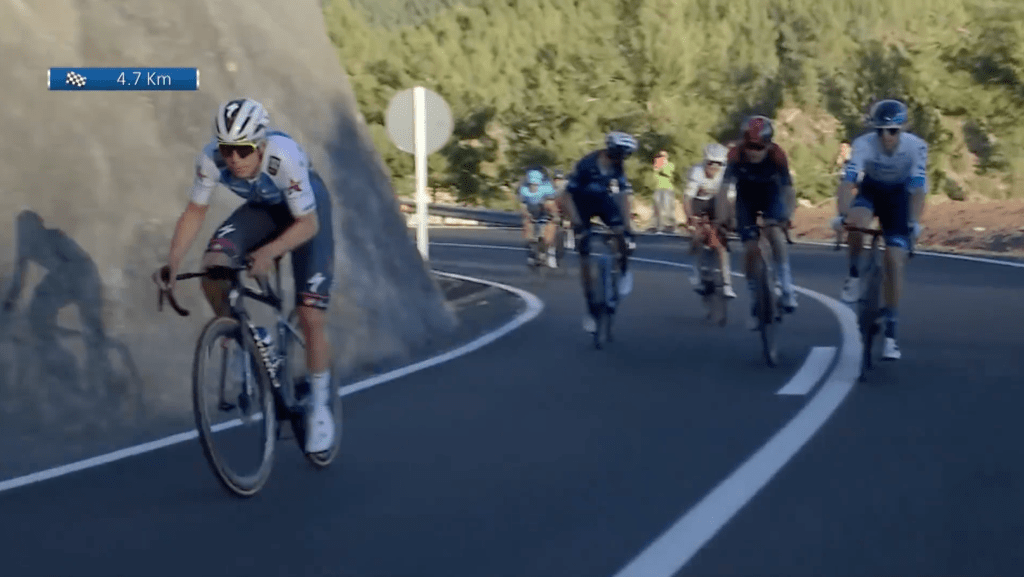
Tolhoek, now on Trek-Segafredo, took the brief pause in action to attack, followed shortly after by Jakub Fuglsang. Enric Mas, rather than pulling across the gap with Valverde in his wheel, surged across with Evenepoel sitting in his draft, similar to Mas’ attacking across to Yates and Haig in the Vuelta a Espana Stage 20, leaving Lopez behind.

Jakob Fuglsang closed by Carlos Rodgriuez, Enric Mas and Evenepoel.

Perhaps the trio in front of him were not even aware he was there, but with Fuglsang hesitating, Evenepoel used the opportunity to attack through the middle of an idling group. No one could (or wanted to) follow and the young Belgian gained a large gap within the space of 30 seconds.

Evenepoel attacks, Rodriguez was in the wrong gear, Mas is looking behind for Valverde and Fuglsang does not have the legs to respond.

The entire climb was set up perfectly for Evenepoel, who, once he crested it with 3km to go, was able to solo to the finish without looking like he had broken a sweat.

Torralba del Pinar – Remco Evenepoel Photo: Luis Angel Gomez/Cor Vos © 2022

Russian Aleksandr Vlasov performed at a good level, attacking from the group behind Mas and Fuglsang, finishing 2nd, but the fastest Spaniard was 21 year-old Carlos Rodriguez. On his 21st birthday he showed a lot of potential beating his more experienced compatriots Enric Mas, Luis Leon Sanchez and Alejandro Valverde.

According to calculations by @naichacacycling, Evenepoel did 6,97 w/kg for 10:33 on the final climb, however with the average speed being over 25km/h in parts, it is difficult to estimate this with much certainty. Regardless, this is a very impressive level from Evenepoel, which is close to Pogačar and Roglič-esque levels for the time duration. As you can see in the graph below, Evenepoel performed better over this duration than Pogačar did on Ermualde in the 2021 Basque Country (although the difficulty of the stages prior to the climbs are not equivalent).

Graph of Remco Evenpoel’s Torralba del Pinar 2022 performance by CyclingGraphs

Even downwards adjusting Evenepoel’s power to account for error in the estimation, Torralba del Pinar is the best climbing performance of Evenpoel’s career so far, superior to his performance on Picon Blanco.

This gives a lot of hope for the future for Evenepoel, who struggled on climbs in the back end of 2021 despite strong performances in Belgian flatter races. Perhaps Patrick Lefevere will rethink Evenepoel’s publicised 2022 schedule and send Evenepoel to the Tour de France this year instead of the Vuelta a Espana, as both parcours suits strong time-trial riders. If he did so, we would fully endorse the decision, as Remco Mania lifts off for 2022. LR and Benji discuss whether Lefevere should change Evenepoel’s schedule in the full stage recap of Valenciana below.

Red Carpet for Caleb Ewan | Saudi Tour Stage 1

The Saudi Tour returned on Tuesday following a one year pause due to the pandemic after it was rebooted in 2020. This year the race promises a more interesting parcours than the sprint-heavy edition of 2020, with a 3km climb on the fourth stage averaging a nasty 12% – far too hard for sprinters who have become accustomed to contesting the general classification in the races in the desert, such as Hatta Dam specialist Caleb Ewan.

Caleb Ewan (AUS – Lotto Soudal) pictured during UAE Tour 2020 – 2nd Edition – stage 2 from Hatta to Hatta Dam 168 km) – Photo: Dario Belingheri/RB/Cor Vos © 2020

The first stage was for the sprinters, with gentle climbs including one small categorised climb with 13km to go before a flat run in to the finish. The notable feature of this parcours was a 10km gravel section with around 25km remaining, the condition of which we were unsure of.

Saudi Tour Stage 1 Profile by La Flamme Rouge

With Ewan present and no Sam Bennett on the startline (despite rumours of his attendance in previous weeks), the Australian on Lotto Soudal was the heavy favourite for this stage in his opening race of the year. Other notable sprinters on the startline included Dylan Groenewegen, the new recruit for Team Bike-Exchange Jayco, Fernando Gaviria of UAE Team Emirates with neopro leadout Felix Gross by his side (or as a rival sprinter…) and Davide Ballerini for Quickstep, who started fast in February last year.

Caleb Ewan’s stress levels at all time lows knowing Bennett hasn’t turned up – 2022-01-31 – Saudi Tour

Unfortunately for the race organisers and for us fans who have been starved of live racing for long enough during the off-season, there was absolutely no live coverage of the race due to the relay plane required for the live images from the motorbikes not receiving permission to take off.

So we saw absolutely nothing of the race. A shame, as the route had some interesting landmarks as Middle Eastern races go, as well as the doomed breakaway of the day expending all of their energy for hours on the flat for absolutely no sponsor exposure.

01/02/2022 – Saudi Tour – Stage 1 – Winter Park – Winter Park – Mohd Shahrul MAT AMIN (TSG) Martin Bugge URIANSTAD (UXT) Polychronis Tzortzakis (KUW)

The major piece of news from the race prior to the sprint (although the details came after) was the crash of talented young Italian Andrea Bagioli of Quickstep-AlphaVinyl, one of the big contenders for Stages 2 and 4 as well as the General Classification win.

Quickstep have announced that Bagioli suffered minor injuries and will be monitored overnight by the medical staff, but is expected to continue the Saudi Tour. Regardless, Bagioli finished the stage last, losing 20 minutes in the process, so is already out of the GC mix.

01/02/2022 – Saudi Tour – Stage 1 – Winter Park – Winter Park – Peloton – Hegra

A short time after the gravel section concluded, we saw some life on the static cameras at the finish. We managed to see sprint from the final sweeping right hand bend with around 225 metres to go, where Jasper de Buyst provided Caleb Ewan with his best launch pad for over a year, coming out of de Buyst’s wheel with under 7 seconds to go in the sprint and dusting off Martin Laas (Bora-Hansgrohe) by over two bike lengths.

See ya boys

When Ewan is provided with a leadout of that quality, he is close to unbeatable, even with Sam Bennett on the startlist. The question is whether Lotto-Soudal can deliver Ewan in that position consistently in the biggest World Tour races, when Deceuninck-Quickstep have their A star leadout. These are of course promising signs for Ewan’s team early on but UAE continue to have leadout problems with Gaviria and Gross sprinting against one another, Groenewegen was in a terrible position on the left hand side sprinting in the wind from the corner and the Van Lerberghe’s leadouts for Quickstep pale in comparison to Michael Mørkøv.

Saudi Tour Stage 1 2022 Top 12 – First Cycling

Stage 2 is one for the puncheurs, finishing with a 1600 metre 7.7% punch that should be too hard for the majority of the sprinters.

Before his crash today, Bagioli would have been a big favourite for this stage but now veteran Rui Costa will likely be the man to beat on this uphill finish, as well as for overall GC. Costa has not won a UCI race in Europe since 2015 but has won a stage of Saudi Tour in 2020 as well as the Abu Dhabi Tour GC with a stage back in 2017, so it is likely the Portuguese rider will be targeting the GC seriously here once again.

2020-02-04 – Saudi Tour – stage 1 – Saudi Arabian Olympic Committee – Riu COSTA – (UAE Team Emirates)

It will also be the first uphill test for Lennard Kämna of Bora-Hansgrohe since his return to racing as well as for two new talented French recruits for Cofidis, Alexis Renard and Axel Zingle. 22 year old Renard had good results at Israel Start-Up Nation in 2021 at punchy races like Wallonie and Pologne whilst Zingle was consistently racking up top 10s on the French hilly one-day circuit, including a sprint to third place behind Biniam Girmay and Vendrame at Classic Grand Besançon Doubs to end the year.

Kind regards

LR

How to Measure Fatigue in a Cycling Race

Fatigue accumulated before the decisive part of a cycling race is one of the most important factors for the way it is raced and the final outcome, but how is fatigue actually measured and interpreted? There have been multiple approaches in the past, such as taking the normalized power, relative power in watts/kg (w/kg) or total energy expenditure in kilojoules (kj) as unit for measuring the fatigue in a race, but I believe the most optimal unit for the right interpretation of the difficulty of a stage is kilojoules/kilogram/hour (kj/kg/h).

Kilojoules itself are a unit for energy expenditure that directly correlates to watts, as total joules (kj*1000) equal avg. watts * time in seconds. They can be accessed for a specific section of a ride using the sauce4strava browser extension, in the analysis view on Strava, as long as the rider has uploaded power data.

As heavier riders naturally develop more watts than lighter riders at the same speed, the kilojoules are divided by the weight of the rider, to create a normalized unit for riders of all weight classes. Recording the same kj/kg in two rides doesn’t automatically mean both rides were at the same intensity, as less kj/kg are produced over the same time on a longer ride, reducing the intensity. This is why kj/kg are divided by the time, creating kj/kg/h – a unit that effectively is w/kg multiplied by 3.6. The nature of it being a unit for energy expenditure makes it more relevant considering the effect of refuelling in races, which is the intake of energy. That is the advantage of the unit compared to average relative power or normalized power.

According to calculations of Dr. Michele Ferrari, published on his 53×12 website, Vincenzo Nibali, one of the best GC riders of the last decade either possesses an incredible glycogen preservation at moderate climbing pace in a long mountain stage or very large glycogen stores. It is expressed that efforts after very long and hard stages are his biggest strengths, compared to other GC riders.

“Almost 800g of CHO is an amount that far exceeds the maximum capacity of saturation of glycogen stores and therefore confirms the extraordinary ability of Nibali to use fat as fuel, saving the CHO for the final stage, where he made the difference over the rivals.”

Current GC riders with similar ability seem to include the Colombian Miguel Ángel López, who has performed very well on hard stages in recent times, such as the stages finishing on the Col de la Loze and the Alto d’El Gamoniteiru, that he both won with impressive efforts on a w/kg basis. Tadej Pogačar is another rider who seems to fare well in difficult conditions, proving his astounding resistance on stage 8 of the Tour de France, when he essentially won the race, putting 3 minutes and 20 seconds into the rest of the contenders, after an effort of 14,80kj/kg/h for 02:43h in the early parts of the stage. See our article by @CyclingGraphs with our full analysis of that momentous stage.

Pogacar gains 3 minutes to Grand Bornand, Tour de France Stage 8 2021

Sergio Higuita on the other hand has excelled on easier stages in the UAE Tour and Tirreno Adriatico, finishing third on Jebel Hafeet and Prati di Tivo as well as achieving a fourth place on Jebel Jais, while performing below par in the Tour de France. He was completely uncompetitive there and although admittedly not being the designated leader of the team, he couldn’t even offer sufficient support to Rigoberto Urán on the majority of mountain stages.

Higuita dropped by O’Connor on the wet, multi mountain stage to Tignes in the Tour de France 2021

These variances between the riders could come down to physiological differences as suggested by Dr. Michele Ferrari or their ability to refuel properly during a race. The ability to refuel properly also depends on the parcours of a race. Races with many climbs following shortly after each other, with not much rest between them, not only drain energy, they also make it difficult to effectively refuel before the next obstacle on the route. The lack of energy, that is created by not being able to refuel sufficiently, leads to bigger gaps as well as gaps in unexpected places. One race in which this clearly applied is the World Championship Road Race in Leuven, with its numerous short punches along the route. Julian Alaphilippe created an enormous gap on the Sint Antoniusberg, a rise that can barely be considered more than a speed bump for the pros with its 0,18km at 6,11%, certainly aided by the very hard race up to that point and a parcours which makes it difficult to effectively refuel.

Below, you can see a basic overview over the difficulty of an effort before the decisive part of a stage in terms of kj/kg/h.

The primary example of an effort after a stage ridden at ‘easy’ tempo is the ascent to Jebel Hafeet on stage 3 of the UAE Tour 2021, a stage race that is known for producing the lowest kj/kg/h of the entire year. On this specific stage, Sepp Kuss, who was in the Peloton going into the climb, rode the 03:38h preceding the Jebel Hafeet climb at 9,85kj/kg/h. This very low intensity definitely was one of the reasons for the high watts/kg efforts of Adam Yates (6,43w/kg for 26,03min) and Tadej Pogačar (6,34w/kg for 26,03min) on the climb, despite the high temperatures that peaked at over 40°C and them likely not being in their best shape in February.

Examples for ‘medium’ intensity ahead of the decisive climbing effort include stage 4 of Tirreno Adriatico, when Tadej Pogačar triumphed ahead of Simon Yates and stage 4 of the Tour of Slovenia, where Pogačar set it up for a Diego Ulissi victory. The ascent to Prati di Tivo remains Pogačar’s most impressive climbing effort ever on a watts/kg basis, as he achieved a remarkable 6,32w/kg for 36:06mins. That stage admittedly was relatively easy for ‘medium’ intensity with 12,28kj/kg/h for 03:13h before Prati di Tivo, according to Egan Bernal’s power data and featured perfect temperatures for high performances of around 14°C on the climb.

On the Sveta Gora climb in the Tour of Slovenia, Pogačar was riding for Diego Ulissi, having already secured the GC. He still climbed the 10:01min long climb at 7,02w/kg, perfectly setting up Diego Ulissi who punched away for the stage in the last 150m. All of this was achieved after a long, hard day on which the peloton rode at 11,87kj/kg/h for 04:04h before the Sveta Gora climb.

Stage 18 of the Vuelta a España was one of the hardest stages of the year, when the group of favourites had no rest, riding at a rate of 14,44kj/kg/h for 04:06h, before tackling the equally brutal climb of the Alto d’El Gamoniteiru – 14,7km at 9,83%. Despite the demanding stage, Miguel Ángel López proved his status as the best climber in the world at climbs longer than 45mins, ascending the Asturian monster in 50:09min at an unbelievable 6,04w/kg – one of the performances of the season.

It has to be noted that kj/kg/h only show the fatigue accumulated on that specific day, which is why kj/kg/h vary strongly between one day races, one week stage races and the third week of a Grand Tour. Further research is needed to show how much fatigue accumulated over multiple days and kj/kg/h on the day influence the watt/kg performances at the end of a race exactly, but they create a way to compare the intensity with which different races are ridden to a certain degree.

Gabriel Stróżyk (@NaichacaCycling)