Latest News

Watts per Kilogram Explained

Since the invention of the power meter, the watts produced by cyclists, both amateur and professional, have been a frequent topic of discussion for fans and those wishing to evaluate performances. We analyse and compare climbing performances primarily based on estimated watts per kg (w/kg), using a mathematical model that we have refined over the past few years.

Naturally, many questions have arisen regarding our calculation of watts, the accuracy of power meters and why riders achieve the same speed at different w/kg. This is why when calculating and comparing climbing performances, we use a standardised equivalent for a 60kg rider, called “etalon” w/kg. The reasons for this are below, and we hope this will explain why our “etalon” figures are sometimes different to published figures from riders or teams.

Basics

The watt (abbreviated: W) is the unit of power or radiant flux which in one second gives rise to energy of 1 joule within the International System of Units (SI). It is used to quantify the rate of energy transfer.

In cycling, the energy transfer is the pushing of the pedals by the cyclist, transferring mechanical energy to kinetic energy (speed/movement) and potential energy (from gravity when going uphill) on a simplified basis.

Watts per kilogram is a basic power to weight ratio measurement, which displays the relative power produced by the cyclist. The simple way to find out w/kg is dividing the absolute watts by the weight of the rider at the time of the performance. The ratio of a rider’s watts produced per kilogram of bodyweight (w/kg) is the key metric which determines how fast they can ride uphill.

On a flat parcours, absolute power (watts) and aerodynamic drag (CdA, draft) are the deciding factors for the speed of a cyclist. Due to gravity, relative power becomes a more important factor on inclines, but aerodynamic drag (CdA, draft) is still an influential factor, especially on lower gradients, where the speed is still quite high in the professional peloton.

Why W/kg does not equal W/kg

Understanding how w/kg is derived is a relatively simple task and one might assume that our job ends there when comparing climbing performances. However not all w/kg are created equally. Heavier riders will always have to produce less w/kg to achieve the same speed as a lighter rider or, conversely, will go faster if they are producing the same w/kg as a lighter rider.

One of the reasons for this is that the bike weight in the professional peloton is typically a smaller percentage of the body weight of a heavier rider, which means they need to produce less relative power (w/kg), to move the total system. This becomes more relevant the steeper the incline, when gravity accounts for a large majority of the force a cyclist needs to overcome to move forward at a certain speed.

Example:
Rider 1 is 60kg with a 7kg bike. The bike weight is 11,67% of his body weight. If he rides at 360w, he is producing 6w/kg. His rider + bike w/kg is 360w / (60kg+7kg) = 5,37w/*kg.

Rider 2 is 70kg with a 7kg bike. The bike weight is just 10% of his body weight. If he rides at 420w, he is producing 6w/kg. His rider + bike w/kg is 420w / (70kg+7kg) = 5,45w/*kg.

The second reason is especially relevant at higher speeds and lower gradients, where aerodynamic drag still makes up a large part of the force a cyclist needs to overcome in conjunction with gravity. That is, heavier riders are more likely to have a higher watts/CdA ratio, as an increase in weight does not bring a linear increase in CdA. The prime example of this in action is Filippo Ganna’s regular success on the long but shallow Alto del Colorado climb in Vuelta a San Juan.

Filippo Ganna (ITA – INEOS Grenadiers) – Egan Bernal (COL – INEOS Grenadiers) pictured during Vuelta a San Juan 2023 – 40th Edition – stage 5 – Chimbas – Alto de Colorado (173,7 km) – Photo: Roberto Bettini/SCA/Cor Vos © 2023

Why then, if heavier riders have an ‘advantage’ over lighter riders in that they can produce less w/kg to go the same speed, do we not see 90kg or 100kg Tour de France winners? This is due to the physiological reality that it is easier to produce higher w/kg at lower weights and as a rider’s weight increases there is not necessarily a linear increase in their ability to produce more watts.

Etalon W/KG

The reality described above means that comparisons between riders’ climbing performances based solely on unadjusted w/kg are not that useful, as they do not accurately reflect how fast they actually went. Standardisation of the w/kg metric is therefore required for ‘apples to apples’ comparison across the broad spectrum of riders of different weights.

‘Etalon’ is the french word for ‘Standard’ and has been used to describe the results of standardised watt calculations like ours for some time by Frédéric Portoleau. We chose an Etalon weight of 60kg, meaning we calculate how much w/kg a 60kg rider would have had to achieve for the identical performance or speed. This is the reason why our final calculations do not actually represent the unadjusted w/kg value a rider may have pushed (as not all riders are 60kg). Instead they are a metric to compare and evaluate performances.

Example:
In June, we published our etalon watt calculation for Ruben Guerreiro on Mont Ventoux, which had the result of 5,98w/kg for 58’36min. Jonathan Vaughters, manager of Guerreiro’s team EF Education EasyPost, replied to us on twitter, stating that Guerreiro had done 5,92w/kg for the ascent. This might look like a big difference, but when calculating the ascent with Guerreiro’s real weight, which is above 60kg, we obtained an unadjusted result of 5,91w/kg, almost identical to Vaughters’ stated result which presumably came from Guerreiro’s power meter and morning weight.

To clarify that we are generally referring to etalon w/kg, we will start to publish our calculations with the notation of ‘ᵉw/kg’ and not ‘w/kg’. Below you can see the unadjusted w/kg needed to achieve the same speed as a 60kg rider pushing 6.00 w/kg for different rider weights at different gradients, assuming standard values for altitude, temperature and wind.

w/kg required to travel at 6.00 w/kg at 60kg at different weights and gradients

The significant differences between the unadjusted w/kg required for a 60kg rider vs a 70kg rider to climb at the same speed has, in part, lead to the development of metrics like the Compound Score, which takes absolute watts into account and has been used for rider evaluation at WorldTour teams such as UAE Team Emirates.

Estimation vs Power meter

Power data from professional riders has been accessible through Strava for a number of years. This raises the question of, if many professional riders are uploading the power of all their races, why w/kg calculations are even necessary or valuable? There are a number of reasons.

Firstly, even with countless professionals uploading their full race power data, it is very rare for the top general classification riders to upload their best race performances. Those that used to publish power data in the past usually stop doing so after becoming absolutely elite. One example of this is Tadej Pogačar, who started hiding his power meter values on Strava after the first week of Le Tour de France 2020, in which he broke the Col de Peyresourde climbing record. Egan Bernal catalogues almost all of his training on Strava (including power data), but when performing at a high w/kg level in races, like on Monte Zoncolan in 2021, he will typically not even upload the ride file to Strava at all.

Even if the UCI took the unlikely step of demanding every athlete publicly published their power data from UCI races, power calculations would still be needed to evaluate performances. The reason for this is the margin of error for power meters in conjunction with inter-manufacturer recording variation and uncertainty regarding user calibration. Most power meter manufacturers claim an accuracy of +/- 2% if calibrated correctly. A rider pushing 6w/kg could therefore get a result between 5,88w/kg and 6,12w/kg even when religiously calibrating their power meter. More importantly, power meters sometimes over/under-read way beyond this margin, may not be calibrated frequently enough or may simply be broken.

Example 1:
Before La Vuelta 2022, Jay Vine performed a power test on Col de Beixalis, in which he set the Strava KOM. Unlike his typical upload practices at the time, Vine hid his power for the effort. The reason for this was that his power meter was not working correctly. It displayed 409w at 68kg body weight – 6,01w/kg.

Jay Vine (AUS – Alpecin – Fenix) pictured during 77th La Vuelta ciclista a Espa–a (2.UWT) – stage 6 Bilbao > Ascensi—n al Pico Jano San Miguel de Aguayo (181.2km) – Photo: Luis Angel Gomez/SCA/Cor Vos © 2022

Vine already realised that this could not be correct, considering the speed he achieved on this steep 8,49% incline into a headwind, so we calculated his effort. In reality, Jay Vine rode the climb at 6,53w/kg, which is equal to 6,66ᵉw/kg, meaning his power meter under-read by 8%.

Example 2:
Sepp Kuss is one of the few top climbers that always publishes his power numbers. In 2019 he won the Vuelta mountaintop finish Santuario del Acebo, during which his power meter read exceptionally high – 6,48w/kg. Comparing this with the calculation (6,24w/kg), it turns out that his power-meter was over-reading by 3,8%. When questioned about this, Kuss confirmed that he had realised the over-read himself and even switched power-meters after the stage.

In these examples we actually knew the exact weight of the rider prior to the ride, but generally weight is one more factor that can lead to major inaccuracy in w/kg calculation via power meter data. We have already discussed the +/-2% margin of error for the measurement of the absolute power (watts) by the power meter, however the second part of the equation is knowing the accurate weight of the rider when using this methodology.

What makes this even more difficult, even for WorldTour teams, is that weight is something that not only fluctuates throughout the season, but also throughout stage races and even single stages. After a race last season, Filippo Ganna shared that he lost multiple kilograms on a single stage. The weight of lighter riders will obviously fluctuate less in absolute terms, but they too can have significant relative changes over an entire race. A solution may be for teams to weigh riders immediately after a stage, to find out the exact w/kg of the rider on the final climb, but this is likely impractical and potentially psychologically intrusive. Power divided by a rider’s Strava input weight is consequently not reliable either and can lead to inaccuracies of 5% or even 10%.

The unreliability of power meters and lack of available data regarding rider weights therefore necessitates an alternative method for estimating the w/kg of a performance – one which does not require the rider’s weight or power data.

Calculating Etalon W/kg

We have refined a mathematical model to estimate a rider’s w/kg, expanded upon from the work of James Martin et al, and standardised to a 60kg rider. In the model, the three main forces that the cyclist needs to overcome are:

  • Gravity
  • Aerodynamic Drag
  • Rolling resistance

The following are some of the parameters used to calculate these forces:

  • Average Speed (km/h)
  • Standard Weight (60kg in our case)
  • Weight of bike and every other object the cyclist has with him (kg)
  • Rolling resistance (crr)
  • Approximate CdA (Cd*A / ft2)
  • Gradient (%)
  • Contemporary Climb Conditions
  • Distance (km)
  • Drivetrain loss (%)

Additionally, the effect of drafting has to be calculated. This is done with a reduction of the aerodynamic drag, depending on time spent in the draft and quality of the draft – the size of group and the size of the rider that the cyclist drafts will impact draft quality. To increase the reliability of our elevation, distance and wind parameters, it is necessary to use sources such as geographical institutes and weather station data.

Accurate power calculations are also only possible on climbs above 4% gradient, unless the exact CdA of the cyclist throughout the ride is known and their position on the bike is not changed significantly. Small descents during a climb, and longer flat sections, can make calculation more difficult and lead to wrong results. In such cases, only the uphill parts should be calculated.

Of course, our calculations of etalon w/kg remain just that – calculations. Just like the measurement of power by a power meter is subject to a margin of error, so too are any calculations. We do, however, ensure that our calculations are as accurate as possible, through the use of high quality parameter sources, multiple people reviewing the video footage of each performance and using up-to-date information regarding the riders’ bike and equipment weight. Where there are outlier or surprising performances, such as Evenepoel and Vine on Gaustatoppen in the Tour of Norway, the calculation is performed multiple times and all parameter sources are double-checked – as well as looking for alternative parameter sources.

We hope this article provided some useful background information on watts/kg and our calculation process. This season we look forward to developing new metrics to enjoy as cycling fans, taking into account things like altitude and spent kilojoules prior to a climbing performance. If you have any further questions please leave a comment down below.

Author: Gabriel Stróżyk (@NaichacaCycling)

Editor: Patrick Broe (@LanterneRougeYT)

All-Time Watts in Volta a Valenciana or Power Meter Issues?

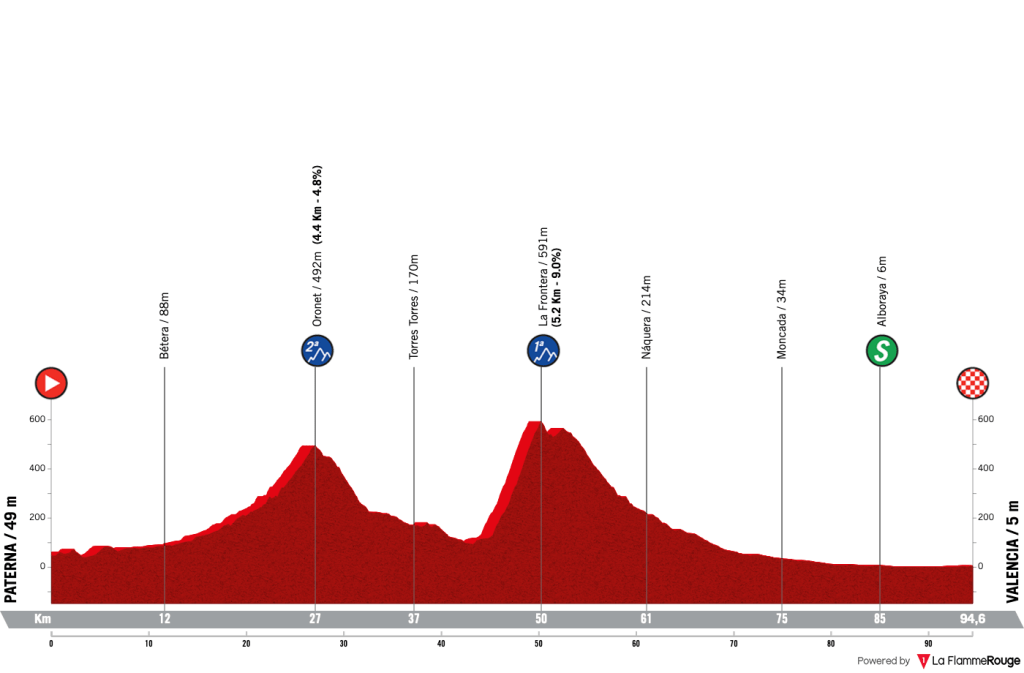
Volta a Valenciana ended with a huge upset from veteran Rui Costa who not only won the final stage but also the overall thanks to his exploits in a cat and mouse final few kilometres. In this article, we will analyse in particular the decisive climb, La Frontera (5.1 km, 9.22%), where the best climbers rode away from the peloton after an hour of racing, doing great watts for early February and maybe even setting their all-time bests.

Volta a la Comunitat Valenciana stage 5 2022 profile by La Flamme Rouge

It was a short stage with only 94.6 kilometres and the pivotal climb cresting with 45 kilometres remaining, almost all of which then comprised of a descent and flat roads. The GC riders had been riding for only around 70 minutes before they started climbing up La Frontera, bringing fresh legs after barely spending 1000 kilojoules before the steep climb – always a recipe for high watts.

Aleksandr Vlasov (Bora – hansgrohe) – Tao Geoghegan Hart (GBR – INEOS Grenadiers) – Giulio Ciccone (ITA – Trek – Segafredo) pictured during Volta a la Comunitat Valenciana 2023 – 74th Edition – stage 5 from Paterna – Valencia 93,2 km – Photo: Luis Gomez/SCA/Cor Vos © 2023

Bora-Hansgrohe lit up the climb with Bob Jungels and Matteo Fabbro. They were riding for the defending champion Aleksandr Vlasov who would probably have preferred a hard uphill finish like Maigmo Tibi, which featured in last year’s Valenciana. After his teammates emptied their tanks, Vlasov was pulling the GC group up the steep La Frontera for quite a while, which is why he pushed 6.7 w/kg for 15 minutes and 7 seconds based on our estimations. That is 0.09 w/kg more than Ciccone, Bilbao, Geoghegan Hart and Soler, who largely sat in the draft.

La Frontera climbing times and w/kg estimations

This is a great performance for February as it is slightly below the yellow Grand Tour winner trend-line. All the climbing efforts from this edition of Valenciana are the red dots in the graph below, and you can see that La Frontera is way above the rest. As mentioned previously, the riders had fresh legs after a fairly easy first hour of the stage and Bora-Hansgrohe did their best from the base of the climb, holding a high steady tempo, which is crucial for high w/kg performances.

After the race, Tao Geoghegan Hart posted in his Instagram story that he averaged 475 watts for 15 minutes and 20 seconds on La Frontera. In the next story, he revealed his weight - 68 kilograms, which meant he did 6.99 w/kg according to his power meter. Our calculations are normalised for 60-kilogram riders which means Geoghegan Hart's 60 kg etalon power for La Frontera would be 7.13 w/kg if using the numbers from his Instagram story.

Screenshot of Geoghegan Hart's Instagram Story

This performance would be between the Generational (red) and All Time Top 25 (pink) trend-lines. Even with fresh legs, 7.13 w/kg for 15 minutes would have been one of the greatest performances in the 21st century as most of the high w/kg efforts happened between 1994 and 1999. Vlasov was also not drafting for the whole time, which meant his etalon power would be even higher, at around 7.22 w/kg for 15 minutes (+0.09 w/kg higher than Tao's) - one of the greatest 15-minute performances of all time.

Lanterne Rouge x CyclingGraphs

But of course, this is too good to be true and in Valenciana Stage 5, the leading group still contained multiple GC riders and they did not push all-time great numbers. Geoghegan Hart's teammate Thymen Arensman's Strava power data shows he pushed close to 500 watts on the climb with a Strava input weight of 69.5 kilograms. Arensman suggested on Twitter after the stage that he still has 2-3kg to lose before being at his ideal race weight, but to be even close to our estimations, Arensman would need to currently weigh around 77.5 kilograms, which is of course unlikely.

The other scenario is that INEOS have unreliable power meters that over-read and/or are inconsistent. If that is not the case, then the INEOS riders' published power numbers suggest they are significantly stronger than Chris Froome at his peak, even in a February preparation race above their target race weight. Regardless, an interesting final stage in Valenciana, with Geoghegan Hart's overall point in his post remaining true - almost all racing requires a top level year round.

Mattias Skjelmose Outsmarts Powless | Etoile de Besseges Stage 4 2023

It was an unusual Queen stage of Etolie de Besseges, as a leading group with multiple GC favourites rode away from the peloton before the climb due to huge crosswinds. Trek-Segafredo put all thekr eggs in the Mattias Skjelmose basket with Jacopo Mosca, Mads Pedersen and Toms Skujiņš giving their best to keep the gap as big as possible. In the end, the Trek-Segafredo team-time-trial effort paid off, as the young Dane won on Le Mont Bouquet and will start the final stage in the leader’s jersey.

Etoile de Besseges stage 4 2023 profile by La Flamme Rouge

It was the only uphill finish in Etoile de Besseges. Le Mont Bouquet has been already used in the 2020 and 2022 editions and it is steep enough to make big gaps in the GC. 4.7 kilometres of 8.9% gradient with a difficult middle section is sufficiently hard for an early February race.

Due to the crosswinds, the peloton split before the final climb with a few climbers making it in the group – Pierre Latour, Pavel Sivakov, Neilson Powless and Mattias Skjelmose Jensen. Trek-Segafredo was the driving force in the first group as the ever versatile Pedersen, Skujiņš and Mosca did their best to increase the gap to the peloton, with this group starting Le Mont Bouquet 1 minute and 20 seconds before the second group.

Pedersen working hard for Skjelmose

The peloton was not organised in chasing as there were both no big teams interested in catching the leading group and Arkea-Samsic (Kevin Vaquelin) and Groupama-FDJ (Thibaut Pinot) lacking the fire power against the Trek-Segafredo trio.

The race leader Arnaud De Lie is in great shape lately. After every big sprinter was dropped in Stage 3, the young Belgian was strong enough to return to the first group and win in a dominant fashion from the small bunch. In Stage 4 De Lie again was showing impressive strength as he was trying to hold the wheel as long as possible with the climbers at the base of Le Mont Bouquet. With 3.7 km to go, GP de Marseille winner Powless attacked and dropped Sivakov, Skjelmose, Latour and De Lie. A few hundred metres later the young Bull lost contact with the climbers but kept going as hard as possible.

Powless attacks, De Lie still with the climbers

Skjelmose Jensen had big pressure on his shoulders as his teammates created a perfect chance for him to win the stage and take the GC lead. The young Dane bridged to Powless and kept going with the American until the finish. In the last hundred metres, Skjelmose attacked and was first into the last corner, just as Tobias Johannesen had done against Vine in 2022. The finish line was right after the last bend and Powless was powerless to come round the Dane.

Le Mont Bouquet – France – cycling – Mattias Skjelmose (DEN – Trek – Segafredo) – Neilson Powless (USA – EF Education – EasyPost) pictured during Etoile de Besseges 2023 – 53rd Edition – stage 2 from Saint Christol Lez Ales – Le Mont Bouquet 147.5 km – Photo: Alessandro Perrone/SCA/Cor Vos © 2023

Kevin Vauquelin was the fastest climber from the peloton and finished sixth. He beat Skjelmose’s time by nine seconds but the Frenchman missed the big move. Arnaud De Lie, despite his huge muscle mass compared to the lightweight climbers, finished 8th, only 94 seconds behind the stage winner and dropped down to fifth place in GC. No one could have expected such an outcome before the race.

Results powered by FirstCycling.com

Vauquelin set the fastest time on the climb and outclimbed Thibaut Pinot by 11 seconds, whilst Skjelmose lost by 46 seconds to the 2022 record time. However, it was a very hard day before the climb. Arnaud de Lie spent 3540 kilojoules in just three hours, which is more than 15.13 kj/kg/h. Those pivotal and painful three hours in the saddle before Le Mont Bouquet and fatigue resistance was extremely important for this stage.

De Lie’s Strava power file shows that he pushed 434 watts for 15:49 minutes or 5.56 w/kg (with an input weight of 78 kg). Our estimations, which are normalised for 60 kg riders, show De Lie did 5.66 w/kg etalon, which is close to his power meter’s etalon numbers as a 78 kg rider needs to push less power on this climb to match the speed of a 60 kg rider.

Le Mont Bouquet climbing times and w/kg estimations by Naichaca

It was huge crosswinds on the climb, which did not really help or hinder the climbers significantly. With no wind conditions, the climbing time would be perhaps 5 seconds slower.

Wind direction on Le Mont Bouquet, light blue tailwind, red headwind

This was one of the best climbing efforts by Skjelmose. His top pure w/kg performance was in Tour of Deutschland 2022, where he did 6.21 w/kg for 27:55 min but the stage before Schauinsland was way easier than before Le Mont Bouquet.

Etoile de Besseges will end with a short time trial, which includes a 2-kilometre 7%+ gradient hill at the end. Skjelmose and Powless will battle out for the GC win and also have a good shot to win the stage. Pedersen came second in this time trial to Ganna last year and seems to be in great shape, whilst Arnaud De Lie will try to impress with another strong performance and keep his spot in the Top 5 of GC.

Etoile de Besseges stage 5 2023 profile by La Flamme Rouge

Ciccone Finds His 2021 Giro Legs | Volta a Valenciana Stage 2

The first mountain top finish in Volta a Valenciana ended with a bunch sprint. Trek-Segafredo climber Giulio Ciccone responded quickly to Mikel Landa’s attack in the final kilometre and won convincingly with enough spare time to celebrate.

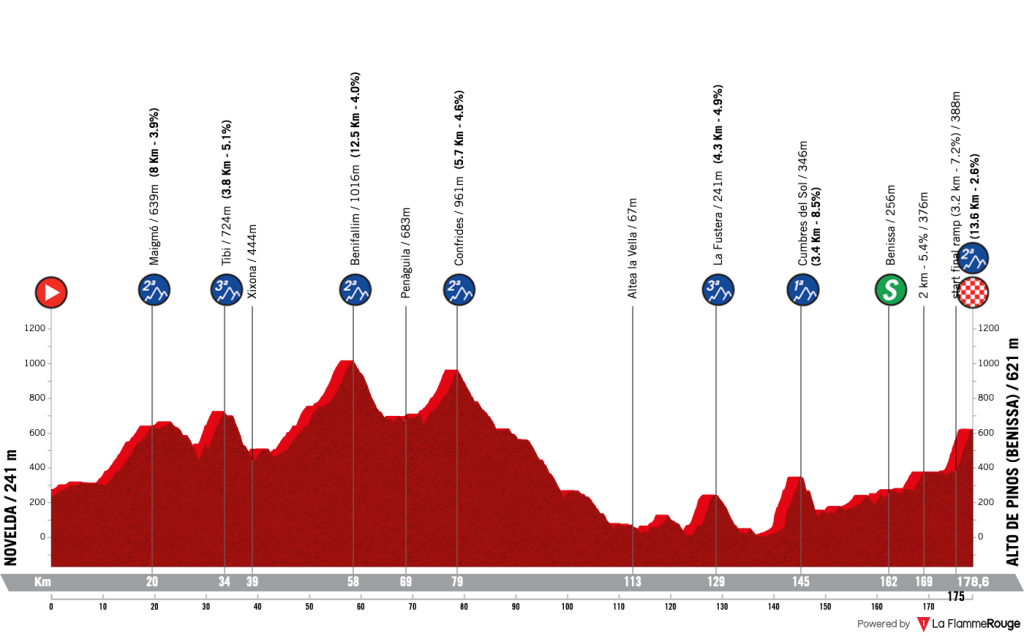
Volta a la Comunitat Valenciana Stage 2 2023 profile by La Flamme Rouge

The stage was not easy, including more than 3500 metres of elevation over 178.6 kilometres. It ended with an uphill finish up the Alto de Pinos (Port de Bernia), which had at the end 2.8 kilometres at 8.04%. In Stage 1 the peloton climbed the Port de Bernia from the other side heading down to the finish in Altea.

The hardest climb in the stage was Cumbre del Sol. It was paced very hard by Bahrain-Victorious rider Matej Mohorič to thin down the peloton and reduce the gap to the last two survivors of the breakaway Javier Romo and Alessandro De Marchi. The peloton did the climb in less than 10 minutes, pushing around 6.46 w/kg, which was harder on the w/kg x time curve than the final climb.

Nothing much happened before the last climb when the INEOS Grenadiers took over from Bahrain-Victorious. Jonathan Castroviejo started an extremely long pull with 10.7 kilometres to go at the base of Alto de Pinos, showing that he has arrived in good shape in his 16th professional season.

Castroviejo starting his huge pull

The tempo was high during Castroviejo’s 8+ kilometres pull, as the peloton was stretched out and it was very hard to move up on the moderate gradients. Castroviejo’s pull was so strong that his teammate Laurens De Plus dropped straight off his wheel. It is not easy to draft behind Castroviejo as he climbs in quite an aerodynamic position. However the Basque rider eventually slowed down when the steeper climbing section started but no one was willing to take over from him with the peloton only around 20 riders deep.

As the pace had been relatively comfortable for stronger climbers, multiple attacks followed. First, it was Brandon McNulty, with Carlos Rodriguez forced to chase the American for Tao Geoghegan Hart but he could not pull for a long time. Thymen Arensman in his debut race for INEOS was already dropped and could not help his team. After no one wanted to chase McNulty it was Jumbo-Visma’s neopro Thomas Gloag’s time to shine. The Briton caught McNulty with 1 km to go and continued with the American on his wheel.

Gloag pulling with McNulty

Tao Geoghegan Hart obviously felt good and closed the gap to the leaders with 1 minute to the finish. Gloag continued to ride at his tempo and everyone was waiting for the next attack with the finish line less than 400 metres to go. Mikel Landa tried his luck and Giulio Ciccone immediately jumped on the Spaniard’s wheel with Landa practically providing him with a leadout as the last section was false flat.

Ciccone responds quickly to Landa’s attack

No one could challenge Ciccone as he sprung from Landa’s wheel in the technical last few hundred metres, showing signs he has his 2021 Giro d’Italia climbing legs back. The Italian took an impressive victory and was able to celebrate very early before the finish line. Hart finished second ahead of Pello Bilbao, but the INEOS rider was later relegated due to his deviation, endangering Bilbao towards the barriers. That meant Aleksandr Vlasov moved to the third spot and earned four bonus seconds, while Bilbao was second.

Giulio Ciccone (ITA / Team Trek – Segafredo) – Tao Geoghegan Hart (GBR / Team Ineos Grenadiers) – Pello Bilbao (ESP / Team Bahrain – Victorious) pictured during Volta a la Comunitat Valenciana 2023 – 74th Edition – stage 2 from Novelda – Alto de Pinos 178.2 km – Photo: Luis Angel Gomez/SCA/Cor Vos © 2023

Nine riders finished with the same time, including Alex Aranburu and Anthon Charmig. UAE Team-Emirates had an awful day as all of their leaders lost time on Alto de Pinos. Four UAE riders finished from 11th to 15th position – Brandon McNulty (11th, +0:08), Diego Ulissi (13th, +0:20), Marc Soler (14th, +0:20) and Rafal Majka (15th, +0:20).

Results powered by FirstCycling.com

Thymen Arensman again was struggling on gradients steeper than 7% and lost 46 seconds, losing even to Callum Scotson. However the Dutchman stated on his Strava that the reason for his unsuccessful day was under-fuelling for the finale.

Thymen Arensman Strava Comment

The climbing level on Alto de Pinos was not that high as the first part of the climb was fairly slow when Castroviejo was pulling for such a long time. It had also been quite difficult in the early part of the stage, with the peloton riding for 4 hours and 38 minutes burning 4,250 kilojoules at 14.12 kj/kg/h. 6.36 w/kg for 7:38 minutes is not anything special but the fatigue, slow speed at the start of Pinos and tempo changes made the difference especially after a 4,000+ kilojoule day.

As mentioned above, Cumbre del Sol’s effort was harder on the w/kg x time curve as it was paced gradually and was earlier than Alto de Pinos.

Guerreiro, Formolo and Buitrago Conquer the Steep Wall | Saudi Tour 2023 Stage 4

The Queen stage of the Saudi Tour did not disappoint. It was clear that Stage 4 as well as the GC would be decided on the steep Harrat Uwayrid climb, which included a 1-kilometre section with an average gradient of 16.5%. Ruben Guerreiro, Davide Formolo and Santiago Buitrago were the fastest up the steep ramps and were able to fend off the chase after the subsequent 8.5-kilometre false flat section. In his debut race for Movistar, Guerreiro was clearly in good shape and won the bunch sprint with a strong, calculated performance.

Saudi Tour Stage 4 2023 profile by La Flamme Rouge

The stage was fairly easy before the final climb which had a three-kilometre section with 11.43% gradient. That is enough to create huge gaps in the peloton and influence the GC fight massively. After the climb followed an 8.5-kilometre false flat section, which gave a chance for slower riders to make some time back if the leading group did not work well together.

If in 2022 the peloton was shattered due to crosswinds before the climb however in 2023 everything was relatively calm and all the biggest favourites arrived at the base together. Ruben Guerreiro, Santiago Buitrago, Davide Formolo and Felix Großschartner were the assumed to be the strongest climbers in Saudi Tour and before the stage they all were very close in GC.

Harrat Uwayrid – Saudi Arabia – pictured during Saudi Tour 2023 – stage 4 – from Maraya – Skyviews of Harrat Uwayrid 163,4 km – Photo: Luca Bettini/SCA/Cor Vos © 2023

Movistar’s climbers were setting a fierce tempo at the first part of the steep section. They had a good mountain support squad for a 2.1 race – Will Barta, Gregor Mühlberger and Oscar Rodriguez. Guerreiro in 2022 had many good climbing performances and, in theory, he was the strongest climber in this race if he had arrived in close to top shape.

Movistar pushing on

UAE-Team Emirates riders Großschartner and Formolo decided to push hard on the steepest section of the climb, where even some of the riders in the first group were zig-zagging up the 20%+ section. Only four climbers made the split – Guerreiro, Buitrago, Formolo and Großschartner.

The leading four with Formolo, Guerreiro, Buitrago and Großschartner

Formolo was riding in the front of the group for quite a while and was obviously feeling strong. In the final kilometre of the climb, the Italian even attacked putting his teammate Großschartner under pressure and dropping him. This did not pay off as Guerreiro and Buitrago claimed 3 and 2 bonus seconds respectively after the crest of the climb because they had saved more energy.

Formolo attacks at the end of the climb

The first group had a massive gap over the race leader Jonathan Milan, with the huge sprinter losing around 1:40 min on the climb. The leading trio did not have much motivation to work well together and Großschartner eventually caught the group. The virtual GC situation at this point was tight, including the bonus seconds earned at the crest:

Guerreiro – virtual leader
Buitrago +0:03
Formolo +0:04
Großschartner +0:04

    Großschartner returns

    With such a close situation it meant that the bonus seconds at the finish would decide everything. The attacks in the group started in the final 1.2 kilometres. First, it was Großschartner who tried his luck but Guerreiro quickly reacted. A few seconds later Buitrago attacked but again it was Guerreiro who was at his wheel and neutralised the young Colombian. Meanwhile, Großschartner lost contact with the trio as he was completely spent.

    Buitrago attacks

    Buitrago, despite emptying his reserves with a late attack, launched the sprint to the finish very early, around 14 seconds before the line. Guerreiro was the favourite to win the sprint and he did it relatively comfortably and even had time to celebrate his first win for Movistar.

    Ruben Guerreiro (POR – Movistar Team) – Davide Formolo (ITA – UAE Team Emirates) pictured during Saudi Tour 2023 – stage 4 – from Maraya – Skyviews of Harrat Uwayrid 163,4 km – Photo: Luca Bettini/SCA/Cor Vos © 2023

    It is an important victory for Movistar as one of their sponsors is the Saudi Cycling Federation which joined the team late in 2022. Jonathan Milan, despite doing his best and reducing the gap after Harrat Uwayrid by more than a minute, lost his leader’s jersey and dropped to fifth place in GC. Stage 5 will be the final one and if there will not be crosswinds it will be almost impossible to make gaps to move up in the GC.

    Results powered by FirstCycling.com

    The stage before the climb was relatively easy as the peloton rode for 3 hours and 22 minutes with around 2500 kilojoules, which is 11.39 kj/kg/h for a 65 kg rider. Nothing too serious. In the shallow section of the Harrat Uwayrid, the riders in the peloton had to do around 5-5.1 w/kg for 10 minutes. That added some fatigue in the legs as after the 5 w/kg effort followed the steep section at 3 km of 11.43%.

    Guerreiro, Formolo and Buitrago did the climb at 10 minutes and 41 seconds at 6.62 w/kg. That is almost two minutes faster than 2022 climbing times by Rui Costa, Maxim Van Gils and Buitrago which is huge on a relatively short climb. However the 2022 stage was way harder due to the early crosswinds, which emptied glycogen stores and fatigued legs.

    Skyviews of Harrat Uwayrid time and w/kg calculations by Naichaca

    This was not anywhere close to Guerreiro’s peak level as it was below the green trend-line, he rode the climb cautiously, and it is the early season. Very rarely do climbers reach their peak wattage in February, with some exceptions (Nairo Quintana in 2020 February). Guerreiro signed a three-year deal with Movistar and is their second-best GC rider behind Enric Mas. He has shown great performances in 2022, by winning the Mont Ventoux Challenge and setting the third fastest time in a road race on the legendary climb, only slower then Marco Pantani and Miguel Angel Lopez.

    Volta a la Comunitat Valenciana 2023 Preview

    Volta a Valenciana is one of the most exciting 2.Pro races and it always gathers an impressive start list thanks to the Valenciana region being the pre-season hot spot of cycling training in Europe. This year’s race will feature a very strong Bahrain-Victorious team that has sent their A-List squad with Bilbao, Landa, Caruso, Wright, Mäder, Mohorič and Poels. Who will challenge them?

    Provisional Start List

    Data powered by FirstCycling.com

    Stage 1

    The first stage features two reasonable climbs. The first ascent is Coll de Rates from the Tarbena side (8.9 km, 4.7%) which the peloton might complete at around 29-30 km/h. After Tarbena follows the Coll de Rates descent.

    Volta a la Comunitat Valenciana Stage 1 profile by La Flamme Rouge

    The last categorised climb will be Bernia, which in reality might be raced as two climbs with a flat section in the middle. There might be some attacks but as drafting matters on such shallow gradients stronger sprinters will very likely survive in the peloton and fight for victory. There are 35 kilometres left after the crest of Bernia and it will be a very hard task for attackers to beat the peloton on the opening stage however anything is possible as practically every rider in the peloton will know the last part of the stage extremely well in the run in to Altea.

    Olav Kooij and Alexander Kristoff climb well for sprinters and might be the fastest guys in a thinned out bunch. Juan Sebastian Molano, Fred Wright, Alex Aranburu, Matej Mohorič, Ivan Garcia Cortina and Edward Theuns will also look forward to Stage 1 and, apart from Molano, might even attack at some point on the descent. If Madis Mihkels is in good shape and completely recovered from his injuries after a car driver hit him in Estonia a month ago he might also surprise for the victory. He proved in Gran Piemonte last year that he can get over reasonably hard climbs and has a good sprint. that race was won by Garcia Cortina and second was Mohorič, both of whom are here.

    Stage 2

    Stage 2, one of two stages with an uphill finish, will be challenging as it includes 3458 metres of elevation gain and multiple hard hills before the final climb. Before the final climb the peloton will ride up La Fustera (Trek-Segafredo did an uphill race here in their 2022 December training camp) and Alto de Puig Llorença, the climb which was featured in the Vuelta a España 2019 Stage 2, won by Nairo Quintana.

    Volta a la Comunitat Valenciana Stage 2 profile by La Flamme Rouge

    The stage will finish with Port de Bernia, which is 2.54 km long and 8.62% gradient in the final part. Although the final climb is not hard and the GC riders might hit over 23-24 km/h, the hard climbing metres beforehand and fatigue in the legs might make some gaps.

    Bahrain-Victorious has a strong team with many options for both GC and the stage win, including Bilbao, Mohoric, Landa, Poels, Mäder and Caruso. It will be curious to see how they will play their cards as they can send multiple riders in early attacks to make other’s team chase. The defending champion Aleksandr Vlasov, INEOS trio Thymen Arensman, Tao Geoghegan Hart and Carlos Rodriguez, UAE’s Brandon McNulty, Rafal Majka, Marc Soler, Diego Ulissi, and Bauke Mollema, Giulio Ciccone, Thomas Gloag and Eddie Dunbar will be some other strong climbers in this race. The finish suits more punchy riders like Vlasov and Bilbao, the latter of whom was in great shape at the Tour Down Under.

    Stage 3

    Another hard stage with difficult climbs in the middle, including El Garbi, one the hardest ascents in the whole race.

    Volta a la Comunitat Valenciana Stage 3 profile by La Flamme Rouge

    El Garbi in reality is a 2.3km climb with an 11.1% gradient with some false flat kilometres afterwards. This is the stage where satellite riders might be very useful as keeping a gap after the steep gradients will be challenging for solo lightweight climbers.

    Bahrain-Victorious, INEOS Grenadiers and UAE Team Emirates might be the teams to tactically use their numbers on this stage. If there is a group together at the false flat downhill finish, Pello Bilbao might be the favourite to take the win as he can sprint well for a climber and won the Tour Down Under Corkscrew stage finish against Simon Yates, while Jay Vine was pulling for GC as well as a similar finish in Basque Country last year.

    Stage 4

    Stage 4 is another hard day in the saddle. 3627 metres of elevation gain but with a fairly easy finishing climb.

    Volta a la Comunitat Valenciana Stage 4 profile by La Flamme Rouge

    Santuario Cova Santa in the final three kilometres averages 7% gradient, where drafting still matters a lot particularly on a short climb. Bahrain-Victorious again could use their numbers on this stage, such as sending riders in the breakaway or attacking early on the 7% section to make other leaders close the gap.

    Stage 5

    Stage 5 will feature the hardest climb in the race. La Frontera (5.2km, 9.0%), which crests 45 kilometres from the finish in Valencia. The familiar name in this preview, Bahrain-Victorious, have two good options for this stage in Fred Wright and Matej Mohorič who can both outclimb almost any other fast finisher on this start list. It is very likely that the team will torch it up the climb and then continue hard on the front until Valencia. Another option is that the La Frontera climb is so selective that GC riders might ride away like the Baza stage in Andalusia last year, where Bahrain began to attack a thinned out group with multiple GC leaders, leading to Wout Poels winning GC.

    Volta a la Comunitat Valenciana Stage 5 profile by La Flamme Rouge

    Contenders

    Bahrain-Victorious with their super six of Bilbao, Landa, Caruso, Mäder, Mohorič and Poels can sweep this race. The most sure bet of the lot is Bilbao, who is in good shape after finishing third in the Tour Down Under, has a good sprint and is a consistent racer throughout the year. Mohorič is the worst climber of the six mentioned riders, however there is no extended mountain top finish and he is capable of coming back quickly on descents such as after La Frontera. He also sits high in the team hierarchy and was in good shape for this race last year. For the others, it will be their first UCI race of the season so it is difficult to know their form.

    Wout Poels (Netherlands / Team Bahrain – Victorious) – Luis Leon Sanchez (ESP – Bahrain Victorious) pictured during 77th La Vuelta ciclista a Espa–a (2.UWT) – stage 6 Bilbao > Ascensi—n al Pico Jano San Miguel de Aguayo (181.2km) – Photo: Luis Angel Gomez/SCA/Cor Vos © 2022

    Juan Ayuso might have been the favourite to win his home race however he unfortunately will not start due to tendinitis. UAE-Team Emirates has still sent a strong team with McNulty, Majka, Soler, Novak and Ulissi so they are capable of winning both stages and contesting for GC.

    Thymen Arensman will make his debut for INEOS. He is great on shallow climbs 6-7% gradients suit him well. He is paired with Carlos Rodriguez, who finished 3rd in this race last year and has improved since then.

    Sierra Nevada – Spain – cycling – Carlos Rodriguez (Spain / Team INEOS Grenadiers) pictured during 77th La Vuelta ciclista a Espa–a (2.UWT) – stage 15 Martos > Sierra Nevada (152.6km) – Photo: Miwa iijima/Cor Vos © 2022

    Young Jumbo-Visma talents Thomas Gloag and Michel Hessmann will also be definitely worth watching out for to see how they perform against top WorldTour competition. Jumbo-Visma does not have as much GC depth on their whole roster as Bahrain-Victorious, UAE Team Emirates or INEOS Grenadiers, so their young riders here have a great chance to prove their strength and merit for selection in the big WorldTour races.

    Aleksandr Vlasov is the defending champion and started the 2022 season very well with consistent results. The route suits the Russian as it does not include long 30+ minute climbs and has some steep punchy sections and finishes which he thrives on – 3rd in La Fleche Wallonne was no fluke.

    Prediction

    I have no idea who will win. There is no huge star like Pogačar, Evenepoel or Vingegaard and as it is an early season race anything can happen. Not everyone is in their best shape and a surprise winner is more than possible at this time of year as the one-day races in Mallorca proved. If I have to pick one rider then it is Pello Bilbao. He checks two boxes, being from Bahrain-Victorious who sent an insanely stacked squad and proven to be in good shape already.

    Superman Lopez Destroys the Alto Colorado Climbing Record

    Vuelta a San Juan’s sole mountain top finish did not disappoint. The action started with Remco Evenepoel’s premature attack and ended with Miguel Angel Lopez’s monstrous time up Alto Colorado, breaking Gonzalo Najar’s 2018 record mainly due to the huge tailwind.

    Vuelta a San Juan 2023 stage 5 profile by La Flamme Rouge

    The stage was fairly easy before the climb as the peloton climbed on shallow mountains all day before Alto Colorado. The highway climb itself is not that hard. 18.8 kilometres with a 4.4% average gradient is perfect for heavier riders like Filippo Ganna, who always performs on Alto Colorado. With only 1 kilometre above 6%, this means drafting has a huge impact for the entirety of the climb.

    Miguel Angel Lopez is now riding for Medellin-EPM and this might be the biggest race in his 2023 calendar as no WorldTour or Pro Conti team wants to sign the Colombian after Astana terminated his contract. Before the race Lopez did a huge effort at altitude in training and was clearly in superb shape. His teammates paced the climb as hard as possible on shallower gradients at the start to fatigue other riders.

    Medellin-EPM pacing hard

    Unexpectedly, with 9.8 km to go, Remco Evenepoel launched from the peloton which still had many riders left and with Medellin and INEOS having multiple teammates left for their leaders. Probably no one was expecting it which is the main reason why Evenepoel even got a gap. On a 4-5% gradient, it is extremely hard to beat a group that is working together even if you are by far the strongest rider. With Medellin and INEOS’ best efforts the World Champion was brought back in a few kilometres, however the leading group was shattered and included only a handful of riders.

    Remco Evenepoel (BEL – Soudal – Quick Step) pictured during Vuelta a San Juan 2023 – 40th Edition – stage 5 – Chimbas – Alto de Colorado (173,7 km) – Photo: Roberto Bettini/SCA/Cor Vos © 2023

    It was also a huge tailwind which favoured long range attacks. If it had been headwind Evenepoel very likely would not have even considered such a brave move.

    Alto Colorado wind direction in arrows, climb direction in blue

    Lopez immediately accelerated and upped the tempo when Evenepoel was caught, making sure the Belgian was dropped whilst his legs were cooked after the hard effort. If a rider goes into the red zone at high altitude like Remco it is much harder to recover than at sea level. Bernal pacing Ganna brought Lopez back initially, but Superman attacked one more time and dropped Sergio Higuita from his wheel proving he is still possibly the best high altitude climber in the world. Maybe only Jonas Vingegaard could challenge Lopez at such a high altitude.

    Lopez drops Higuita

    Despite the shallow gradients in the remaining 5km, Lopez was too strong enough for everyone and won the stage comfortably. Despite now being on a continental team, the Colombian had optimised everything as he had a road suit, fairly long socks, S-Works bike with aero wheels and aero helmet – likely a faster set-up than he had at either Astana or Movistar. Aerodynamics are extremely important when climbing at such high speed.

    Miguel Angel Lopez (COL – Team Medellin – EPM) pictured during Vuelta a San Juan 2023 – 40th Edition – stage 5 – Chimbas – Alto de Colorado (173,7 km) – Photo: Roberto Bettini/SCA/Cor Vos © 2023

    Ganna had performed well on Alto Colorado already in 2018 and 2020 and was back at his game, proving that 4-5% gradients suit huge riders if they have big watts under the bonnet. Ganna at one moment was even 15 seconds away from Lopez closing the gap, according to TV time gaps, but the 7% section at the end finished his attempt to close the ga as it was too steep for him, compared to the much lighter Lopez.

    Filippo Ganna (ITA – INEOS Grenadiers) – Egan Bernal (COL – INEOS Grenadiers) pictured during Vuelta a San Juan 2023 – 40th Edition – stage 5 – Chimbas – Alto de Colorado (173,7 km) – Photo: Roberto Bettini/SCA/Cor Vos © 2023

    Lopez won the stage by 30 seconds and the last two days will be for sprinters. If there are no huge crosswinds or unexpected crashes, the GC should not change. Evenepoel finished 69 seconds behind Lopez between Brandon Rivera and Nicolas Paredes from the SEP San Juan team. Quinn Simmons who is also a fairly big rider compared to the Colombians performed well for his standards and ended in the Top 10 of the stage. It was brilliant to see Egan Bernal performing at a high level after his horrific crash a year ago.

    Results powered by FirstCycling.com

    Thanks to the pacing of his team and huge tailwind Miguel Angel Lopez was able to break Gonzalo Najar’s 2018 record. Najar attacked very early and did not have such a huge tailwind pushing him forward, which is why his performance from a watts perspective is still way more impressive.

    Gonzalo Najar (S.E.P. de San Juan) pictured during Vuelta a San Juan 2018 – 36th Edition – stage 6 – from San Juan : San Juan (152.6KM) – photo ilario Biondi/LB/RB/Cor Vos © 2018

    Najar did an estimated 6.3 w/kg for 36:58 min up to a finish at 2624 metres above sea level, one of the greatest climbing performances ever. Nonetheless, Lopez’ effort was also very good as he did an estimated 5.99 w/kg for 36:20 min whilst Ganna was 8 seconds faster than Najar and did 5.77 w/kg. All calculations are made normalised to a 60kg rider, which means Ganna’s unadjusted w/kg that he actually put out were much less compared to the lighweight Colombians Higuita, Bernal, Rubio and Rivera all of whom finished behind him. In the 2020 edition the best climbing time was 39:06 set by Miguel Eduardo Florez, 2 minutes and 46 seconds slower than Lopez’ time.

    Despite blowing himself up, Evenepoel was 1:40 min faster this year than in 2020, however this time he had perfect conditions. In 2022 the Belgian also struggled in the early season races, such as Valenciana where he was dropped by Vlasov, but for his main goals in the second part of the season he was dominant.

    Cadel Evans Great Ocean Road Race 2023 Preview

    The first WorldTour one-day race of the 2023 season is upon us, featuring 14 teams of which 11 are WorldTour level. The last time the biggest Australian one-day race, with its equally long name, happened was in 2020. It is one of the few WorldTour races on the calendar that has optional participation for WorldTour teams, so teams like Jumbo-Visma and Groupama-FDJ have already headed back to Europe after the Tour Down Under. Australians including Michael Matthews, Caleb Ewan and Jay Vine are some of the favourites to win the race, however, in its short history, the only Australian to have won the Cadel Evans Race is Jay McCarthy, who was victorious in 2018.

    Provisional Start List

    Data powered by FirstCycling.com

    The parcours suit many types of riders. A climber, puncheur or strong sprinter has a realistic shot to win. Jay Vine, Mauro Schmid and Michael Matthews fit those different types and this course offers all of them a good chance to win. In the 174 kilometres route there is only 1666 metres of elevation but the hardest hills are included in the second part of the race and close to the finish in Geelong.

    Cadel Evans Great Ocean Road Race 2023 profile by La Flamme Rouge

    Challambra Crescent (0.9 km, 8.9%) will be the hardest hill at 0.9 km of 8.9% gradient and will be completed four times. It is around a two minutes climb but is hard enough to cause massive splits in the peloton particularly if UAE launch the climb with their punchy squad – Finn Fisher Black took the KOM on a recon ride this morning. Right after it follows another punchy hill – Melville (0.6 km, 8.3%).

    In the past, the race in honour of the Tour de France winner Cadel Evans has been won by various types of riders like Dries Devenyns, Elia Viviani and Jay McCarthy. The South African Daryl Impey even finished third three times in a row. He will also start this weekend in his final year in the peloton, but his performance in Santos Tour Down Under does not suggest an ability to replicate his past success.

    Cadel Evans Ocean Road Race historic results by FirstCycling.com

    Contenders

    In the betting markets, Michael Matthews is the big favourite, followed by Caleb Ewan, Marc Hirschi, Mauro Schmid, Simon Yates, Jay Vine, Magnus Sheffield and Corbin Strong. Climbers like Yates and Vine who performed exceptionally well in the Santos Tour Down Under a week ago and are in great shape are not the biggest favourites but looking at how the 2020 race played out, where Dries Devenyns and Pavel Sivakov, both climbers, sprinted for a victory when the route was practically the same, maybe the climbers this year have been a little bit underrated.

    Dries Devenyns (Belgium / Team Deceuninck – Quick Step) – Pavel Sivakov (Rusland / Team Ineos) pictured during 5th Cadel Evans Great Ocean Road Race – Elite a one day race from Geelong to Geelong (171,7) – photo Zac Williams/SWpix/Cor Vos © 2020

    Challambra Crescent (0.9 km, 8.9%) might not seem that challenging but its combination with Melville (0.6 km, 8.3%) right after makes this course harder than expected and gives little respite to the riders in the finale. Four loops are enough to completely shatter the race and give climbers like Vine, Yates and O’Connor a good chance to win. Vine already proved in Santos Tour Down Under that he is strong enough to make splits and ride away from the peloton even on stages with a single hard climb. Vine has performed well on shorter races/stages such as in the Tour Down Under so maybe this race of around four hours duration might be even better for him. The main impediment for Vine to win is his sprinting ability. There is a high chance if he successfully attacks that Yates or other riders will be on his wheel. The hills are not hard enough for him to just ride away but still hard enough to make a difference against sprinters. There is a decent chance that Vine will initiate the winning move but will finish 2nd or 3rd in a small group sprint for the win or perhaps he bucks that trend and wins the sprint too.

    Jay Vine (AUS / UAE-Team Emirates) – Rohan Dennis (AUS / Team Jumbo-Visma) pictured during 23rd Santos Tour Down Under (2.UWT) for elite men stage 2 from Brighton to Victor Harbor (154.8km) – Photo: Dion Kerckhoffs/Cor Vos © 2023

    Magnus Sheffield already proved he is great in hilly races and won Brabantse Pijl in 2022 with an impressive performance. The American super-talent is in good shape as he finished 4th in Santos Tour Down Under. His teammates Luke Plapp and Ethan Hayter also might do well on Sunday and INEOS have multiple cards to play. Plapp and Sheffield can play a more attacking role while Hayter sits in the bunch and waits for the sprint.

    Magnus Sheffield (USA / Team Ineos Grenadiers) pictured during 23rd Santos Tour Down Under (2.UWT) for elite men stage 2 from Brighton to Victor Harbor (154.8km) – Photo: Dion Kerckhoffs/Cor Vos © 2023

    There are multiple sprinters here who can get over hills at a decent pace such as Michael Matthews, Caleb Ewan, Corbin Strong, Emīls Liepiņš, Hugo Page and Jordi Meeus. Matthews has a 20-25% chance to win according to bookmakers and he climbs well. But can he win? If the assumption above is right regarding Vine and Yates, then the climbers will be strong enough to drop them and gain a big enough gap to win. Matthews is likely to finish high but even if a climbing group is brought back, he might lose a sprint because everyone will be looking at him and force him to close gaps like in the Australian National Championships Road Race – there he lost in the sprint for second to Simon Clarke.

    Versatile riders such as Alberto Bettiol, Mauro Schmid, Sven Erik Bystrom, Alessandro Covi, and Simon Clarke must be happy with this course. If Bettiol gets a gap he might be strong enough to solo to the victory like in Ronde van Vlaanderen 2019 or the hilly circuit of the Giro d’Italia 2021 Stage 18. Bettiol’s sprint is also strong enough to win from a reduced bunch. He finished second behind Bryan Coquard in an uphill finish in Santos Tour Down Under.

    Alberto Bettiol (ITA / Team Ef Education – Easypost) pictured during 23rd Santos Tour Down Under (2.UWT) for elite men prologue in Adelaide (5.5km) – Photo: Dion Kerckhoffs/Cor Vos © 2023

    Predictions

    The race will be aggressive and too hard for sprinters like Strong and Liepiņš. The climbers will up the tempo on the climbs and four laps are enough, particularly with UAE’s strong squad. Sheffield showed multiple strong performances in 2022 and is currently in good shape. He will make the leading group which will consist of 4-10 riders and after that, the future Tour de France winner will go solo like in Brabantse Pijl.

    Trofeo Calvia 2023 Preview

    Trofeo Calvia is the first of five UCI 1.1 category one-day races in Mallorca. Some riders use the Mallorcan races as training to get in better shape like Alejandro Valverde but with loads of UCI points on the line some teams are definitely motivated to perform already in January.

    As the series of races are uniquely five consecutive one-day races rather than a stage race, teams can substitute riders in and out of the team each day as they wish, choosing from their broader squad that will presumably be training in Mallorca. For the first time Trofeo Calvia and the other races in Mallorca will be broadcast live, which is great news.

    Calendar of Races in Mallorca

    25.01 Trofeo Calvia
    26.01 Trofeo Port D’Alcudia – Port D’Alcudia
    27.01 Trofeo Andratx – Mirador D’es Colomer (Pollença)
    28.01 Trofeo Serra de Tramuntana (Lloseta – Lloseta)
    29.01 Trofeo Palma – Palma

    Trofeo Calvia Start List

    Data powered by FirstCycling.com

    The profile of this opening race is hilly and suited for climbers and hilly specialists like Brandon McNulty, Tim Wellens and Julian Alaphilippe – the top 3 favourites to win the race when the betting markets opened. There are not many hard hills in the route but in 149.7 kilometres there is 3129 metres of elevation with the road either going up or down. These hills will thin out the group and after most riders are dropped and there is some fatigue in the legs, it is possible to do a long solo. McNulty proved that in 2022, winning Trofeo Calvia with a 60 kilometre solo after dropping everyone in the mountains.

    Trofeo Calvia Profile by La Flamme Rouge

    In the last 100 kilometres all the hills are below 6% gradient. Usually 7% is the mark where the drafting effects becomes less important and the stronger riders can more easily get separation. All of the climbs in the 2nd half of the race are in the range of 4% to 5.2% gradient.

    Behind McNulty in 2022 was a second group of nine riders – Suter, Albanese, Wellens, Clarke, Valverde, Goosens, Owsian, Buchmann and Zwiehoff. In 2021 the race culminated with a sprint between Ryan Gibbons and Anthony Delaplace where the UAE Emirates rider Gibbons won. Rune Heregodts was third and after that there was a huge group with 33 riders. Before 2021, the last time Trofeo Calvia happened in 2011. However when looking at the old results, it was sprinters who won but the parcours and racing style has changed and now it suits the hilly specialists.

    It is forecasted that it will rain during the race and possibly for all five races in Mallorca. The temperature might be around 10 Celsius, which is cold for Spanish standards even at this part of the season. With the tailwind dominating in the second part of the race, the scenario of someone winning from a solo is very likely.

    Contenders

    UAE-Team Emirates has won Trofeo Calvia twice in a row and have brought an incredibly strong team for a January UCI 1.1 race. They are very likely to continue their winning streak as they have sent Brandon McNulty and Tim Wellens who both are huge favourites in the betting markets. Wellens performs the best in early season races because it is colder and the Belgian suffers from allergies brought on by the effects of heat. Matteo Trentin and Diego Ulissi are also both in the Top 20 favourites and it is clear UAE-Emirates might play with numbers and send riders in multiple attacks. If nothing works then Trentin might win from the bunch sprint. If the race has been attritional and there are only climbers left in the leading group, Ulissi might have a good shot at winning from a small group sprint. In 2022 the UAE-Emirates riders performed exceptionally in the early part of the season, with Ulissi’s win in GP Industria on 27th March being the team’s 22nd victory at that time. There is a good chance that once again the UAE-Emirates riders are in great shape already in the early season, as shown by Jay Vine winning the Tour Down Under GC. McNulty in the early 2022 races also performed great and for some time he was the leader in the earned UCI points for 2022.

    Brandon McNulty (USA – UAE Team Emirates) pictured during Trofeo Calvia 2022 – Challenge Mallorca – 31st Edition – Peguera – Palmanova 154,7 km – 26/01/2022 – Photo: Luis Angel Gomez/Cor Vos © 2022

    Julian Alaphilippe on paper might be the biggest name in Trofeo Calvia. After an unsuccessful 2022 season, mainly due to the effects of his horrific crash in Liege-Bastogne-Liege, the French star will want to perform. In both 2021 and 2022 Alaphilippe arrived in great shape in Tour de La Provence, which sadly will not be held in 2023. Soudal-Quick Step team manager Patrick Lefevere has recently made harsh comments about Alaphilippe in the media, which is not the first time Lefevere has criticised big stars of his team. If a rider earns big money on Quick-Step, they must deliver results every single year or otherwise Lefevere will throw some punches in the media.

    Les Praeres. Nava – Spain – cycling – Julian Alaphilippe (FRA – Quick-Step Alpha Vinyl Team) pictured during 77th La Vuelta ciclista a Espa–a (2.UWT) – stage 9 Villaviciosa > Les Praeres. Nava (171.4km) – Photo: Luis Angel Gomez/SCA/Cor Vos © 2022

    The course is perfect for Alaphilippe. The problem is the Frenchman does not like rainy and cold conditions as he has shown multiple times. One of the best examples is the 2019 World Championships in Yorkshire where it was extremely wet and Alaphilippe was not close winning, despite a perfect parcours. His teammate Andrea Bagioli also has a decent sprint and the power to get over hills. Quick-Step has sent a good climbing squad to Mallorca with Ilan van Wilder, Fausto Masnada, Louis Vervake and Mauri Vansevenant to complement their fast finishers. They are the second strongest team behind only UAE-Emirates and might do a big damage.

    Other notable riders in Trofeo Calvia are Lennard Kämna, Andrea Piccolo, Axel Zingle, Emanuel Buchmann, Neilson Powless, Cian Uijtdebroeks, Warren Barguil and Guillaume Martin. It is an early season race and an outsider might have a good shot to surprise everyone if they are in great shape. Intermarché-Circus-Wanty are such a team that might surprise, bringing Rune Herregodts and new signing Lilian Calmejane. Both riders odds are less than 1% in the betting markets, but they pushed good numbers recently in the training camp and Intermarché performance staff likely has made them arrive in good shape for the plentiful points on offer. Herregodts was strong in the early season in 2022, winning his first race of the year, the opening stage of Andalucia in the middle of February.

    Prediction

    Brandon McNulty will defend his title successfully. UAE-Emirates has sent a strong team and multiple riders might win from that group. With team tactics likely involved, my pick is McNulty who will again do a solo. Of course, everyone knows he is dangerous and will watch for his attacks but the American in the winter trained hard and already performed exceptionally in the early 2022 season. He is a strong one-day racer and this course suits him. Even with a target on his back from the other riders, when he is on his day there are very few riders in the world that can stay with him, most of whom will not be in attendance in Mallorca.

    Kārlis Ozols (@CyclingGraphs)

    Vuelta a San Juan 2023 Preview

    The Vuelta a San Juan is the most prestigious stage race in North and South America and attracts some of the biggest names in cycling. Remco Evenepoel will start his 2023 season in Argentina as the current world champion whilst other stars lining up include Peter Sagan, Egan Bernal, Daniel Felipe Martinez, Filippo Ganna, Miguel Angel Lopez, Fabio Jakobsen and Sam Bennett. To Evenepoel’s chagrin, there is no time-trial this year. Instead the fight for the GC title will be decided by the mountain stage up Alto del Colorodo.

    Provisional Start List

    Data powered by FirstCycling.com

    Stage 1

    The first stage is made for pure sprinters like Fabio Jakobsen and Sam Bennett who are here in San Juan. The sprinters field is stacked as there are possibly six stages for the fast guys. Soudal – Quick Step have brought Yves Lampaert, Michael Morkov, Jan Hirt, Remco Evenepoel and Pieter Serry to accompany the European Champion sprinter, which should be a formidable train for a January .Pro race. Do not be surprised to see Evenepoel helping with the sprint train as he did in the 2022 early races such as Valenciana and Algarve. Bora-Hansgrohe have Bennett with possibly the strongest lead-out man in the world Danny van Poppel and set-up man Ryan Mullen. Fernando Gaviria will debut for Movistar, with the Colombian having won eight stages in San Juan in the past. Other sprinters competing are Elia Viviani (INEOS), Gleb Syritsa (Astana), Sam Welsford (DSM), Peter Sagan (TotalEnergies), Giacomo Nizzolo (Israel – Premier Tech), Jon Aberasturi (Trek-Segafredo), Giovanni Lonardi (EOLO-Kometa) and German Nicolas Tivani (Corratec).

    Vuelta a San Juan 2023 Stage 1 Profile By La Flamme Rouge

    Stage 2

    Stage 2 is a little bit harder with 1461 metres of gradual elevation gain but with no steep climbs this stage is once again made for sprinters.

    Vuelta a San Juan 2023 Stage 2 Profile By La Flamme Rouge

    Stage 3

    The Stage 3 finish will be different to the preceding stages. Despite only having 375 metres of elevation gain, most of the climbing will be done in the final part of the route, so expect everyone will be fresh in the last 10 kilometres with a huge fight for position into the circuit entrance.

    Vuelta a San Juan 2023 Stage 3 Profile By La Flamme Rouge

    The 3-4% rise at the end still should not be a big problem for the pure sprinters. The last 5 kilometres will be done in an autodrome, which includes many sweeping corners and some small rises.

    Circuito San Juan Villicum

    This finish was used twice in San Juan, first in 2019 where German Nicolas Tivani won from a breakaway, beating the peloton by 12 seconds whilst Bennett and Gaviria were the fastest from the bunch behind.

    In 2020 Zdenek Štybar surprised the bunch with a late attack from the peloton and won solo. This means someone like Quinn Simmons or even Remco Evenepoel might have a small chance to go solo in the final kilometres if other teams make a mistake and do not close their attack immediately or if Quickstep deliberately let Evenepoel’s wheel go during a leadout. Otherwise this should be another chance for the sprinters.

    Stage 4

    2646 metres of elevation gain means this is easily the second hardest climbing day of the race but the final 110 kilometres are relatively easy. The early climbs are not steep but are extremely long and it is possible to drop sprinters if a team like INEOS commits to pacing. However with 6 rider teams, even if some sprinters are initially dropped, it might be hard to pull off keeping them behind if INEOS receive no help from other teams. This scenario is unlikely but a hard pace to fatigue sprinters still might be a worthwhile endeavour. This stage also might be suited for breakaway for someone like Quinn Simmons, who has been in breakaways in similar Vuelta stages, but as the first three stages are for sprinters and no one will have lost a ton of time there might not be many breakaway riders allowed in a move.

    Vuelta a San Juan 2023 Stage 4 Profile By La Flamme Rouge

    Stage 5

    The only mountain stage in San Juan and the final climb is not even that steep. Alto del Colorado (18.8 km, 4.4%) goes up to 2623 metres above sea level but it is a perfect climb for heavier riders. Filippo Ganna in 2020 finished 6th on the climb losing only four seconds to the stage winner Miguel Eduardo Florez and finishing together with Evenepoel.

    Vuelta a San Juan 2023 Stage 5 Profile By La Flamme Rouge

    The second part of Alto del Colorado is steeper as it includes more 5% sections. At two kilometres to the finish there is a 7.1% section, which is a perfect launching point if climbers are still together. Jan Hirt will be crucial for Evenepoel as everyone might work against him and make him close the attacks and gaps like in the 2020 race. Evenepoel is the big favourite and all eyes will be on him, with Medellin having Sevilla and Lopez to play the numbers game.

    The climbing record is owned by Gonzalo Najar. The Argentinian produced one of the greatest climbing performances of all time (this is not a joke) and beat Oscar Sevilla by almost two minutes. Najar did the climb in 36 minutes and 58 seconds, beating Tiesj Benoot (+2:23), Filippo Ganna (+2:23), Rafal Majka (+3;07), Fausto Masnada (+3:22) by huge amounts of time, considering that drafting is extremely important on this shallow climb and Najar was solo for an extended period. In 2020 Evenepoel did the climb over two minutes slower in 39:09 min. Najar, after this super human performance, was suspended as he tested positive for EPO-based blood booster CERA on January 21 of 2018, four days before his mythical Alto del Colorado performance.

    Can anyone break this record? It is extremely unlikely. Evenepoel or Miguel Angel Lopez would need to push their record power and probably even more watts. It would not be an easy job to break this record even with a huge tailwind. Najar’s performance is out of this world even compared to the high 2020-2022 w/kg levels when accounting for the high altitude.

    Stage 6

    After two harder days, Stage 6 is another straight forward sprint stage.

    Vuelta a San Juan 2023 Stage 6 Profile By La Flamme Rouge

    Stage 7

    On the final day the sprinters will again compete on the streets of San Juan for the stage win.

    Vuelta a San Juan 2023 Stage 7 Profile By La Flamme Rouge

    Contenders

    Remco Evenepoel is the huge favourite to win this race. With a time-trial like in 2020 where he destroyed everyone, including Filippo Ganna, there would be no doubts about Evenepoel winning the GC but with a single mountain top finish anything can happen. There might be bonus seconds that prove decisive in the intermediate sprints. In the 2021 Giro Evenepoel used the powerful Soudal Quick-Step train to snatch some bonus seconds in intermediate sprints and might do the same in Argentina (despite saying he would never do so again in a Grand Tour).

    Remco Evenepoel (BEL – Deceuninck – Quick Step) pictured during 38th Vuelta a San Juan Internacional (2.Pro) stage 7 from San Juan to San Juan (141.3KM) – Photo: Ilario Biondi/RB/Cor Vos © 2020

    Apart from Evenepoel there are a few more decent GC contenders hailing from Colombia, Miguel Angel Lopez, Sergio Higuita and Daniel Felipe Martinez. Martinez might have better support in the mountains from his team with Narvaez, Ganna, Rivera and Bernal. It will be curious to see Bernal’s form as he is training hard and has said he wants to ride the Tour de France this year. Both Higuita and Martinez are punchy and might win the Alto del Colorado mountain top finish where bonus seconds could prove crucial.

    Surprisingly, when the betting markets opened, Miguel Angel Lopez was 4th favourite behind Evenepoel, Martinez and Higuita. Lopez despite his contract being terminated from Astana and now riding for Medellin – EPM is in incredible shape as he showed in local Colombian races. Lopez even did a huge training performance at high altitude in Colombia recently. Medellin was testing their mountain train on the Alto de las Palmas climb, which has been used in the Tour of Colombia, where Lopez did an estimated 6.34 w/kg for 26:17 min, which is super impressive for a climb that goes up to 2520 metres above sea level.

    Lopez’ teammate Oscar Sevilla is still in great shape at age 46 and might be the perfect domestique for Lopez on Alto del Colorado or potentially a threat as a co-leader. At the time of writing Sevilla is 6th favourite in the betting markets behind Evenepoel’s teammate Jan Hirt.

    Remco Evenepoel (BEL – Deceuninck – Quick Step) – Oscar Sevilla (ESP – TeamMedellin) pictured during 38th Vuelta a San Juan Internacional (2.Pro) stage 5 from Caucete to Alto Colorado (175.1KM) – Photo: Roberto Bettini/RB/Cor Vos © 2020

    Other riders that might perform in the GC are Egan Bernal, Filippo Ganna, Jhonthan Narvaez, Einer Augusto Rubio, Steff Cras, Quinn Simmons, Marco Brenner, Harold Tejada and Stephen Williams.

    Prediction

    It would be too easy picking Evenepoel but I will do it anyway. He might not win the Alto del Colorado finish as Higuita, Martinez and Lopez will likely stay with Evenepoel and have a chance to outsprint him, however the Soudal Quick-Step train should be strong enough to get crucial bonus seconds for him from intermediate sprints.

    Quinn Simmons is not even a Top 20 favourite but he trains at altitude in Colorado and New Mexico. The Alto del Colorado might even suit him and it would not be a surprise if he performs well given its moderate gradients and his high absolute watts. Before San Juan Simmons has done huge 25-32 hour weeks in the winter months. If he trained at the right volume and brought fresh legs, he might be surprise even himself.

    Kārlis Ozols (@CyclingGraphs)