Latest News

Movistar Fall after Mas’ Crash as Cofidis Surge Clear of Israel – Relegation Battle

The last two weeks have not led to almost any changes in the ranking of the teams at risk of relegation, but they have served to consolidate trends. While Cofidis, Arkéa and Intermarché remain on a positive streak, Israel cannot find a way to score points and the prospects of renewal of its WorldTeam licence are worsening by the week.

The Past Two Weeks

As you can see, Cofidis is already closer to the group of Movistar, BikeExchange and EF than the relegation zone, with those 4 teams all between 11,000 and 12,000 points. In fact, there is already a gap of more than 1,000 points between Lotto and Israel with respect to Cofidis. This is not an insurmountable gap with more than 6 months to go, but both Lotto and Israel will have to optimise their planning to increase their chances, which Lotto in particular have not been fully committed to. As mentioned in last week’s article, Israel have only dropped into the relegation zone recently so perhaps that will serve as a wake up call to the team to focus on the UCI points fight.

Michael Woods (CAN – Israel – Premier Tech) pictured during 61st Itzulia Basque Country (2.UWT) stage 6 between Eibar and Arrate (135.7KM) – Photo: Luis Angel Gomez/SCA/Cor Vos © 2022

Whilst this series of articles primarily focusses on the UCI points ranking as it pertains to the assessment of WorldTour licences according to the sporting criterion, there are a number of other criterion that are used by the UCI in assessing a team’s application for a WorldTour licence prior to even applying the sporting criterion (this system is fully explained here). One of these criterion is the applicant’s financial position, i.e. do they have the financial resources to run a WorldTour team, including paying staff and rider wages.

In the past months there have been reports that Astana Qazaqstan has been unable to pay its riders’ wages on time. Whilst this may be resolved during this year and the team may be able to convince the UCI that they meet the financial criterion in order to receive a WorldTour licence for the 2023-25 cycle, the financial stability (or lack thereof) of at least one WorldTour team is unfortunately a frequent cause for headlines every year. Last year we saw the folding of Qhubeka as a WorldTour team, which opened up an additional automatic wildcard invitation slot in WorldTour races.

Qhubeka at the Tour de France 2021

There is always the possibility that later this year a current WorldTour team may fold or lack sufficient sponsorship to apply for WorldTour status for the next cycle, in which case there would only be one spot in the ‘relegation zone’ rather than two. So if, for example, Astana folded, or were denied a WorldTour licence based on other criterion, the fight would be between Israel Premier Tech and Lotto Soudal, with a mere 44 points between them, rather than between those two and Cofidis above them.

The star of the fortnight for Cofidis was their 2022 marquee signing Ion Izagirre, who scored big points with 2nd in GC and a stage win in the Itzulia Basque Country. With Max Walscheid out of action after his unfortunate training accident and Coquard training before his next cycle of races, Cofidis needed another rider to step up during the past two weeks, and young French talent Axel Zingle delivered. Despite being a neo-professional, the former mountain biker has been a revelation for Cofidis this season, taking victory in La Route Adélie de Vitré and 5th overall in the Circuit Cycliste Sarthe over the last two weeks.

Manosque – France – cycling – Axel Zingle (FRA – Cofidis) pictured during 7th Tour de la Provence (2.Pro) – stage 2 from Arles to Manosque (180.6Km) – Photo: Robert Bettini/Cor Vos © 2022

Lotto Soudal has gained almost 500 points in the last two weeks, another solid haul, but it will not do them much good if Cofidis continues to pull away from them in the standings. Campenaerts brought a welcome 175 points in Dwars door Vlaanderen, but in the Tour of Flanders he could not make an impression. In the first Ardennes race of the year, Amstel Gold Race, team leader Tim Wellens repeated Campenaerts mistakes in the Ronde van Vlaanderen, attempting fruitless early attacks whilst other teams were pacing hard, ruining his chance of a top result. It was unlucky for the Belgian team that Scheldeprijs was such a hard race with the crosswinds, as Arnaud de Lie missed out on the first group and a good chance for a top 5 in the final sprint, however the young Belgian star did score 125 points for the team by winning the Volta Limburg Classic, his third victory of the year in 1.1 races.

Tim Wellens (Belgium / Team Lotto Soudal) pictured during 56th Amstel Gold Race (1UWT) 2022 a one day race between Maastricht and Valkenburg (254.1KM) – Photo: Nico Vereecken/PN/Cor Vos © 2022

Arkéa and Intermarché are moving further and further away from the relegation zone. In the last two weeks they have achieved one-day ProSeries victories with Warren Barguil and Alexander Kristoff in GP Indurain and Scheldeprijs respectively, scoring 200 points apiece. At this point of the season in 2021, after the conclusion of the Amstel Gold Race, Arkéa sat 18th and Intermarché 24th in the annual UCI ranking. Currently they sit 4th (Arkéa) and 7th (Intermarché), with 14 wins between them including .Pro GC victories, WT stages, a semi-classic win and most importantly Biniam’s historic Gent-Wevelgem victory. Undoubtedly they are the two most improved teams of 2022 and we commend the great work done by their technical staff in raising their teams’ level.

Alexander Kristoff (Norway / Team Intermarche – Wanty – Gobert Materiaux) pictured during the Flanders Classics 110th Scheldeprijs cycling race with start in Terneuzen (NDL) and finish in Schoten on April 6, 2022 in Schoten, Belgium – Photo: Peter de Voecht/PN/Cor Vos © 2022

Michael Matthews is supporting BikeExchange in the classics, taking 220 points between the Tour of Flanders (11th) and the Amstel Gold Race (7th). However, BikeExchange could have added much more than that if they had participated with their Australian and New Zealand riders in the Oceania Championships, held last weekend with a prize of 250 UCI points for the winner of just the road race, with the time trial providing providing 70. It is understandable that Matthews has to be in the best races in the world, but it would have been smart to be represented with strong riders like Alex Edmondson, Kelland O’Brien or Dion Smith. For example, in the 2017 race, Mitchelton Scott scored more than 600 UCI points in just the road race, with Lucas Hamilton, Michael Storer and Jai Hindley on the podium.

Michael Matthews (Australia / Team BikeExchange Jayco) – Mads Pedersen (Denmark / Team Trek – Segafredo) pictured during 106th Ronde van Vlaanderen – Tour des Flandres 2022 (1.UWT) a one day race from Antwerp to Oudenaarde (272.5KM) – Photo: Tim van Wichelen/Cor Vos © 2022

In a recent interview with Cycling Weekly, Matt White, head sports director of Team BikeExchange, complained about the UCI ranking scoring system and the possibility of BikeExchange losing their WorldTour licence. It is undeniable that it is not a perfect system, but teams know (or should have known) the rules of the game since the reform of the regulations at the end of 2018. The rules are the same for everyone and they have had time to adapt, so complaining now (which is not unique to BikeExchange) shows a certain lack of planning in some teams. For the cost of the flights, and perhaps some grumbling from riders not wanting to travel to and from Australia during the season, BikeExchange could have sent some riders to farm enough points in one weekend at the Oceania Championships to put them out of reach of the relegation zone for good. With Matthews in good form and Yates a podium favourite for the Giro, the team will likely be safe anyway, but having to partially focus on the points battle rather than just winning top races is clearly a source of annoyance for the team.

At DSM, every week spent maintaining their once large margin to the relegation zone is a success. Their breakthrough rider is Australian Sam Welsford, who took DSM’s first podium finish in 2022 at the prestigious Scheldeprijs. Welsford, an outstanding pistard and neo-professional on the road, already has 230 points for the team and only Søren Kragh Andersen has more points than him in DSM. He showed in Saudi Arabia back in February, that he is at home in the crosswinds and him even making the first group in the toughest Scheldeprijs in years should be hugely encouraging for DSM.

Welsford in Group 1 in Saudi Tour after Quickstep split the race in crosswinds

The pity for DSM in Scheldeprijs is that they could not add the 100 points from Casper Van Uden’s fourth place, as he is under contract with the continental Development Team DSM.

Movistar Team has not taken off either, but at least they maintain their margin of almost 1500 points to the relegation zone. Valverde preferred to recover physically and not to be cold at the uncharacteristically snowy GP Indurain, where he had won last year. Enric Mas was also unlucky in the last stage of the Itzulia, dropping from seventh to ninth overall due to a crash on the Krabellin descent following Bilbao. Given his form on the preceding climb, it looked likely that the Mallorcan could move up in GC on the final climb to Arrate, but the best he could do was finish the race bloodied and bruised. The Spanish team has not taken advantage of many of the home races that suit them best, such as Andalucía, Catalunya, GP Indurain and País Vasco, and they could suffer from mid-August to October, when there is a very rich calendar of one-day races in Belgium, Luxembourg, France and Italy that could favour the rival teams such as Lotto-Soudal.

Arrate – Spain – cycling – Enric Mas (Spain / Team Movistar) pictured during 61st Itzulia Basque Country (2.UWT) stage 6 between Eibar and Arrate (135.7KM) – Photo: Miwa iijima/Cor Vos © 2022

As we said, Israel has once again been one of the losing teams this fortnight. The team did not even participate in Flanders and Scheldeprijs because of the numerous casualties in its squad and it seems that Sep Vanmarcke is going to leave the classics season empty-handed. This must be extremely disappointing for the team, as they had a very competitive classics squad last year and riders like Nizzolo and Vanmarcke, when not injured or sick, still seem capable of achieving top 10 results in WorldTour one-day races. Michael Woods and Jakob Fuglsang seem to be slowly improving after their physical problems, but neither Woods in Basque Country nor Fuglsang in Amstel could get into the top 10. The only good news for Israel was Simon Clarke’s podium finish at the GP Indurain, who has already accumulated 360 UCI points after being signed in January at the last minute.

Finally, EF was the team that scored the fewest UCI points in the last fortnight. Alberto Bettiol is still missing and Michael Valgren is competitive in the classics, but hovering around the 20th and 30th places rather than fighting for a top result. The veteran Rigoberto Urán has given them at least some runs on the board, with his 10th place overall at the Itzulia Basque Country anonymous but useful. Without Enric Mas’ crash or a Michael Matthews 5th instead of 7th at Amstel, EF would have fallen another two spots this week, down to 17th.

2023 Wildcards

In the fight for the 2023 WorldTour wildcards, TotalEnergies and Lotto Soudal continue to widen their margin in the top two positions.

As the 2023 wildcards are only decided based on the 2022 ranking, a team that ‘falls fast’ in the triennium ranking, risks both relegation and no automatic invitation to the biggest races. Consequently, despite sitting just above Lotto Soudal in the triennium rankings, Israel Premier Tech is actually in the worst position of all the teams in the relegation fight. They are more than 1,000 points away from winning the WorldTour stage race wildcards (e.g. the Tour de France golden ticket), as well as being more than 1,000 points away from jumping out of the relegation zone. In contrast, as Lotto Soudal are having a strong 2022 compared to 2021 (on a points basis), if they were relegated they would actually be in Alpecin-Fenix’ current position, being invited to any WorldTour race in the world automatically but being able to turn down the ones they did not wish to attend.

The good performance of TotalEnergies continues to draw attention. The French team scored 170 valuable points at the GP Indurain with the double top 10 finish of Latour and Vuillermoz, although they had to mourn Latour’s withdrawal in the Itzulia Basque Country when he was in the top 10 of the overall classification. It is incredible that despite Sagan’s dearth of points, they have been able to achieve double the points of Israel.

The Next Two Weeks – 11 April to 24 April

In the next fortnight, the classics will continue to take centre stage with the Monuments Paris – Roubaix and Liège-Bastogne-Liège on the next two Sundays and De Brabantse Pijl and La Flèche Wallonne on the next two Wednesdays. We will also have three non-WorldTour stage races, the Tour of Turkey, the Giro di Sicilia and the Tour of the Alps.

The upcoming classics will be key in the relegation battle. Lotto Soudal need Vermeersch to replicate his top result at Paris-Roubaix last year this Sunday, whilst Wellens in De Brabantse Pijl and the Ardennes has to achieve some top 10 placings. Israel is also almost obliged to score in the Ardennes with Woods and Fuglsang if they do not want to fall further.

Antenas del Maigm— – Spain – cycling – Jakob Fuglsang (DEN – Israel – Premier Tech) pictured during the Volta a la Comunitat Valenciana 2022 – stage 3 from Alicante to Antenas del Maigm— (155.1KM) – Photo: Luis Angel Gomez/Cor Vos © 2022

Movistar needs Valverde to score big points in his favourite races Flèche and Liège. If Valverde has not recovered from his physical problems or suffers a crash in the Ardennes, it would put the Spanish team in a delicate situation particularly if Mas cannot deliver a top 5 result in both the Tour de France and Vuelta a España later in the year.

Arkéa is looking for Nairo Quintana’s easy points in the general classification of the Tour of Turkey however it has been a tough start to the race for him, losing nearly 2 minutes in the second sprint stage. Also Harm Vanhoucke (Lotto Soudal), Kevin Colleoni (BikeExchange) and Henri Vandenabeele (DSM) are hoping to score valuable points for their teams in the general classification, considering the low level of climbers in the race compared to say the Volta a la Comunitat Valenciana which was also a .Pro race.

At the time of writing, Caleb Ewan has already won a sprint at the Tour of Turkey for a measly 20 UCI points. It is understandable that Lotto Soudal wants to test his sprint train ahead of the Giro and Tour, but Ewan’s season to date has been far from optimised for accumulating points, participating in three stage races below World Tour level and just one semi-classic, Kuurne where he scored well. Between his planning not focused on scoring points and his physical problems, the Lotto Soudal star has 257 points and is only 82nd in the individual ranking so far this season despite his four wins.

Caleb Ewan (Australien / Team Lotto Soudal) pictured during Tour des Alpes Maritimes et du Var 2022 – 54th Edition – stage 1 from Saint-Raphael to La Seyne sur Mer (176,1km) – Photo: Tommaso Pelagalli/LB/RB/Cor Vos © 2022

The Tour of the Alps will feature Romain Bardet (DSM) and Hugh Carthy (EF) in preparation for the Giro d’Italia. A top 5 in the general classification would give them very important UCI points for their teams. On the opposite side of Italy, Intermarché appear to be the only team in the relegation battle sending a team to the Giro di Sicilia, which is in April this year rather than its place at the end of the season last year, where Valverde took 2nd on GC. Movistar will not be sending a team this year, so expect both Pozzovivo and Meintjies from the Belgian squad to appear in the top 10 on GC in this race, for another 100+ points to Intermarché’s total.

We will see you here again in two weeks on Monday the 25th of April. As always, make sure to let us know on twitter if you have any thoughts on the article or what teams could be doing differently – if you enjoyed it, share it with a friend (or a Directeur Sportif in need).

Editor’s Note: This article was prepared by Raúl Banqueri with contributions from the Editor, Patrick Broe and cover art by Louemans. Raúl Banqueri is a Spanish journalist who has been tracking the UCI points system for a number of years, with the UCI often correcting their ranking to accord with his.

INEOS Almost Robbed Once Again | Amstel Gold Race 2022

INEOS played Amstel Gold Race 2022 perfectly. After making the race defining move on the Keutenberg, Michal Kwiatkowski attacked from the group which contained strong sprinters such as Mathieu van der Poel and Michael Matthews. Kwiatkowski was joined by Benoit Cosnefroy, who had to do the lion’s share of the work with Pidcock in the group behind. In the end it was a sprint between the two, resulting once again in a photo finish. At first Cosnefroy was announced as a winner, but after looking at the photo finish it was clear that Kwiatkowski won. 

Amstel Gold Race 2022 profile by La Flamme Rouge

Once again Ben Turner proved why he is one of the best domestiques in the 2022 classics races. The 22-year-old INEOS rider drilled hard at the front of the peloton for 20 minutes, thinning it down to 30 riders when his job was finished with 35 km to go. Turner was strong enough to chase down singlehandedly attack from Tim Wellens. Another monster performance by the young Brit, who had Pidcock, van Baarle and Kwiatkowski in his wheel.

Thomas Tom Pidcock (GBR / Team INEOS Grenadiers) pictured during 56th Amstel Gold Race (1UWT) 2022 a one day race between Maastricht and Valkenburg (254.1KM) – Photo: Nico Vereecken/PN/Cor Vos © 2022

After Turner ended his turn, his teammate Michal Kwiatkowski attacked at the base of the Keutenberg climb (1.7 km, 5.6%) with Tom Pidcock on his wheel. Jumbo-Visma rider Tiesj Benoot lit up the climb and only a few riders were able to sit on his wheel. The race favourite Mathieu van der Poel was distanced at the end of the Keutenberg, showing some weakness, but a brief moment later he caught up with the front riders.

Van der Poel not able to follow on the Keutenberg

An elite 11-man first group was formed with van der Poel, Matthews, Hirschi, Cosnefroy, Pidcock, Kwiatkowski, Kung, Benoot, Asgreen, Kamp and Teuns. Only Pidcock and Kwiatkowski were from the same team. Two of the biggest riders to miss the split were Tim Wellens and Valentin Madouas, but the second group were not willing to work together as many riders had teammates in the first group.

Tiesj Benoot (Belgium / Team Jumbo-Visma) – Thomas Tom Pidcock (GBR / Team INEOS Grenadiers) pictured during 56th Amstel Gold Race (1UWT) 2022 a one day race between Maastricht and Valkenburg (254.1KM) – Photo: Nico Vereecken/PN/Cor Vos © 2022

It was inevitable that punchier riders like Kwiatkowski, Hirschi, Teuns, Benoot and Cosnefroy would try to attack, fearing going to the finish against the sprint of van der Poel. The first successful move was done by the former world champion Kwiatkowski, who slid away from the group before going into the last lap of the race. After some watching by the others, van der Poel started to chase when the gap was fairly big, but could not close by himself.

Kwiatkowski attacks going into the last lap

A few kilometres later Cosnefroy bridged to Kwiatkowski. They both were interested in working together, as in the group were faster guys like van der Poel and Matthews. Cosnefroy was forced to work more as Kwiatkowski had in the group, his teammate Pidcock. The chasing group with van der Poel worked together reasonably well, with Asgreen and Kung doing a lot of pulling. Van der Poel even gave Kung a biddon, as the Swiss was his best domestique in Amstel Gold Race.

Cosnefroy and Kwiatkowski in the first group

The gap between Kwiatkowski and Cosnefroy was a mere 20 seconds big in the last few kilometres but Van der Poel had been holding something back and did not chase full-gas as he attacked multiple times in the last kilometres, was marked by Pidcock so the group then slowed down. Not the best strategy to chase down the leaders and so we would not have a repeat of Amstel Gold Race 2019.

Cosnefroy was forced to lead-out Kwiatkowski in the last kilometre, opening his sprint with 200 metres to go, Kwiatkowski got a nice lead-out and in the final metres beat the Frenchman with a perfectly timed bike throw.

A photo finish between Kwiatkowski and Cosnefroy

At first glance, no one was not sure who won as it was 2021 once again, when it was a photo-finish between Pidcock and Van Aert. Then it was announced over race radio that Cosnefroy won. The Frenchman with his team was already celebrating the win, while Pidcock was commiserating with a despondent Kwiatkowski. Then was the best part, after looking at the photo finish it was Kwiatkowski who won and he was confirmed as a winner, again showing what an amateur sport cycling is.

INEOS almost robbed twice, two years in a row as in 2021 it was impossible to tell who had actually won between Pidcock and van Aert, but van Aert was declared the winner, with the photo-finish camera was moved around 25 centimetres before the finish line. 

Evenepoel Impresses in the Mountains | Itzulia Basque Country Stage 6

Remco Evenepoel started the last stage of Itzulia Basque Country as the GC leader with a slim margin over the other contenders. Despite producing his best 15 minute power in a race, and catching the leaders before the final climb, Arrate, it was not enough for the isolated Belgian to defend the leader’s jersey. Daniel Martinez, who was dropped on the descent off Krabelin but came back with Evenepoel’s help on the flat, won the GC, while Ion Izagirre, despite crashing on Arrate, recovered to win the final stage.

Itzulia Basque Country Stage 6 2022 profile by La Flamme Rouge

It was a predictable stage start as INEOS paced hard on all climbs, controlling the race for Daniel Martinez, who was only 2 seconds behind the race leader Remco Evenepoel. The fireworks started on the steep Krabelin (4.1 km, 10.5%) climb when Primož Roglič attacked from the peloton. Martinez, Vlasov and Mas were able to follow the Slovenian immediately, while Evenepoel was already showing signs of weakness as he was distanced on the steep sections. The Belgian did not panic and rode the climb in his rhythm with the leaders in sight.

Roglič pulling the other GC contenders on his wheel did not make sense as behind the group still was his teammate Jonas Vingegaard, who was higher in GC (Vingegaard 6th, +0:29 vs Roglič 8th, +1:05). Later the Dane joined Roglič, who continued to drill hard, putting Evenepoel under pressure on a 15% steep gradient. Remco minimised his losses to the group and caught them once Roglic’ pacing relented.

Roglič flying up Krabelin with Evenepoel chasing

At the end of Krabelin Enric Mas attacked. The Movistar rider rarely attacks, but this day was an exception and his legs must have been very good as Evenepoel could not respond to acceleration and was again dropped as well as other GC contenders like Vlasov being in difficulty. When Evenepoel reached the top of Krabelin, he was 15-20 seconds behind the group of other GC contenders, with a fast descent approaching.

Movistar had Nelson Oliveira in the breakaway, who waited on the descent to work as a satellite rider for Mas. Everything was going perfectly for Movistar up to this point, with Mas looking in dangerous form before the final Arrate climb.

Bahrain-Victorious daredevil descender Pello Bilbao caught the group despite cresting the climb behind Evenepoel in a third group, some 30 seconds back. He is one of the best descenders in the world as he already showed in Tour of the Alps stage 4 last year, where he caught Simon Yates and Aleksandr Vlasov in a technical descent and won the stage in a sprint. Bilbao was born in the Basque region and knows these roads well, paired with good form as shown in his stage win earlier in the week. When Bilbao drilled the descent at the front of the GC group, Martinez was already put on a small gap whilst Mas, in second wheel, over-braked in a corner behind Bilbao and crashed heavily. His teammate Oliveira also went down and did not finish the stage, with Mas continuing despite being bloodied and bruised, finishing 14th at the end.

Martinez, who is one of the worst descenders in the WorldTour, was dropped further due to the crash and was eventually caught by a bigger chase group with Evenepoel in it. Bilbao, Vlasov, Izagirre and Vingegaard went clear and with a long valley before the Arrate climb, were all interested in working together as they were in the GC from 3rd to 6th position. They later caught the last survivor of the early breakaway, Davide Formolo.

GC group after the descent

Evenepoel and Martinez were 30 seconds back and worked together. The gap decreased gradually and with 15 km to go, both Evenepoel and Martinez bridged to the front group. Unfortunately for the Belgian, who already had done a lot of work, riders attacked and he was dropped. Evenepoel used his greatest strength and caught everyone on the flat section. 

Evenepoel unhappy with work in the second group

Evenepoel won the intermediate sprint, gaining three bonus seconds, while Martinez took two seconds. Before the final climb, Formolo, who was not a GC threat, attacked the group, with nobody responding. Gino Mader was the only domestique in the GC group and worked at the front for Bilbao until the Arrate climb (4.6 km, 8.5%).

The GC still was open when they reached the base, with Martinez needing just 3 seconds from Evenepoel to win GC, whilst Vlasov and Vingegaard needed to attack early if they wanted to put 20+ seconds into Martinez. Evenepoel paid for his previous efforts, dropping early with Izagirre pacing hard at the front and then attacking. Martinez immediately became the virtual GC leader and switched his focus to closing attacks from Vlasov and Vingegaard.

Remco Evenepoel (Belgium / Team Quick-Step Alpha Vinyl) pictured during 61st Itzulia Basque Country (2.UWT) stage 6 between Eibar and Arrate (135.7KM) – Photo: Miwa iijima/Cor Vos © 2022

Formolo was caught mid-way up the climb and it was going to be a bunch sprint for the stage win as the last two kilometres were false-flat. Martinez began to set a steady pace to prevent attacks, whilst Izagirre crashed when colliding with Vingegaard’s back wheel. He miraculaously managed to catch back to the ground and started to sprint first with 200 metres to go on this descent finish, taking the stage ahead of Vlasov.

Martinez won his second World-Tour stage race GC after the Dauphiné 2020. Vlasov, who finished 3rd, lost to the Colombian by 16 seconds. In stage 5 when Vingegaard put Vlasov into the barriers, Vlasov lost 17 seconds Martinez including bonus seconds, which might have cost Russian the GC win.

Evenepoel in the end lost only 21 seconds to Martinez in GC. With stronger domestiques he might have won, and this arguably is Remco’s best GC performance against a stacked field in a very hard World-Tour race.

Watts

The stage overall was hard already before the Krabelin, with riders doing 14.00 kj/kg/h for 2 hours and 32 minutes. All the big GC riders produced 6.49-6.56 w/kg for 15 minutes on the steep climb, which is impressive.

Krabelin times and w/kg calculations by Naichaca

Considering the fatigue of the week and the start of the stage, Krabelin might be Evenepoel’s best climbing performance. His best pure w/kg performance so far is surprisingly from 2019 Tour of Turkey, but the stage was not hard before the climb.

Lanterne Rouge x Cycling Graphs – Remco Evenpoel best performances

Due to big fatigue, no domestiques to pace and cat and mouse tactics, the watts on Arrate was not that impressive as the fastest riders in the GC group did 6.22 w/kg for 13:47. 

Arrate times and w/kg calculations by Naichaca

Michael Woods, who was dropped early and finished almost 3 minutes behind Ion Izagirre, did the climb 21 seconds faster than the GC riders pacing himself. He pushed 6.38 w/kg for 13:26.

Michael Woods Arrate Strava data

Like Martinez, Woods also struggles on the descents, which are just as decisive in this fantastic one week race as the uphills, particularly when Bilbao and Izagirre are in good shape.

How Good was Egan Bernal on Passo Giau? The Miserable Stage of the Giro d’Italia 2021

Egan Bernal was in his best ever shape during Giro d’Italia 2021 and produced some incredible performances across the three weeks. The killer blow was dealt on GC in the wet and cold stage 16, which finished in Cortina d’Ampezzo. No one stood a chance against Bernal on Passo Giau (9.7 km, 9.51%), which topped out at 2225 metres above sea level. Let’s look at this historic performance.

Egan Bernal (COL – Ineos Grenadiers) pictured during 104th Giro d’Italia – (2.UWT) stage 16 – from Sacile to Cortina d’Ampezzo (212KM) – photo LB/RB/Cor Vos © 2021

The stage perfectly suited Colombian. It was originally planned as a 212 kilometre queen stage with three mountain passes above 2000 metres, but unfortunately due to possible wet and snowy conditions, it was re-routed. As a consequence, Passo Fedaia and Passo Pordoi were removed and the stage was shortened by 59 kilometres and over 1,500 metres of climbing.

Profile before changes

Giro d’Italia stage 16 2021 profile before changes

If the original profile had stayed the same then Bernal’s performance would have been more dominant. It is possible that Simon Yates could have cracked completely like in the Giro d’Italia 2018 Finestre stage, as he lost 2 minutes and 37 seconds to Bernal on this ‘easier’ course. Bardet was at home on the cold and wet descents and lost the chance at stepping onto the GC podium with the parcours change whilst Remco Evenepoel had his hopes for a decent GC result ended, losing 24 minutes.  

Profile after changes

Giro d’Italia stage 16 2021 profile after changes

A hard day before Passo Giau

Riders in the peloton before Passo Giau rode for 3 hours and 28 minutes in non-stop pouring rain, during which Bernal averaged 230 watts (3.90 w/kg) with normalized power being 263 watts (4.46 w/kg). The Colombian burned 2872 kilojoules before Passo Giau. Despite the two climb steady climbs before Giau, the riders accumulated a lot of fatigue, with their kilojoule burn rate of 14.00 kj/kg/h, indicating a high stage difficulty. The context of this stage being at the start of the third week of Giro should also be considered, when riders have two weeks of fatigue already in their legs.

Giro d’Italia stage 16 2021 Egan Bernal Strava data

The temperature at the start of Passo Giau was only 6 Celsius degrees, but at the top 4 Celsius degrees. Before the attack on Passo Giau, Bernal did 5.84 w/kg for 16:56, while drafting the train of Education-First. Bernal attacked after Simon Carr, teammate of Hugh Carthy (5th in GC before the stage, +2:11 to Bernal), finished his pull, when the group was only comprised of Bardet, Ciccone, Caruso, Bernal and Carthy (Yates had already been dropped). Staying seated, and not seeking to create a huge gap immediately, Bernal produced 7.1 w/kg for 57 seconds, which was enough to drop everyone.

Bernal attacks on Passo Giau

He kept his power steadily and paced it perfectly, pushing 6.01 w/kg for 15:41 when going solo. Bernal’s average cadence was 81.

Egan Bernal power data on Passo Giau

After the attack, Bernal was catching one by one early breakaway riders such as Davide Formolo, Joao Almeida and Antonio Pedrero, who had a few minutes buffer before Passo Giau.

Bernal catches one by one breakaway riders on Passo Giau

Bernal did not upload his heart rate data, but it would not be surprising to see if his heart started to beat faster when two men with functioning chainsaws started to chase him up the climb.

Two men running with chainsaws

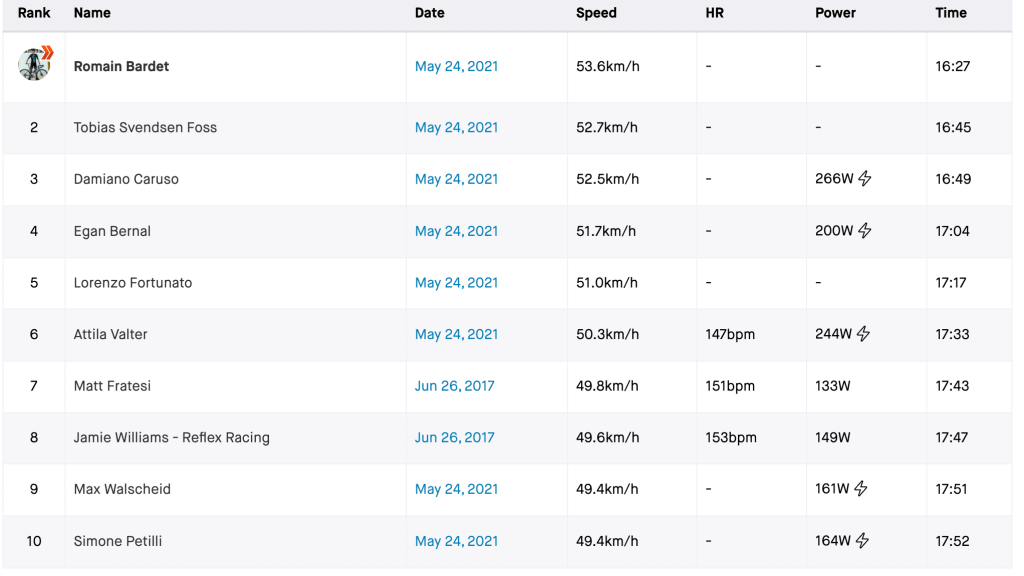
Despite the poor conditions, Bernal set a new climbing record of Passo Giau, beating the previous record by 49 seconds.

Passo Giau climbing times and w/kg calculations by Naichaca

The previous record was set by multiple riders in the 2016 Giro d’Italia stage 14. It is important to mention that after Passo Giau, they needed to do Passo Valparola (12.2 km, 5.8%). The stage was won by Esteban Chaves where he beat in the sprint Steven Kruijswijk and George Preidler, the latter of which was handed a four-year ban later in 2019 after it was discovered the Austrian was involved in the Operation Aderlass doping scandal.

Steven Kruijswijk (Netherlands / Team LottoNL – Jumbo) pictured during stage 14 of the 99th Giro d’Italia 2016 from Alpago to Corvara 210 km – foto Miwa IIjima/Cor Vos © 2016

Bernal did not need to risk everything on the wet and technical descent into Cortina d’Ampezzo as he had a 45-second gap over the next closest rider, Damiano Caruso at the top of Passo Giau.

Bernal descending after Passo Giau

Romain Bardet took the KOM title of the Passo Giau descent, gaining 37 seconds on Bernal but it is likely that the Basque Gorka Izagirre went even faster than Bardet. Bardet’s superb descent meant he only lost 27 seconds to Bernal on the stage, finishing second together with Damiano Caruso. 

Passo Giau descent Strava segment

Bernal also gave a few seconds back to the chase group in the last kilometre as he took off his rain jacket to show the pink jersey to the photographers at the finish line.

Bernal taking off his jacket before the finish

Bernal peak performances

Compared to other Bernal peak climbing and Giro d’Italia 2021 performances, his Passo Giau effort does not seem that impressive, but that is because of the high altitude, where it is harder to produce high w/kg due to the lower amount of oxygen, as well as the difficulty of the stage before the climb. That is the main reason why also his Col d’Iseran performance, which guaranteed Bernal the Tour de France 2019 GC victory, is not on this graph. The most impressive Giro d’Italia 2021 performance by pure w/kg and time duration was on Monte Zoncolan Sutrio, where Bernal dropped every GC rival, producing 6.09 w/kg for 40:02.

Lanterne Rouge x Cycling Graphs – peak and Giro d’Italia 2021 performances by Bernal

It is hard to compare altitude performances, but here are Bernal’s best ones:

  • Passo Giau 5.91 w/kg for 32:45 (start 1303m -> top 2225m) Giro d’Italia stage 16 2021
  • Vallter 2000 5.78 w/kg for 33:10 (1264m -> 2145m) Volta a Catalunya stage 3 2019
  • Col d’Iseran 5.77 w/kg for 35:50 (1804m -> 2758m) Tour de France stage 19 2019
  • Alto de las Palmas 5.59 w/kg for 39:21 (1479m -> 2519m) Tour of Colombia stage 6 2019
Lanterne Rouge x Cycling Graphs – peak, altitude and Giro d’Italia 2021 performances by Bernal

If we divide the starting point and top of the climbs then Col d’Iseran’s performance seems outstanding. The higher the climb goes, the harder it is to produce big power, particularly above 2500m. 

Average altitude of climbs:

  • Col d’Iseran 2281 m
  • Alto de las Palmas 1999 m
  • Passo Giau 1764 m
  • Vallter 2000 1704.5 m

For this reason, in our view, Col d’Iseran is Bernal’s most impressive high altitude performance ever, but Passo Giau is close considering its miserable conditions compared to the summer jersey weather at the Tour in 2019.

Egan Arley Bernal Gomez (Columbia / Team INEOS) pictured during the 106th Tour de France (2.UWT) – stage 19 from Saint-Jean-de-Maurienne to Tignes (126.5KM) – Photo: Peter de Voecht/PN/Cor Vos © 2019

Make sure to check out the full analysis video of the stage from LR down below, and let us know which moment from the past in the Giro d’Italia, Tirreno-Adriatico, Lombardia, Strade Bianche or Milano-Sanremo you would like analysed in the future.

Evenepoel Buries Roglič GC Hopes | Itzulia Basque Country Stage 5

It was a hard day for GC riders in Itzulia Basque County stage 5. Remco Evenepoel showed some great legs and attacked from the peloton at the end of the Karabieta climb, forming a group containing all the major GC contenders except race leader Primož Roglič as well as Adam Yates. Evenepoel in the end lost in the uphill finish to Dani Martinez, but the Belgian became the new race leader after Vlasov was crashed by Jonas Vingegaard. The stage was won from the breakaway by 21-year-old Carlos Rodriguez who drafted for many kilometres behind Marc Soler and dropped the UAE-Emirates rider on the last categorized climb, taking his first pro victory.

Itzulia Basque Country stage 5 2022 profile by La Flamme Rouge

It was a perfect chance for the breakaway to get a win as Jumbo-Visma did not look capable of controlling attacks. After numerous attempts to form a break, with 100 km to go a strong 7-man breakaway formed. The biggest GC threats were Pello Bilbao (6th in GC, +0:19 to Roglič) and Marc Soler (14th, +1:08). They were in the group with Carlos Rodriguez, Kenny Elissonde, Lucas Hamilton, Sergio Samitier and Sepp Kuss. It was strange to see Kuss in the group as Jumbo-Visma were chasing the dangerous breakaway to not let the gap grow too big. 

Later Bilbao dropped out of the group because with him in it nobody would let the breakaway win and the other riders in the breakaway probably convinced him to drop out voluntarily. The tempo was hard and with 59 km to go, only Soler and Rodriguez remained in the group. Unfortunately, Lucas Hamilton needed to abandon as he crashed on a descent and went over a barrier into a ravine.  

Carlos Rodriguez (ESP – INEOS Grenadiers) – Marc Soler (ESP – UAE Team Emirates) pictured during 61st Itzulia Basque Country (2.UWT) stage 5 between Zamudio and Mallabia (163.8KM) – Photo: Luis Angel Gomez/SCA/Cor Vos © 2022

Soler and Rodriguez took over a 4 minute gap on a tired peloton. Rodriguez already had lost more than 6 minutes in GC before the stage and was riding solely for the stage win, while Soler was still high in GC with only 68 seconds back to Roglič. This meant that Soler needed to be at the front the whole time, while Rodriguez was drafting behind the frustrated UAE-Emirates rider. 

Teams outside of Jumbo-Visma and Quickstep began to chase in the peloton as they were lacking the fire power to bring the duo back or close the gap at all. Bahrain-Victorious and Bora-Hansgrohe sent their domestiques to the front, with Herman Pernsteiner and Emanuel Buchmann working for their team leaders Pello Bilbao (6th in GC) and Aleksandr Vlasov (4th). 

Everybody was waiting for the GC action on this stage on the Karabieta and Remco Evenepoel delivered it. The Belgian attacked on the false flat section in the end of the climb and only the strongest GC riders could follow him. At first glance, nobody wanted to work after Remco ended his pull, as everybody’s legs were probably cooked at that moment. Ion Izagirre from Cofidis did a turn and that encouraged others to work together. The biggest riders to miss the move were the race leader Primož Roglič and Adam Yates, but they at least had teammates in the first group, Jonas Vingegaard and Dani Martinez. It was not clear if Roglič was feeling bad or if he could follow the attack but chose not to due to some tactical plan.

Evenepoel attacks and forms a strong GC group

Meanwhile, Rodriguez was still drafting behind Soler, who was riding full-gas. It was clear that the INEOS rider at some point needed to help Soler or attack him if he had good legs. Rodriguez attacked at the top of the climb with 14 km to go. It was not the best time as there was a high chance he would get caught and Martinez would have needed a domestique in the GC favourites group behind them, but Rodriguez decided to go for the stage victory.

Carlos Rodriguez attack Marc Soler

The big group with Roglič and Yates behind was not going to catch anyone as only Groupama-FDJ were chasing with Sebastian Reichenbach who as we saw in the Finestre stage of the Giro d’Italia 2018, is not the man to bring back a move in a hurry. All riders behind the Swiss had teammates in the front group riders and were not willing to help for obvious reasons. The gap grew to over a minute to Evenepoel’s group despite only he, Izagirre and Vlasov consistently working, with Martinez and Vingegaard sitting in.

Reichenbach chasing alone

Rodriguez in the end, finished first a handful of seconds ahead of the GC group behind, taking his first ever pro victory at age 21. It was a matter of time as he already showed great potential in the early 2022 season races, finishing 3rd in Valenciana GC and 4th in Vuelta a Andalucia.

Rodriguez fighting up the steep gradient

The last 500 metres were extremely steep and the wet asphalt did not make life easier for riders as Vlasov and Vingegaard crashed with 25 metres to go and finished, walking up the last metres. Vingegaard lost control of the bike and pushed Vlasov in the barriers.

Martinez finished first from the GC group, beating Evenepoel by 2 seconds, but that was not enough and the Belgian became the new race leader. It was an impressive performance by Evenepoel as he worked the most and hardest in the group, which was formed after his attack. Without the Vlasov crash, Martinez would likely have taken the GC lead with Evenepoel missing out on additional bonus seconds.

The biggest losers of the day were Jumbo-Visma and Primož Roglič. After the finish, the Slovenian in a short interview said that the stage went at the way he wanted. That makes little sense, as after today’s stage Roglič lost more than a minute to other GC contenders, and on the last steep 500m hill he lost quite a bit of time to ultra-mythical climbers Felix Gall and Fernando Barcelo.

Roglič before the stage admitted in an interview his legs were not in top shape and stage 5 probably proved that he was not lying about that. Regardless, Jumbo-Visma’s plan to ‘give away’ the leader’s jersey before the final stage, like they did last year, appears to have backfired, with their best place rider Jonas Vingegaard sitting 6th in GC, behind Evenepoel by 29 seconds and Martinez by 27.

It will be very hard for Evenepoel to defend the race lead as Quick-Step does not have a strong supporting cast and he might be isolated early. Martinez has looked great and INEOS with Rodriguez, Tullett, Thomas, Hart, Yates and Fraile can do a lot of damage. INEOS might be interested in controlling the stage as Martinez is only 2 seconds back to Evenepoel and Martinez will be favoured to drop the Belgian on the steep sub 15 minute climb finish at the end of a very hard day. For Evenepoel to defend his GC lead he will need to produce his career-best numbers on the Krabellin and Arrate climbs. 

Lanterne Rouge x Cycling Graphs – Remco Evenpoel best performances

The last stage of the Basque race as usual, will finish up the mighty Arrate climb (4.4km, 8.90%). Before that there will be many hard climbs. Last year everything the race was turned on its head before the steep Krabelin climb (4.9km, 9.78%), when UAE-Emirates were not ready for a descent attack from the Astana daredevils and lost the race. Roglič won the GC, while Gaudu took the stage with Pogacar left frustrated behind.  

Itzulia Basque Country stage 6 2022 profile by La Flamme Rouge

Van der Poel’s Best Ever Ronde van Vlaanderen | Power Analysis

No one thought at the start of March that Mathieu van der Poel would have made this impressive a come back in Milano-Sanremo and the Tour of Flanders, considering his back problem and missed training kilometres in the winter. However in a perverse way, the enforced rest, during his usual cyclocross schedule, probably made his incredible victory at Flanders possible. The Dutchman was the only one able to stay with Tour de France champion Tadej Pogačar on the short Flandrian climbs and then produced his typical 15s power to win the final sprint. Let’s look at van der Poel’s and other riders’ power from the big race.

Campenaerts pushes 10.1 w/kg for 1 minute

Nothing special happened in the race for van der Poel until the last 60 kilometres as he did not attack (nor did any other big favourites) and patiently saved his legs in the peloton. From 140 km to 56 km to go in the hilly section he averaged 309 watts (4.12 w/kg) with normalized power being close to 5 w/kg. 

Van der Poel strava data from 140 km to 56 km to go

Though van der Poel did not attack, he produced the best 1-minute power in the race on the Berg ten Houte climb when Victor Campenaerts and Matteo Trentin from the panicking UAE-Emirates made an acceleration. Van der Poel produced 727 watts for 1 minute on the 0.4 km, 8.9% section. Campenaerts who attacked did a huge 700 watts, which is 10.1 w/kg but the attack did not really yield any benefits for the Belgian.

Pogačar attacks on the Kwaremont

The race changed when Pogačar attacked on the second Oude Kwaremont. His attack was devastating and the whole top 10 in Strava in the Oude Kwaremont segment (2.79 km, 3.5%) was from Ronde van Vlaanderen 2022. That does not include Pogačar, as he did not upload his ride, but he would certainly take the KOM of the legendary climb, when he bridged to the front group. Van der Poel did 499 watts for 5:05 on the Oude Kwaremont, trying to follow Pogačar. Van der Poel was put under big pressure as his heart rate peaked at 187 bpm which is the heart rate range we saw at the end of his 15 minute tests back in Alicante in February in our earlier article.

Oude Kwaremont Strava segment

After that immediately followed the steep but short Paterberg (0.35 km, 11.7%). Jan Tratnik made a hard acceleration on the climb, doing 651 watts (9.57 w/kg) for 66 seconds and created a selective group with a dozen riders and dropped every Quick-Step rider. He did not take the KOM of Paterberg as many people go KOM hunting there. The Strava segment record belongs to 20-year-old Belgian Jens Vanden Heede, who did the famous climb in 44 seconds, producing an insane 869 watts (12,41 w/kg).

Tratnik during 106th Ronde van Vlaanderen – Tour des Flandres 2022 (1.UWT) a one day race from Antwerp to Oudenaarde (272.5KM) – Photo: Tim van Wichelen/Cor Vos © 2022

Pogačar makes a move on the Koppenberg

The race was decided on the Koppenberg (1.62 km, 3.9%), which followed after the second tiring Oude Kwaremont. Pogačar attacked on the Koppenberg and only Madouas and van der Poel could follow the Slovenian. Van der Poel did 514 watts (6.85 w/kg) for 3:18, while Madouas who is a few kilograms lighter, did 484 watts (6.78 w/kg) with the same time. To keep up with Pogačar on the toughest part of Koppenberg (0.49 km, 12.6%) van der Poel did 620 watts for 1:42, already after very tough climbs before the Koppenberg. 

Tadej Pogacar (Slovenia / UAE-Team Emirates) – Mathieu Van Der Poel (Netherlands / Team Alpecin Fenix) pictured during 106th Ronde van Vlaanderen – Tour des Flandres 2022 (1.UWT) a one day race from Antwerp to Oudenaarde (272.5KM) – Photo: Dion Kerckhoffs/Cor Vos © 2022

After the Koppenberg Pogačar, Madouas, van der Poel worked together and caught Dylan van Baarle and Fred Wright, who were at the front. They stuck together for some time until the last Oude Kwaremont x Paterberg combination with Madouas, Wright and Van Baarle all happy to collaborate with the big favourites.

Van der Poel climbing data from 60 km to go until the finish:

  • Oude Kwaremont 1: 499 w for 5:05
  • Paterberg 1: 679 w for 1:08
  • Koppenberg: 620 w for 1:42
  • Steenbeekdries: 495 w for 1:24
  • Taaienberg: 564 w for 1:30
  • Oude Kruisberg: 470 w for 3:06
  • Oude Kwaremont 2: 475 w for 5:20
  • Paterberg 2: 649 w for 1:10
Lanterne Rouge x Cycling Graphs – van der Poel’s climbing power

Pogačar did not accelerate on the last Oude Kwaremont, but dropped everyone except van der Poel. Madouas lost to van der Poel 22 seconds on the climb, producing 427 watts (5,98 w/kg) for 5:42, while van der Poel survived the Pogačar steady tempo and pushed 475 watts (6,33 w/kg) for 5:20. The hardest part was done at 545 watts for 3 minutes. Then was left only the Paterberg, which was done at a consistent pace 649 watts for 70 seconds. Both climbs were done slower than when Pogacar had initially attacked with around 50 kilometres to go, as shown below.

The first Oude Kwaremont x Paterberg duo was done at a faster pace:

Van der Poel’s Oude Kwaremont and Paterberg data compared

The sprint

Then was only left a 12 kilometre flat section until the finish. Pogačar and van der Poel worked together, exchanging turns and both seemingly happy to go to a sprint. The Dutchman did 330 watts for 16 minutes after the last Paterberg until the sprint with his average heart rate at 160 bpm.

In the final straight, where both riders began to cat and mouse, the speed dropped below 29 km/h, while Van der Poel’s heart rate dropped from 159 to 145 bpm in 40 seconds. The start speed of the sprint was 33.5 km/h as the duo were closed down by Madouas and van Baarle and at that moment MVDP produced 1406 w peak power and 1127 w for 15 seconds, which was enough to win in a convincing fashion against the group.

Mathieu Van Der Poel (Netherlands / Team Alpecin Fenix) – Dylan Van Baarle (Netherlands / Team INEOS Grenadiers) pictured during 106th Ronde van Vlaanderen – Tour des Flandres 2022 (1.UWT) a one day race from Antwerp to Oudenaarde (272.5KM) – Photo: Dion Kerckhoffs/Cor Vos © 2022

Van der Poel’s coach Kristof de Kegel published in his Instagram story a table, which shows van der Poel’s sprint data in Ronde van Vlaanderen from 2019 to 2022. Compared to 2021, where he lost to Kasper Asgreen in the final showdown, van der Poel’s performance was more impressive in 2022. In 2021, he started at a higher speed and sprinted only for 10 seconds (1470 w peak power and 1261 w for 10 seconds) and surrendered early to Asgreen. In 2022 van der Poel achieved similar values, but sprinted for a longer period of time (1406 w peak power and 1127 w for 15 seconds). As you can also see in the table below, the starting speeds in both of MVDP’s successful sprints (against Wout van Aert in 2020 and Pogacar in 2022) were much lower than in 2021, with MVDP preferring to take advantage of his world class acceleration.

Van der Poel’s sprint data from Ronde van Vlaanderen

Overall, the race in 2022 compared to 2021 was harder:

  • 2021 (254.3 km): avg 274 w for 5:58h, avg 139 bpm
  • 2022 (272.5 km): avg 293 w for 6:16h, avg 143 bpm

The hilly section until the finish

  • 2021 (134.3 km): avg 330 w for 3:08h, avg 158 bpm
  • 2022 (138.3 km): avg 333 w for 3:17h, avg 156 bpm

If we compare 2021 and 2022 peak power and normalized power, then it is clear that van der Poel’s performance in 2022 was more impressive. Only 5-second peak power is better in 2021, while his 2022 performance dominates in all other time periods. Whether Alpecin-Fenix opt to repeat MVDP’s preparation in 2023 remains to be seen, but it certainly worked last weekend. Perhaps even the Dutchman can reach a higher level in Paris-Roubaix in just over a week, before he returns to training to prepare for the Giro d’Italia.

Below are three graphs with power from strava:

Lanterne Rouge x Cycling Graphs – van der Poel’s 5 second to 2 minute power in RVV 2021 vs 2022
Lanterne Rouge x Cycling Graphs – van der Poel’s 5 to 180 minute power in RVV 2021 vs 2022
Lanterne Rouge x Cycling Graphs – van der Poel’s 5 to 180 minute normalized power in RVV 2021 vs 2022

Van Der Poel Smashes Pogačar | Ronde van Vlaanderen 2022

Ronde van Vlaanderen 2022 did not disappoint despite the absence of Belgian champion Wout van Aert. Tadej Pogačar is not a regular Tour de France champion, who just targets one big race a year, with the Slovenian showing his punch on the short Belgian cobble climbs, creating multiple splits throughout the day. Only Mathieu van der Poel could hold his wheel in the finale as the race ended with a sprint from a standing position between the Dutchman and Slovenian. As Van der Poel and the Slovene finessed, Maduoas and van Baarle returned from behind, boxing in Pogačar in the last 200 metres, whilst van der Poel opened up a huge sprint to win his second Ronde van Vlaanderen. The frustrated Pogačar only finished 4th as he was surpassed by Dylan van Baarle and Valentin Madouas who took podium honours.

Ronde van Vlaanderen 2022 profile by La Flamme Rouge

Sadly, Wout van Aert due to Covid infection, missed the race after he won Omloop and E3 earlier this season. Gent-Wevelgem winner Biniam Girmay and world champion Julian Alaphilippe also skipped Flanders with the former returning to Eritrea and the latter preparing for his Ardennes campaign.

The race opened with 100 km to go as Jumbo-Visma used one of their domestiques, Nathan van Hooydonck, and sent him in an early attack from the peloton. No one reacted to this move and he caught Jonas Koch, the Bora-Hansgrohe rider who attacked a few kilometres previously, and worked together, putting pressure on other favourite teams in the peloton.

Nathan Van Hooydonck (Belgium / Team Jumbo-Visma) pictured during 106th Ronde van Vlaanderen – Tour des Flandres 2022 (1.UWT) a one day race from Antwerp to Oudenaarde (272.5KM) – Photo: Dion Kerckhoffs/Cor Vos © 2022

With 91 km to go Ivan Garcia Cortina from Movistar launched an attack on a climb and created a dangerous 11 rider group, which included one of the big pre-race favourites, Mads Pedersen as well as Ben Turner, Alberto Bettiol, Zdenek Štybar and more. Almost all of the big teams were represented except TotalEnergies and the UAE-Emirates who missed the move and were forced to chase for Tadej Pogačar and Anthony Turgis. Later Bahrain-Victorious joined chasing for Matej Mohorič and AG2R Citroën for Oliver Naesen and Greg van Avermaet.

The situation looked dangerous for Pogačar as the 13 rider group (they caught Koch and van Hooydonck) was strong and there were multiple teammates, willing to work hard such as Kirsch for Pedersen. Eventually, Quick-Step riders Steimle and Štybar, who were both in the small group, stopped pulling as their team leader Kasper Asgreen was back in the peloton with van der Poel and Pogačar, who looked stressed in his Ronde van Vlaanderen debut and even attempted to close the gap himself after it had grown to over one minute.

Bettiol Alberto (ITA) of EF Education-EasyPost and Pedersen Mads (DEN) of Trek – Segafredo pictured during 106th Ronde van Vlaanderen – Tour des Flandres 2022 (1.UWT) a one day race from Antwerp to Oudenaarde (272.5KM) – Photo: /Vincent Kalut/PN/Cor Vos © 2022

Crashes are inevitable in the Belgian classics and two of the race favourites Christophe Laporte and Anthony Turgis were involved in a big crash at the back of the peloton prior to the second ascent of the Kwaremont, a crucial point of the race where riders do not want to be spending extra energy chasing.

With Quickstep no longer cooperating in the Pedersen group, Tim Wellens, Kevin Geniets and Connor Swift proved that it is possible to bridge the gap from the peloton in a short period of time. However the race was turned upside down when the peloton reached the mighty Oude Kwaremont climb where Pogačar went full-gas despite starting from a bad position, catching both the front group and the early breakaway of the day. Pogačar continued to pull hard on the front and completely thinned down the group on the climb. Only a few riders like van der Poel could stay on his wheel whilst Benoot and Laporte were dropped. 

After Kwaremont there was another steep cobble climb, Paterberg, where Jan Tratnik accelerated and dropped like four Quick-Step riders. On the flat section the Wolfpack needed to work hard to pull back a dozen rider big group with Pogačar, Pidcock and van der Poel in it. Quick-Step pulled everyone back except Fred Wright and Dylan van Baarle, who had previously attacked. Despite Tratnik dropping every Quick-Step rider on Paterberg, the Belgian team continued to pace and waste energy.

Tour des Flandres 2022 (1.UWT) a one day race from Antwerp to Oudenaarde (272.5KM) – Photo: Tim van Wichelen/Cor Vos © 2022

The next climb proved that it was not going to be Quick-Step’s day and there must be some concern with Patrick Lefevere with his team’s sub-par performance in all of the Spring classics. It was again Pogačar’s show on Koppenberg (0.6 km, 9.7%), as the Slovenian looked head and shoulders above everyone on climbs, distancing the entire field except van der Poel and Valentin Madouas who were able to cling on. Asgreen did not look good on the climb and later had his race finished by a mechanical at the end of the Koppenberg.

Tadej Pogacar (Slovenia / UAE-Team Emirates) – Mathieu Van Der Poel (Netherlands / Team Alpecin Fenix) pictured during 106th Ronde van Vlaanderen – Tour des Flandres 2022 (1.UWT) a one day race from Antwerp to Oudenaarde (272.5KM) – Photo: Dion Kerckhoffs/Cor Vos © 2022

Van Baarle and Wright where still at the front with a few second lead. Pogačar, van der Poel and Madouas caught them, creating a strong five man group. It was game-over for everyone else behind them as they quickly took a 63 second lead with 29 kilometres to go. The question now was if someone could hold on to Pogačar’s wheel when he goes full-gas up the last Oude Kwaremont x Paterberg combination.

Oudenaarde – Belgium – cycling – Tadej Pogacar (Slovenia / UAE-Team Emirates) pictured during 106th Ronde van Vlaanderen – Tour des Flandres 2022 (1.UWT) a one day race from Antwerp to Oudenaarde (272.5KM) – Photo: Dion Kerckhoffs/Cor Vos © 2022

Everyone willingly collaborated with Pogačar, ignoring his dominant performances in Strade Bianche and Tirreno-Adriatico, despite van Baarle having Pidcock in the group behind. Eventually Wright skipped some turns as they closed in on the Oude Kwaremont and Paterberg. 

Surprisingly, Pogačar decided on the Kwaremont to pace steadily, but hard with no huge acceleration. Usually it is easier to drop someone with an uneven tempo or an acceleration, but Pogačar chose Annemiek van Vleuten’s strategy in Strade Bianche 2022, where she paced steadily on the hard finish climb with Lotte Kopecky holding on her wheel and later beating her in the last hundred metres. Only van der Poel could hold Pogačar’s wheel with van Baarle dropping immediately on the Kwaremont and Madouas the last to be distanced.

The Slovenian had another chance to drop the Dutchman on the last climb of the day, the Paterberg, with van der Poel surprisingly willing to work together with Pogačar before the climb. It was a perfect situation for the Tour de France champion but again on the Paterberg he chose to ride up with a constant pace. Van der Poel struggled hard and did not even pick the right gear as he was grinding with an extremely low cadence, but luckily Pogačar was not strong enough to ride away from the Dutchman.

Pogačar trying to distance van der Poel on Paterberg

After the climb there was left a 12 kilometre flat section with both van der Poel and Pogačar working hard together as they had a 30 second lead over Madous and van Baarle. In the last kilometre they both stopped completely as van der Poel refused to provide a lead-out for Pogačar and they began to track stand. It was going to be a sprint from a standing position like in the 2020 Ronde van Vlaanderen, were van Aert lost to van der Poel, who suits this kind of sprint low-speed sprint. The two favourites played cat and mouse so much that Madouas from the back caught them with van Baarle in his wheel, but when van der Poel opened his devastating sprint with 225 metres to go, no one had a chance. The Dutchman won Ronde van Vlaanderen for the second time in his career. 

Mathieu Van Der Poel (Netherlands / Team Alpecin Fenix) – Dylan Van Baarle (Netherlands / Team INEOS Grenadiers) pictured during 106th Ronde van Vlaanderen – Tour des Flandres 2022 (1.UWT) a one day race from Antwerp to Oudenaarde (272.5KM) – Photo: Dion Kerckhoffs/Cor Vos © 2022

Pogačar got boxed-in and finished only 4th. A terrible end for the Slovenian who was perhaps the strongest overall rider in the race. There were not an easy option for him in the end, as he would have preferred MVDP to provide a higher pace leadout for the sprint, but van der Poel held his nerve.

Van Baarle finished 2nd. Another silver medal in a big race for the INEOS Grendiers rider who finished 2nd also in 2021 World Championships in Flanders. Groupama-FDJ puncheur Valentin Madouas was 3rd, after showing great results in E3 (7th) and Dwars door Vlaanderen (11th) earlier in 2022. It was a marvelous race for FDJ as Stefan Kung finished 5th.

Van der Poel’s Monster Power Numbers In Dwars Door Vlaanderen

Mathieu van der Poel won the hard and hilly Dwars Door Vlaanderen race on Wednesday, showing great shape in advance of his bid for the Ronde van Vlaanderen this weekend. The Dutch superstar since his return from a back injury has uploaded every ride on Strava and is basically the only superstar rider who shares his power and heart rate data publicly in 2022. Let’s dissect Van der Poel’s powerful win.

Berg ten Houte split

The race was decided on the Berg ten Houte climb, where INEOS duo Ben Turner and Tom Pidcock lit up the climb and only the strongest of the peloton could follow their move. Van der Poel needed to put out 490 watts for 4:05 but the hardest part was the first minute of the effort, where Dutchman pushed 721 watts (9.61 w/kg) for 60 seconds. Considering that Van der Poel drafted in their wheels, while Pidcock and Turner did the work in front, the British riders’ numbers must be outrageous. 10 w/kg for 60 seconds is decent power even with fresh legs, but this was done after two and a half hours hard racing. No wonder why only six riders from the peloton made the split.

Chaotic last 10 minutes

The most impressive part of van der Poel’s performance occurred in the last 10 minutes of the race. The Dutchman had to close multiple attacks from Stefan Küng, Victor Campenaerts and Tiesj Benoot, which show up as 600-750 watts spikes for ~30 seconds. He averaged 439 watts (5.85 w/kg) during this 10 minute period, with his normalised power over 6w/kg, after he was racing for almost 4 hours.

Last 10 minutes of the race – Van der Poel’s strava data

Van der Poel follows Benoot and wins the race

With 1.7 km to go, van der Poel bridged to Tiesj Benoot’s attack without an acceleration. He just needed to do 500-600 watts to close the gap to Jumbo-Visma rider, while no one reacted in the group behind. Van der Poel averaged 501 watts (6.68 w/kg) for 2:04 in the winning move, where he worked together with Benoot, who could not do anything against van der Poel in the final sprint. During the sprint, Alpecin-Fenix superstar hit 1388 watts of maximum power, averaging 1188 watts for 10 seconds. Impressive power, considering how hard the last 3 hours of the race was as well as the preceding 10 minutes. 

Van der Poel’s strava data after following Benoot’s attack

Full race data

In the 4 hour-long Dwars Door Vlaanderen van der Poel spent 4617 kilojoules. That is 1128 kj per hour or 15.04 kj/h/kg. His average power was 313 watts (4,17 w/kg) and average heart rate 147 bpm. According to Strava sauce, he burned 26 tacos, 149 cups of broccoli, or 29 beers.

Van der Poel’s strava data from Dwars door Vlaanderen

The hilly section

If the easy and flatter early section of the race is removed then the numbers are even more ludicrous. During the last 2:41 hours the average speed on a hilly course with 3-5 minute climbs was 45.5 km/h. No wonder that van der Poel averaged 351 watts (4.68 w/kg) during this time but with a much higher normalised power of 404 watts, given the up and down nature of the efforts. His heart rate regularly hit over 185bpm with short sections of recovery on the downhills. During this period he spent 1265 kj per hour or 16.87 kj/kg/h, which is an extremely high calorie burn rate.

Van der Poel’s strava data from Dwars door Vlaanderen

Dwars Door Vlaanderen is 4 hours long, while monuments Ronde van Vlaanderen or Paris-Roubaix are usually over 6 hours. The two hour difference is extremely important, as not all riders can perform at the same level after the additional fatigue. In the case of Van der Poel, he lost his two most important sprints in 2021, in Ronde van Vlaanderen to Kasper Asgreen and in Paris-Roubaix to both Sonny Colbrelli and Florian Vermeersch. In Milano-Sanremo, where there is less fatigue in the first 4 hours compared to other monuments, MVDP produced a similar sprint to Dwars door Vlaanderen, with 1358 watts peak and 1206 watts for 10 seconds. In Ronde van Vlaanderen 2021, MVDP produced a better peak, at 1470 watts, as well as a comparable 1160 watts for 10 seconds, however he faded very quickly after 10 seconds and could not maintain his sprint from the 200 metre mark where he launched.

Van der Poel is Back | Dwars door Vlaanderen

The Dutch superstar Mathieu van der Poel warmed up for Ronde van Vlaanderen with the hard and hilly Dwars door Vlaanderen. Van der Poel made the first group after INEOS blew up the peloton and in the last part of the race closed down many attacks. The Alpecin-Fenix superstar followed Tiesj Benoot’s late acceleration and convincingly beat Jumbo-Visma rider in the final sprint, winning Dwars door Vlaanderen for the second time after 2019.

Dwars door Vlaanderen 2022 profile by La Flamme Rouge

Some of the biggest names like Wout van Aert, Kasper Asgreen, Matej Mohorič and Christophe Laporte did not attend Dwars door Vlaanderen, which is a UCI World-Tour race, but the field was stacked with classics stars nonetheless.

The biggest move in the peloton was with 69 km to go when INEOS neo-pro Ben Turner went full-gas on the Berg Ten Hout climb (1.1 km, 5.6%). His teammate Thomas Pidcock helped with pacing and the peloton was in shambles. Only the strongest riders could follow this devastating attack set by the talented INEOS duo. Tadej Pogačar missed the split as he was in a terrible position before the climb, so deep in the bowels of the peloton that he had no chance following this move. 

Ben Turner and Thomas Pidcock goes full-gas on a climb

The riders who got away were Mathieu van der Poel, Tiesj Benoot, Stefan Küng, Victor Campenaerts, Tom Pidcock and Ben Turner. They later caught the breakaway, from which Nils Politt and Kelland O’Brien were strong enough to stay with the favorites for many kilometres.

Dwars door Vlaanderen – A travers la Flandre 2022 (1.Pro) a one day race between Waregem and Waregem( 120KM – Photo: Dion Kerckhoffs/Cor Vos © 2022

The big losers also were Trek-Segafredo and AG2R Citroën as all of their riders missed the move. Quick-Step Alpha Vinyl is having a terrible classics season and it was not a surprise seeing no one from the Wolfpack in the leading group. It was game over for everyone in the peloton, with Pogačar trying multiple times to chase the group but unable to bridge across solo. Finally, he was showing some signs that he is a human. Does this mean Pogačar is in bad shape and will not show anything in Ronde van Vlaanderen? No, if he were in a better position, he had the legs to make it the first group. Pogačar also before Il Lombardia 2021 did not perform well at races like Milano-Torino, but at his target race he was a different rider and no one could challenge him.

Tadej Pogacar (Slovenia / UAE-Team Emirates) pictured during Dwars door Vlaanderen – A travers la Flandre 2022 (1.Pro) a one day race between Waregem and Waregem( 120KM – Photo: Tim van Wichelen/Cor Vos © 2022

It was an 8-man group at the front. It was clear that Küng, Benoot and Campenaerts must attack as they did not have a finishing kick to compete against van der Poel and Pidcock, who had teammate Turner with him. Politt and O’Brien were in the breakaway and their legs were not as fresh as the others to do attempt some attacks.

Van der Poel was not feeling comfortable and tested everyone on a cobble climb with 22 km to go, but nothing changed. On a descent later on Campenaerts attacked. Campenaerts mentioned after the race that he was riding a 58T chainring at the front, while Pidcock, who was behind him, was with only a 53T chainring. Campenaerts spinned his legs as fast as he could, and his genius masterplan worked as he got a small gap over the peloton. But the problem for Victor was that Pidcock had up his sleeve his teammate Turner, who worked very hard to bring back the Belgian. Pidcock, Benoot and van der Poel helped too, and Campenaerts move was caught with 18 km to go. After the race van der Poel said that during a training camp Campenaerts had tested the type of attack with him, with the Dutchman, who was helpless against Campenaerts’ attacks. Dwars door Vlaanderen was Lotto-Soudal rider’s target race. He was riding with very narrow handlebars and had reconed the course 5 times before the race as he is living very close to the course.

Campenaerts descent attack

It was calm before the storm as multiple riders without a fast sprint needed to gamble to win. Küng attacked on a climb with 8.5 km to go, but van der Poel did not let the big Swissman go away. On a descent, Campenaerts again launched his special move. Riders in the peloton were struggling as everyone looked at van der Poel, who pulled a lot. After he ended his turn, Benoot used the perfect moment and launched his attack. Everyone was waiting for someone to close Jumbo-Visma rider’s attack, but no one was willing to do it and Van der Poel had no choice but to burn multiple matches again and chase down everyone, which he successfully did.

Dwars door Vlaanderen – A travers la Flandre 2022 (1.Pro) a one day race between Waregem and Waregem( 120KM – Photo: Dion Kerckhoffs/Cor Vos © 2022

With 3 km to go Campenaerts again attacked as he had almost zero chance of winning a sprint. Benoot followed him, but they were caught by Pidcock. The INEOS rider put pressure on the group, but it did not work and after his attempt failed, Benoot tried again with 1.8 km to go, and this time it worked. Van der Poel quickly bridged him, and back in the group the riders looked for too long and the gap was too big to close it down.

Waregem – Belgie – cycling – Tiesj Benoot (Belgium / Team Jumbo-Visma) applauds for so much power as Mathieu Van Der Poel (Netherlands / Team Alpecin Fenix) crosses the finish line victorious pictured during Dwars door Vlaanderen – A travers la Flandre 2022 (1.Pro) a one day race between Waregem and Waregem( 120KM – Photo: Davy Rietbergen/Cor Vos © 2022

Surprisingly, Benoot worked with van der Poel. The Dutchman started his sprint with 250 metres to go. Benoot, even sitting on his wheel during the sprint, was not able to do anything as van der Poel won his first World-Tour race in 2022. Pidcock won the bunch sprint and finished 3rd. Campenaerts, who was very active, ended 4th, getting 175 UCI points, which Lotto-Soudal badly needs as they are in the relegation zone.

Girmay Saves Intermarché, Cofidis Rise to Safety & Israel Plummet | Relegation Battle

With a heavy concentration of top category races, the last two weeks have been key for teams in the fight to avoid WorldTour relegation. As custodians of this invaluable fortnightly ranking, it was incredible to see UCI points darling Biniam Girmay graduate from top 10 results in .Pro one day races like Laigueglia, to 5th at E3 Saxo-Classic and then a stunning victory at Gent-Wevelgem.

For the first time this season we see a change in the relegation zone, as Cofidis have managed to overtake Israel – Premier Tech who have been unable to get out of their slump since the beginning of 2022. In case you are new to the world of the cycling relegation battle, you can see our list of previous articles explaining the system here.

The Past Two Weeks

Illness, crashes and physical problems, ever present at the start of the 2022 season, have heavily influenced the fight against relegation. On the GC side, Simon Yates (BikeExchange), Valverde (Movistar) and Woods (Israel) were unable to finish the Volta a Catalunya whilst Nairo Quintana’s consistent run of form for the last two months has been the bedrock of Arkéa’s success.

In one-day races, Lotto Soudal have been the most affected team with Caleb Ewan missing Milano-Sanremo, Brugge – De Panne and Gent – Wevelgem classics due to stomach problems. They were almost level with Cofidis in our article a fortnight ago and now sit nearly 1000 points behind. Also absent from the classics was last year’s Gent-Wevelgem runner-up Giacomo Nizzolo, who fell on the descent of the Poggio, which ruined not just his Sanremo result but also caused him to fracture a bone in his left wrist and miss several important races as Israel’s leader.

Caleb Ewan (AUS – Lotto Soudal) pictured during 57th Tirreno – Adriatico (2.UWT) – Photo: Luca Bettini/SCA/Cor Vos © 2022

Cofidis’ strong start to the year is not the only problem for Israel, as other teams at risk including Intermarché, BikeExchange, Movistar and Arkéa have increased their margin of safety to the 19th spot enormously. In fact, such a clear gap has been established between Intermarché, Arkéa and the relegation zone, that it may not be much longer that they will be included as a ‘team at risk’ in these articles.

The past two weeks have not just been disappointing for Israel-Premier Tech and Lotto Soudal but also for a first time entrant in this series, EF Education – EasyPost, who have moved from 13th to 15th in the last two weeks. The team led by Jonathan Vaughters is the worst performing WorldTeam so far this season by UCI points and their margin of safety from the relegation zone has shrunk from 2652 points at the start of the year to 1587 now.

Illness and injury have weighed heavily on them, with a broken collarbone for Magnus Cort in Tirreno and a covid infection for Alberto Bettiol causing them to miss the early classics. Whilst having their big stars out of action has certainly cost EF, it is clear that increasing their UCI points total is not a focus for their team either, with Vaughters unaware in January this year that the UCI WorldTour licence triennium ends in 2022 rather than 2021.

EF have riders who can compete for the biggest wins on the calendar like Carthy, Bissegger, Padun, Urán, Chaves, Valgren, Powless and the aforementioned Cort and Bettiol, but a characteristic of almost all of those riders is their lack of consistency in producing top results. There is no steady (but maybe boring) Enric Mas who is a lock to top 5 the Vuelta and they also lack any bunch sprinter with whom they can at least compete for results in flat one-day races. Without Powless and Valgren’s incredible results in the World Championships in 2021 (which may not be replicated) they would be at serious risk of relegation.

Neilson Powless scored 300 UCI points for EF at the 2021 World Championships Cycling – photo Davy Rietbergen/Cor Vos © 2021

Undoubtedly, the winning team of the last few days has been Intermarché, led by Eritrean Biniam Girmay with fifth at E3 and an incredible victory in Gent-Wevelgem, a race that scores at the same level as the monuments with 500 points to the winner.

Biniam Ghirmay Hailu (Eritrea / Team Intermarche – Wanty – Gobert Materiaux) – during 84th Gent-Wevelgem in Flanders Fields (1.UWT) – Photo: Dion Kerckhoffs/Cor Vos © 2022

However, the team has decided to let Girmay end his classics season to return to his family in Eritrea and prepare for the Giro d’Italia, which will be his first Grand Tour. Intermarché are now 1700 points clear of the relegation zone which reduces the pressure on them to aggressively hunt points, with sport director Steven De Neef telling Wielerflits:

“We let him race without pressure for now. It’s great what he’s doing, but we’re not going to burn him because we need UCI points. We will give Biniam every chance to prepare the way he wants to”

The engine behind Cofidis’ 1100 point fortnight was the big german Max Walscheid, who scored 525 points between Nokere Koerse, Bredene Koksijde and Brugge – De Panne.

Max Walscheid (Germany / Team Cofidis) during 46th Minerva Classic Brugge-De Panne (1.UWT) Photo: Tim Van Wichelen/Cor Vos © 2022

Unfortunately, Walscheid suffered a heavy collision while training in Germany last Thursday and will be out of action for a few weeks, in an accident where it is described that he was “lucky to survive.” Frenchman Guillaume Martin played his part in the Volta a Catalunya, scoring 100 UCI points with an eighth place overall, and Bryan Coquard took the podium at La Roue Tourangelle (1.1), adding to the team’s hot streak.

The philosopher leads the charge after Ben O’Connor on La Molina

Unsurprisingly, Arkéa continued to score consistently with their stars Nairo Quintana, Nacer Bouhanni and Hugo Hofstetter. Despite missing out on the win and looking vulnerable in the last two stages, Quintana’s fourth place in Catalunya brought almost 250 valuable points for his team. Bouhanni has earned podium places in Milano – Torino and Brugge – De Panne and victory in La Roue Tourangelle (his first since September 2020), while Hofstetter scored 210 points between Nokere Koerse and Bredene Koksijde. Arkéa are virtually safe from falling into the relegation zone this year (even though they are a ProTeam), so it will be interesting to see if they amend their race and scheduling strategies for the rest of the year.

Hugo Hofstetter (France / Team Arkea Samsic) and his dog Petrus pictured during 76th Danilith Nokere Koerse (1.Pro) – Photo: Tim van Wichelen/Cor Vos © 2022

BikeExchange had their best two week period since the start of the year, thanks to Matthews’ fourth place in Milano – Sanremo and Groenewegen’s second place in Brugge – De Panne. In the Volta a Catalunya they were prominent with the stage victories of Matthews and Groves, but from a points perspective they would probably have preferred a podium in the general classification with Simon Yates, who had to abandon the race due to sickness contracted during Paris-Nice. With Matthews able to achieve top results in the biggest one-day races and Yates a podium favourite for the Giro d’Italia, if BikeExchange continue this trajectory they should be safe this year.

Michael Matthews (AUS – Team BikeExchange – Jayco) pictured during the Volta Ciclista a Catalunya 2022 – Photo: Luis Angel Gomez/SCA/Cor Vos © 2022

DSM and Movistar have not had brilliant weeks, but they scored enough to maintain their wide gap to the relegation zone. In the case of DSM, Søren Kragh Andersen has given them peace of mind with 7th place in Sanremo and 5th place in Gent, scoring 375 points on his own. For its part, Movistar scored 395 points between García Cortina, Aranburu and Kanter in the classics, partly alleviating the potential loss of points derived from Valverde’s abandon in the Volta a Catalunya.

Soren Kragh Andersen (DEN – Team DSM) pictured during 113th Milano-Sanremo (1.UWT) Photo: Luca Bettini/SCA/Cor Vos © 2022

Israel have certainly had bad luck this season, but so have many other teams, who have been able to rely on their deeper squads to achieve some sort of results in the face of adversity. Their four leaders (Woods, Fuglsang, Nizzolo and Vanmarcke) have all been suffering from illness and injuries rendering them unable to compete at their big targets. The team has adopted a strategy of paying top dollar for older riders in the past few years, rarely spending big on young stars who can pick up the slack if things go wrong for the top riders (as Biniam Girmay has done for Intermarché whilst Kristoff has been slow in the classics). With the exception of Clarke, they have been very disappointing. If Woods and Fuglsang are not able to perform in the Ardennes Classics, the team’s situation will become critical and they will need to fervently chase points.

Michael Woods (CAN – Israel – Premier Tech) during the Volta Ciclista a Catalunya 2022 Photo: Luis Angel Gomez/SCA/Cor Vos © 2022

On the other hand, Lotto Soudal has had to mourn the stomach problems of Caleb Ewan, and only the neo-pro Arnaud De Lie is giving them good points in the classics. Victor Campenaerts has continued to show strong physical condition in E3 Prijs and Gent-Wevelgem, but ill-timed mechanicals and poor race decision making has cost him the ability to achieve top 10 results with a late attack like Kragh Andersen in the run in to Wevelgem. With the advent of the big WorldTour races, the team’s good trend of results from the start of the season has stalled and they are back to almost 1000 points from salvation.

Victor Campenaerts (Belgium / Team Lotto Soudal) pictured during 84th Gent-Wevelgem in Flanders Fields (1.UWT) Photo: Dion Kerckhoffs/Cor Vos © 2022

2023 Wildcards

As the 2022 UCI Points ranking stands, Israel would not receive automatic wildcards to any 2023 WorldTour races if they were relegated. They would likely need to buy invites to races or convince the race organiser that they possessed enough star power that they merited an invitation – like Sagan to the Giro d’Italia in 2020. With the current condition of their marquee signing, Chris Froome, the latter seems to be an unlikely proposition.

Turgis and Van Gestel’s podium finishes at Milano-Sanremo and Gent respectively have massively boosted TotalEnergies in the fight for automatic 2023 invitations, although the French team is still waiting for Peter Sagan to perform at a competitive level. If Arkéa is promoted to the WorldTour, Cofidis is saved and TotalEnergies obtain the automatic invitations for next year, France would have 5 teams in all of the world’s biggest races in 2023.

Van Gestel with the big boys during 84th Gent-Wevelgem in Flanders Fields (1.UWT) – Photo: Dion Kerckhoffs/Cor Vos © 2022

For just the WorldTour one-day invitations, Uno-X currently have a narrow lead over Israel, but it will be impossible for Uno-X to maintain this lead with Israel present at all WorldTour races for the rest of the year and Uno-X riding a smaller schedule.

What are ‘Discarded’ Points

Following our last article, several readers asked about the concept of discarded UCI points in each team. The UCI rules clarify that only the points from the top 10 riders from each team in each calendar year count for the team ranking, so the rest of the points are discarded. The reasoning behind this rule is unclear, but it could be to avoid penalising teams that cannot afford a very large squad. In practice, it benefits teams that score with a few leaders and disadvantages those that score with a large number of riders in a larger calendar, such as Arkéa or Intermarché. In the following graph, we show the valid and discarded UCI points for each team at risk so far in the 2022 season.

As you can see, Intermarché and Arkéa lose more than 500 points because of this top 10 riders rule, while BikeExchange has only lost 35 points. At this stage of the season it is difficult to determine which riders will be part of the top 10 for each team with one good result able to move a rider from 11th into 6th. In our view it is actually a positive that Arkéa and Intermarché have a few riders in 11th and 12th positions with good points, in case riders in the back half of their top 10 suffer injury, illness or a lack of form later in the season. In contrast, Movistar and BikeExchange are extremely reliant on stars Mas, Valverde, Matthews and Yates.

At some point in the year, perhaps after the Tour de France, the teams at risk should analyse their riders’ points and prioritise riders who are already in the top 10, while those riders outside the top 10 should be compelled to play a domestique role. For example, if we arrive at the Tour of Guangxi (the last race of the year, if it is not cancelled) with the fight still open, the teams playing for the relegation should make sure to field riders from their top10, otherwise the points they score in that race will be useless.

Enric Mas (ESP – Deceuninck – Quick Step) pictured after winning the Tour of Guangxi 2019 – Photo: Dario Beligheri/RB/Cor Vos © 2019

In the following interactive graph, you can see the points of each rider of the teams at risk. By clicking on the name of the team, a graph opens with the points of each rider of that particular team. The black colour represents the discarded points. For example, Arkéa’s 11th rider, Daniel McLay (110 points), has only 3 points less than EF’s best rider, Alberto Bettiol (113 points), but McLay’s points do not count towards Arkéa’s valid points total.

The Next Two Weeks – 28 March to 11 April

The next two weeks are not as full of races as the previous two, but we will still have Dwars door Vlaanderen, Ronde van Vlaanderen, Amstel Gold Race (which scores as a 500 point monument) and Itzulia Basque Country as the main courses in the WorldTour. The Amstel Gold Race will be brought forward by a week to the detriment of punchy riders who double as one-week GC contenders, like Mike Woods. They will have to choose between racing the hilly Itzulia or Amstel Gold Race, as the Basque race finishes on Saturday and the Dutch race takes place on Sunday, with Woods on the provisional startlist in Itzulia but curiously Jakob Fuglsang absent from the Amstel Gold Race startlist. With Israel desperately in need of points, it would be a mistake not to send Fuglsang, who was on the podium in 2019, to an Amstel edition with potentially a weaker startlist.

WOODS Michael (CAN) of ISRAEL START-UP NATION – Stage 8 Tour de Suisse (118KM) – photo PdV/PN/Cor Vos © 2021

Arkéa do not have a deep roster of GC contenders, and with Itzulia Basque Country’s parcours not suiting Nairo Quintana, they have turned down their invitation and instead appear to be sending him to the .Pro Tour of Turkey, where he will be a heavy favourite in GC. Do not be surprised if Warren Barguil is their highest points scorer in the next two weeks. WaWa took his first World Tour win in years on a punchy stage in Tirreno-Adriatico and lines up at GP Indurain and Amstel Gold race with leadership for the french outfit.

Warren Barguil (FRA – Team Arkea Samsic) during 57th Tirreno – Adriatico (2.UWT) – Photo: Luca Bettini/SCA/Cor Vos © 2022

The next couple of weeks are almost do or die for Lotto Soudal. They need Campenaerts and Vermeersch to score big points in both Dwars door Vlaanderen and Ronde van Vlaanderen as well as Wellens in the Dutch races of Limburg and Amstel Gold. They are however sending Caleb Ewan to the Tour of Turkey and only Arnaud de Lie to Scheldeprijs, which indicates that they perhaps do not appreciate the severity of their position in the relegation standings. A stage win for Ewan at Turkey nets a measly 20 UCI points, whilst 4th at Scheldeprijs is worth 100 points. Ewan has even won Scheldeprijs as recently as in 2020, so the clear choice in our view would be to send both Ewan and de Lie to sprint for themselves in the Belgian sprinters’ classic, like Arkéa-Samsic have been doing for years.

Arnaud De Lie has been a revelation, but will it be enough? Photo: Tim van Wichelen/Cor Vos © 2022

Movistar need to recover the best versions of Alejandro Valverde and Enric Mas, who will coincide in the .Pro GP Miguel Indurain, where the former world champion defends his 2021 victory. Then, Enric Mas will lead the team in the Basque Country and in theory Valverde will lead the team in the Ardennes, a heavy ask for a 41 year old who was clearly battling sickness in Catalunya. A bright spot could be Ivan Garcia Cortina, who has struggled since joining Movistar but took his best result in a long time in Gent-Wevelgem on the weekend. He has a good chance for another top 10 at Dwars door Vlaanderen if it comes down to a slightly thinned out sprint.

Ivan Garcia Cortina (Spain / Team Movistar) pictured during 85th Tour de Suisse (2.UWT) – photo PdV/PN/Cor Vos © 2021

Cofidis will of course be sending Basque rider Ion Izagirre to aim for the general classification of the Itzulia however it is Bryan Coquard who has the potential to score huge points for them in the next fortnight. He is in an incredible patch of form and even has the potential to win Dwars door Vlaanderen or at least the bunch sprint for podium places like Laporte did for Cofidis last year.

Rousson – France – cycling – Bryan Coquard (France / Team Cofidis) during Etoile de Besseges – Tour du Gard 2022 Photo: William Cannarellaor Vos © 2022

Otherwise Intermarché are expected to continue to fill the top 20 of WorldTour one day races with strong riders like Petit, Pasqualon and Kristoff, even if Girmay returns to Eritrea. EF will be hoping that Bettiol and Valgren can achieve their career peak level across the Ronde van Vlaanderen and Amstel Gold Race combination whilst DSM need new signing John Degenkolb can show some competitiveness in the remaining Belgian classics. BikeExchange appear to be sending an uncompetitive squad to Basque Country but with the consistent Matthews lining up at Flanders and Amstel, they should continue to score solid points.

Alberto Bettiol (Italy / Team EF Education First) during the Ronde van Vlaanderen 2019 – photo GvG/PN/Cor Vos © 2019

We will see you here again in two weeks on Monday the 11th of April. As always, make sure to let us know on twitter if you have any thoughts on the article or what teams could be doing differently – if you enjoyed it, share it with a friend (or a Directeur Sportif in need).

Editor’s Note: This article was prepared by Raúl Banqueri with contributions from the Editor, Patrick Broe and cover art by Louemans. Raúl Banqueri is a Spanish journalist who has been tracking the UCI points system for a number of years, with the UCI often correcting their ranking to accord with his.