Latest News

Lotto starts its comeback and BikeExchange prays for Yates | Relegation Battle

The Giro d’Italia may take almost all of the media attention this May, but we cannot forget about the exciting battle to avoid relegation, which takes place across every UCI race. In this article, we also take a look at the winners and losers of the first part of the season now that it is over including which teams have under or over-performed compared to their 2021 campaigns.

The Past Two Weeks

Analysing the ranking, we see that there are 3 clusters among the teams at risk of relegation. First of all, Lotto and Israel are the teams most likely to be relegated, but a positive reaction from both teams is being noticed in the last weeks. Israel’s manager Kjell Carlström has declared in Cycling News that they are going to modify their race planning, since they did not expect to be in this critical situation.

“We are looking at different races where we could potentially score more points – just because of the situation. If we find those races, we might reinforce our roster for them, compared to what we initially thought in the beginning of the year, when we planned it. That’s the thing with this point system, that you actually have to target small races when you’re hunting for points. There are only so many guys that can score points on the WorldTour”.

It is a positive sign for fans of Sylvan Adams’ team that the management is taking steps to avoid relegation however with a large chunk of available points already gone from the classics, it will take a large turnaround in Israel’s fortunes to avoid relegation.

Rick Zabel (GER / Team Israel Premier Tech) – Jenthe Biermans (BEL / Team Israel Premier Tech) and Alex Dowsett (GBR / Team Israel Premier Tech) pictured during 59th Eschborn-Frankfurt (1.UWT) a one day race from Eschborn to Frankfurt-am-Main (185KM) – Photo: Rene Oehlgen/Cor Vos © 2022

The first cluster in safety, BikeExchange, EF, Cofidis and Movistar have a margin of between 1000 and 1600 UCI points, which does not allow them much room for error or injury to their leaders. BikeExchange in particular, who slid below Cofidis to 18th in the last two weeks, are extremely reliant on their leaders Yates and Matthews. Those who can be more relaxed are Intermarché, Arkéa and DSM, with more than 2000 points of advantage, although they cannot sleep until the end of the season either, especially DSM, which is not a team well designed to score points.

In the last few days, we have had more statements from the protagonists about the promotion and relegation system. UCI president David Lappartient confirmed on WielerFlits that they will apply the relegation rules at the end of the season, despite criticism from several teams and even scepticism from many fans, as the UCI has elected to not enforce the triennium ranking system in the past. Movistar Team general manager Eusebio Unzué, speaking to Diario de Navarra, is one of those who has recently complained about the system.

“There should be a proportion between effort, difficulty and points. It’s not logical that winning a stage of the Tour gives the same points as a five-day tour in I don’t know where”

For Movistar, the big GC points on offer in the upcoming three Grand Tours are their ticket to safety, after their triennium points total was once again bolstered by the immortal Valverde in the Ardennes. Whether Unzué likes the points system or not, with the upcoming retirement of Valverde, Movistar will need to make smart signings to replace his huge points haul every year so they survive in the next licence cycle.

In the last fortnight, Cofidis was once again the highest scoring team. The depth of the squad is the key to Cofidis’ success this season, with 11 riders above 220 UCI points. Only Ineos, UAE and Bahrain have a better 11th rider than Cofidis at this stage of the season. This is helped by an extensive calendar and surprising performances such as Simon Geschke’s podium finish at the Tour de Romandie, where he scored 350 UCI points. Also, in Eschborn-Frankfurt we saw how they race smartly for points, with Consonni and Allegaert sprinting independently to take 8th and 9th place and 135 UCI points between them, more than Simon Yates receiving for winning the ITT in the Giro.

Points aside, BikeExchange will be pleased with the performance of Yates in that time trial, but will have to pray that he does not suffer crashes or disconnect from the general classification on a bad day, as happened to him in the Vuelta a Asturias or Giro 2018. The lack of depth in the BikeExchange squad was evident at the Tour de Romandie, where their best overall rider was Tsgabu Grmay in 53rd place as well as them not even participating in Eschborn-Frankurt even though there were huge points on offer in a soft field. The design of their squad is the opposite of that of Cofidis.

Photo Fabio Ferrari/LaPresse May 07, 2022 Budapest, Hungary sport Cycling Giro d’Italia 2022 – 105th edition – Stage 2 – ITT – From Budapest to Budapest In the pic: Simon Yates (Team BikeExchange-Jayco)

Despite the unfortunate crashes of Ewan and De Lie in sprints in the Giro and the 4 Jours de Dunkerque, Lotto Soudal has finally been able to close the gap to the team’s in virtual safety. Gilbert’s overall victory at the 4 Jours de Dunkerque not only brings a huge 200-point haul, but more importantly a much needed boost to morale, which will be key for the team as they keep fighting for their salvation deep into the year. The bad news for the team, as expected, is that the UCI has not added Reinardt Janse van Rensburg’s 343 points accrued prior to his signing, and his account has started from 0 for Lotto Soudal.

Gilbert Philippe (BEL) of Lotto Soudal and Beullens Cedric (BEL) of Lotto Soudal pictured during 2nd Paris-Roubaix (1.WWT) a one day race from Compigne to Roubaix(257,2km – Photo: Nico Vereecken/PN/Cor Vos © 2022

The other team in the relegation zone, Israel – Premier Tech, also managed to slightly close the gap to BikeExchange, but they still scored less than expected. Nizzolo was 18th in Eschborn-Frankfurt and neither Woods nor Fuglsang made the top 15 overall in the Tour de Romandie. The only good news was Bevin’s stage win in Romandie, but the performance of the team’s theoretical leaders has been rather disappointing.

Otherwise, Intermarché, Movistar and Arkéa have had decent weeks, widening their gap to the relegation zone. Intermarché scored 215 UCI points with Kristoff’s third place in Frankfurt, plus good stage performances from Girmay and Thijssen in the Giro and the 4 Jours de Dunkerque respectively. Movistar also tasted victory with Sosa in the Vuelta a Asturias and Rubio’s surprise top 10 in Romandie, while Arkéa continued to add consistently on the continental circuit, especially with Edet in the Vuelta a Asturias and Hofstetter in the 4 Jours de Dunkerque.

On the other hand, DSM and EF have been the losers of this fortnight, scoring less than 50 UCI points. There were expectations with John Degenkolb in Eschborn-Frankfurt, but he could only finish 22nd. The German DSM rider is not having his second youth in his second stint at DSM, and still has not managed a top 10 so far this season. More worrying is the case of the EF, who continue their terrible streak of injuries, with the collarbone fracture of Rigoberto Urán in Romandie, where he was one of the podium contenders. Neilson Powless replaced Urán as EF leader, but finished 14th overall with only 40 UCI points.

In the following interactive graph, which we will continue publishing until the end of the season, you can see the riders’ 2022 points for each team at risk, as well as the points that are discarded. By clicking on the name of the team, a graph opens with the points of each rider of that particular team. The black colour represents discarded points, as only the points of the top 10 riders of each team in each calendar year count for the team ranking.

2023 Wildcards

In the fight for the 2023 WorldTour invitations, decided by the 2022 annual ranking, the only change is that Lotto Soudal overtakes TotalEnergies, but both teams have a gap of about 1000 points over Israel – Premier Tech.

As we repeat every fortnight, the current situation of Israel – Premier Tech is the worst possible, as if they are relegated from the WorldTour, they would be dependent on the organisers to ride the best races in the world in 2023. Moreover, their rivals TotalEnergies have continued to score points on a regular basis, last week with a double top 10 for Manzin and Simon in the general classification of the 4 Jours de Dunkerque.

First Half Season Review

The first part of the season is over and it is therefore a good time to look at the performance of the teams compared to the same point last season, the first Monday of the Giro d’Italia. This is what we want to show you in the following graph, where we can see the winners and losers of this first part of 2022.

Regarding the teams at risk, the progress of Intermarché (+339% points), Cofidis (+136% points) and Arkéa (+135% points) is impressive, being the 3 most improved WorldTeams. On the other hand, Israel (-27% points) and BikeExchange (-17% points) worsen their numbers from last year, despite the fact that many more races have been held in 2022 than in 2021, when the pandemic forced the cancellation or postponement of part of the calendar.

In the graph below, we take a closer look at the performance of the key riders of the teams at risk. It is clear how Israel’s 4 leaders are underperforming, or how neo-professional Arnaud De Lie is uplifting Lotto Soudal’s chances of salvation with his massive 755 points. Also noteworthy is the improved performance of the leaders of Arkéa and, above all, Intermarché, with Girmay and Kristoff multiplying the points they scored last season at this stage. It is obvious that Intermarché has not only done a great job in the transfer market, but also in terms of performance and physical preparation.

The Next Three Weeks – 9 to 29 May

Our next update on the relegation battle will be right after the Giro d’Italia, so let’s take a look at what’s in store for the next 3 weeks. It’s undeniable that the Giro is the most important race of the month, but in terms of points we will have 13 races on the continental circuit that together will hand out far more UCI points combined than the Italian race. It may sound strange, but that’s how the scoring system works. In this previous article, you can find the table with the points distributed in each race category.

The Giro is probably the most important race of this season for BikeExchange, and, seeing how Simon Yates has started, the least we can expect is a repeat of last year’s podium. In terms of UCI points, it would be great if he could take the lead as soon as possible, as the wearer of the maglia rosa receives 20 UCI points each day (the same as third in a stage). However, his team is not too strong and that strategy already took its toll on him in 2018, so perhaps he will ride more conservatively. Other contenders for the top places in the Giro include Hugh Carthy (EF), Guillaume Martin (Cofidis), Alejandro Valverde (Movistar) and Romain Bardet (DSM), who would score valuable points to keep their teams away from relegation.

Hugh John Carthy (GBR – EF Education – Nippo) pictured during 104th Giro dÕItalia – (2.UWT) stage 14 – from Cittadella to Monte Zoncolan (205KM) – photo LB/RB/Cor Vos © 2021

In contrast, the two teams in the relegation places, Lotto and Israel, have focussed their Giro squads on their sprinters Ewan and Nizzolo, with no luck so far. The problem with chasing stages (as far as UCI points are concerned) is that it is only worthwhile if you win and get the 100 points, but after sixth place in the stage no more points are given. In addition, the secondary points and mountain classifications only award 100, 40 and 20 points to the first 3 riders, so they are not sufficiently rewarded in UCI points considering the effort it takes to win them. Nizzolo will try to finish the Giro to fight for the points classification, but Ewan will probably drop out after stage 13.

Lotto Soudal will probably score more points in the alternative calendar than in the Giro, as they have 7 of the 9 classics in their programme over the next 3 weeks. It is clear that the team has expanded its calendar to maximise its UCI points and that is one of the reasons for the recent signings of Barbero and van Rensburg. If Arnaud De Lie has recovered from his crash at the 4 Jours de Dunkerque, he can add more than 500 points this May, starting with the GP Morhiban and this weekend’s Tro-Bro Leon.

Israel is relying on Bevin to score points in the general classification at the Tour of Hongrie and Tour of Norway, but the team is only targeting the Rund um Köln among the one-day races. As Bevin explained to Cycling Tips, the New Zealander wanted to go to the Giro as he is in great form, but the team has preferred him to focus on a smaller calendar where it is easier to get UCI points. However it will not be easy to achieve a top result at Hongrie, which features no less than 11 WorldTour teams this year for the 2.1 race as teams have been able to more easily participate given their team busses and cars were already in Hungary for the Giro Grande Partenza.

Patrick Bevin (NZL – Israel Start-Up Nation) – Nico Denz (Germany / Team DSM) – Alberto Bettiol (Italy / Team EF Education – Nippo) pictured during 104th Giro dÕItalia – (2.UWT) stage 18 – from Rovereto to Stradella (231KM) – photo LB/RB/Cor Vos © 2021

For his part, Groenewegen will be a leader in BikeExchange’s alternative calendar, leading at the Tour of Hongrie, the Veenendaal-Veenendaal Classic and the Rund um Köln. Among the teams at risk, EF and Movistar are the only ones that will not race one-day races in May, so they will lose ranking positions if they do not shine in the Giro. EF will only race the Tour of Norway, while Movistar will only race the Tour de Hongrie and Boucles de la Mayenne.

We will see you here again after the Giro d’Italia has concluded. As always, make sure to let us know on twitter if you have any thoughts on the article or what teams could be doing differently – if you enjoyed it, share it with a friend (or a Directeur Sportif in need).

Editor’s Note: This article was prepared by Raúl Banqueri with contributions from the Editor, Patrick Broe and cover art by Louemans. Raúl Banqueri is a Spanish journalist who has been tracking the UCI points system for a number of years, with the UCI often correcting their ranking to accord with his.

Mathieu van Der Poel’s Preparation & Performance at the Giro d’Italia

Mathieu Van der Poel has started the Giro d’Italia in superb form, winning the stage 1 hill top finish and finishing second on the punchy stage 2 time-trial, ensuring he will keep the Maglia Rosa until the Giro goes to Etna on stage 4. The Dutch superstar finished his classics season on April 18th with Paris-Roubaix, after which he took a four day break, according to Strava.

Van der Poel is practically the only superstar who publishes on Strava all his races, training, heart rate and power data. Previously we analysed his preparation for Milano-Sanremo, as he was recovering from a back injury. In this article we will look at how he prepared for the Giro d’Italia as well as his performance in the opening two stages.

An Eight day training camp in Spain

Van der Poel did an eight day training camp in the Alicante region of Spain. He stayed once again at the Syncrosfera hotel, where it is possible to simulate high altitude in the rooms despite the hotel being practically at sea level. It is surprising that Van der Poel decided to do the Giro d’Italia after the classics season, taking into account his recent back problem as well as his plans to do the Tour de France. Before the 2022 season Van der Poel had done only 8 stages at Tour de France and there is no way to know how his body will react after finishing a Grand Tour, especially after an injury.

Van der Poel’s short eight day training camp was intensive. Only two out of eight days were easy, while the other ones included some harder efforts, almost all of which were in the 5-15 minute range. Van der Poel is never doing long hard efforts. That makes sense, as he is not competing for the win in the mountains but in punchy finishes and sprints, with the A goal of this camp being taking the Maglia Rosa on the first stage of the Giro in Budapest.

Van der Poel’s training rides from 22nd April to 30th April. Data – Strava

Van der Poel usually does harder efforts after some fatiguing intervals. For example, on this ride he first did 4x 500 watts for 4 minutes, then rested for 5 minutes and did 460 watts for 12 minutes, which is a little bit longer effort than the Giro d’Italia stage 1 finish climb.

Van der Poel’s 27th April ride data

It is also interesting to see how fast Van der Poel’s heart rate drops on descents after already more than 4 hours in the saddle. For example, in this case his heart rate dropped from 158 to 61 bpm in 2 minutes and 22 seconds on a descent.

Van der Poel’s heart rate drops really quickly

Giro d’Italia stage data

After the short training camp in Spain, Van der Poel returned to Belgium, where he did a training ride on a time-trial bike and he forgot to charge his powermeter, according to the Strava description. Van der Poel tested his set-up for the Giro d’Italia stage 2 time-trial. After two days in Belgium he went to Hungary.

On the first day in Hungary he did a recon of the stage 1 finish climb, doing 484 watts for 7:15 on a 3.5 kilometre, 5.0% section. If we compare the recon and race data on the same segment, then it is clear that drafting in the peloton makes a big difference. Van der Poel in the recon pushed 491 watts on the same segment, but did it in 6:29, while in the race he did 458 watts and did the segment in 5:45, being 44 seconds faster with 33 watts less even though the segment is uphill.

Drafting makes a big difference on 4.6%

Giro d’Italia stage 1

In the race, Van der Poel did the stage 1 climb in 8 minutes and 20 seconds, averaging 478 watts. In the final 42 seconds of the climb he pushed 743 watts, but only did a maximum of 1166 watts, which was enough to beat Biniam Girmay and Pello Bilbao after a hard drag up the shallow climb. It was surprising for us to see that Van der Poel won the ‘sprint’ without hitting a peak of over 1200 watts, but that is testament to how hard the climb was in the final three minutes, with riders like Biniam, Cort and Ewan running out of steam and MVDP able to keep pushing 700 watts to the line.

Giro d’Italia stage 1 finish climb – Van der Poel’s data

Van der Poel hit the maximum heart rate of 198 bpm and after the finish was completely spent, lying on the ground. One of the hardest finishes in his career definitely.

Mathieu Van Der Poel (NED – Alpecin – Fenix) – Biniam Girmay (ERI – IntermarchŽ – Wanty – Gobert MatŽriaux) pictured during 105th Giro dÕItalia 2022 – (2.UWT) – stage 1 from Budapest to Visegrad (195KM) – Photo: Luca Bettini/SCA/Cor Vos © 2022

Giro d’Italia stage 2 ITT

Van der Poel finished second in the time-trial, losing by three seconds to winner, Simon Yates. Van der Poel lost to the lightweight Yates on the flat section 1 second and on the climb 2 seconds.

Giro d’Italia stage 2 time-trial – Van der Poel’s data

Van der Poel was one of the fastest riders on the finish climb (1.29 km, 4.9%). He did it in 2 minutes and 18 seconds, losing to Rick Zabel, the rider with the fastest time on the climb, by 4 seconds. Zabel was saving his legs before the climb, doing the flat part maximally easy, which is why he had even a better time than Simon Yates as the German lead-out man targeted the KOM jersey.

Budapest – Hungary – cycling – Mathieu Van Der Poel (NED – Alpecin – Fenix) pictured during 105th Giro dÕItalia 2022 – (2.UWT) – stage 2 from Budapest to Budapest ITT (9,2 KM) – Photo: Ilario Biondi/SCA/Cor Vos © 2022

It is incredible that Simon Yates could gain time on the heavier Van der Poel on the flat section of the course, especially as the Dutch superstar averaged 447 watts despite having to stop pedalling multiple times in tight corners. Yates showed in the punchy Paris-Nice time trial that his position on the flat is amongst the best in the world and unlike there, he was able to keep something back for the short climb above Fisherman’s Bastion in Budapest. Regardless, MVDP may be disappointed in missing out on the stage win today, but he achieved his big goal of wearing the Maglia Rosa as the Giro leaves Budapest, showing that his preparation, whilst short, was effective.

The Climbs of the Giro d’Italia 2022

The Giro d’Italia is famous for legendary mountains like the Stelvio, Mortirolo or the Zoncolan, but which climbs await the riders in the 2022 edition of the race? Below we will take a closer look at the main climbing obstacles of this year’s route.

Mt Etna Stage 4


A stage finishing on Mount Etna in week one of the Giro has become a recent tradition of the race. Just like in 2011, 2017, 2018 and 2020, this year’s race will face the volcanic mountain before the first rest day. The Etna isn’t the steepest or most decisive climb, but its incredible length of 22.7km at an average of 6% certainly make it challenging. The riders will also face the climb from a new side this year, starting from Biancavilla and ending at the Rifugio Sapienza at 1900 meters of altitude. The stage could see a change in the lead of the overall classification, but a significant gap between the main contenders is unlikely. This stems from the fact, that the drafting benefit on these gradients is still very high and the hardest section of the climb, a kilometre at 9.9%, comes with nearly eight kilometers left. The likeliest scenario is a break victory (see Polanc in 2017), with a secondary GC threat slipping away for a few seconds in the last kilometre, (see Zakarin in 2017).

Mt Etna 2017, Polanc wins and Zakarin attacks

Alternatively, a team like Movistar may control for a small group sprint, playing into the cards of riders like Valverde and Almeida. With all this in mind, a relatively slow tempo, that reduces the group to the main contenders, but does not challenge them too hard can be expected, particularly if there is a headwind on the climb.

W/kg prediction: 5.70w/kg* – 54’31min – 24.98km/h – 1499 VAM
* – est. using standard values for wind, draft, temperature and weight.

Monte Scuro, Stage 7

Stage 7 of the Giro is one of the dangerous medium mountain stages that does not have the most difficult high mountain climbs, but can still lead to significant gaps in the general classification if the big contenders attack – especially when you take a closer look at the Monte Scuro – a nasty 6.1km climb at 9.51%. This stage has a similar stage design to stage 20 of the 2021 Vuelta a Espana, when INEOS and Bahrain set up a raid and that distanced Lopez, boosting Jack Haig onto the overall podium.

INEOS set up Yates and Mader to counter, dropping Lopez

That much tension is unlikely on this stage, as it comes quite early in the race rather than that final throw of the dice in Stage 20 of the Vuelta, but some teams will certainly try something here. If the stage is ridden hard and especially if it rains, a lot of time can be lost if a GC contender has a bad day or if a rider is exposed on the descents. Landa and Carapaz look like the main contenders to set something up on this stage with their strong teams, while riders who struggle on messy stages and descents, such as Almeida will just try to survive. This climb is a new addition to the race as well and the w/kg will really depend on the situation on the road. If the race explodes here they can reach up to 6.3w/kg but with no rider willing to attack, they could ride below 6w/kg in the end.

W/kg prediction: 6.30w/kg* – 19’23min – 18.87km/h – 1795 VAM
* – est. using standard values for wind, draft, temperature and weight

Blockhaus, Stage 9

Blockhaus, Stage 9

Blockhaus is back in the Giro d’Italia after Nairo Quintana’s incredible win in 2017. It is the hardest finishing climb of the entire race: 12.8km at 8.69%. Before this stage, many riders will still be in GC contention, but after the Blockhaus climb, the number of serious GC contenders should be reduced to around five. Overall, the climb is quite exposed, so the wind could play a part in how the stage plays out. Last year’s Giro featured a very similar climb, Sega di Ala, where Joao Almeida dropped the rest of the contenders, so the Portugese star should back himself on this finish in his first Grand Tour for UAE Emirates.

Almeida drops Bernal and Yates on Sega di Ala, Giro 2021

Due to his very limited climbing support, he will have to rely on Bahrain or Ineos to make the stage hard for Landa or Carapaz who also thrive on these climbs. The Passo Lanciano is featured before the Blockhaus climb, which should add extra fatigue before this mountain-top finish. With riders still fresh in the first week and wanting to make early differences in the general classification, a high climbing effort should be expected here and matching the climbing time, if not the w/kg, of Nairo Quintana in 2017 (38’36mins – 6.26w/kg) is actually possible, as it was achieved into a strong headwind.

W/kg prediction: 6,15w/kg* – 38’36min – 19,89km/h – 1729 VAM
* – est. using standard values for wind, draft, temperature and weight.

Mortirolo, Stage 16

The Mortirolo – one of the famous climbs of the Giro d’Italia – synonymous with the race deciding ascents of Marco Pantani, Ivan Gotti or Alberto Contador, is in the route again this year. The surprising part however is that the riders will tackle the climb from Monno and not the traditional side that starts in Mazzo di Valtellina. This means we will not see the brutal 11.8km at 10.9%. Instead the climb will be 12.7km at ‘only’ 7.51% and with it topping at still over 70km to go it should not have a massive impact on the race, except some added fatigue before the final challenge of the day. This leads me to believe the riders won’t climb at more than 5.4w/kg unless once again INEOS or Bahrain want to set up a long range attack for Landa or Carapaz.

W/kg prediction: 5.40w/kg* – 37’44min – 20.19km/h – 1517 VAM
* – est. using standard values for wind, draft, temperature and weight.

Valico di Santa Cristina, Stage 16

The climb to Santa Cristina is one of the classic 30min+ climbs (12.6km at 8,33%), that are found in every Grand Tour. Interestingly enough, this climb is not used as an uphill finish, so the following 6km descent with a few technical sections could hurt the poor descenders. The climb starts off relatively easy and then gradually gets steeper with the last 6.8km being at an average of 9.69% and multiple kilometres hitting over 11%, perfect for an on-form Simon Yates.

13/03/2022 – Paris Nice – Etape 8 – Nice / Nice (115,6km) – Simon YATES (TEAM BIKEEXCHANGE-JAYCO)

With these super-steep gradients and a very hard stage including the Mortirolo before, the pure climbers will have a big advantage here and can create huge gaps. The full climb is new in the Giro, but the steep last 6.8km have been climbed a few times before. The climbing record unsurprisingly belongs to Marco Pantani (22’24min) from his raid in the 1994 Giro d’Italia, when he put 3mins into his closest competitor. The performances this year will not be quite as nuclear, but we can expect around 6.2w/kg, with Simon Yates able to go even faster on a good day.

W/kg prediction: 6.20w/kg* – 36’26min – 20.75km/h – 1726 VAM
* – est. using standard values for wind, draft, temperature and weight.

Monterovere, Stage 17

The ascent to Monterovere is another of the many new climbs in this year’s Giro d’Italia, a clear trend that has been noticeable in the route. The climb falls into the same length-category as the Santa Cristina the day before and also features 8km of rolling terrain and descents to the finish, which makes both stages very comparable. With 8km at 9.69%, the gradients are even more brutal than the day before, especially when you look at the 3km section at 11.2% near the top. The scenario should be similar to the day before, but even if a rider can get a gap on the climb, they will need an engine to stay away on the following 8 kilometres of rolling terrain. This could hurt a rider like Mikel Landa, but help a rider like Almeida who has a great TT to limit losses or get a bigger gap.

Richard Carapaz (ECU – INEOS Grenadiers) pictured during the Volta Ciclista a Catalunya 2022 – 101st Edition – stage 4 between La Seu d’Urgell and Bo’ TaŸll (166.7KM) – Photo: Luis Angel Gomez/SCA/Cor Vos © 2022

Another thing to consider is the group two syndrome that has been seen frequently in the past year. This was also visible on stage 14 of the 2019 Giro d’Italia, when Carapaz gained over a minute on a 9km uphill false-flat over a big chasing group in the stage to Courmayeur, as the cooperation between Nibali and Roglic was non-existent. A similar situation could occur here. If a team can pace the early slopes, the w/kg could be quite high, but the race is now nearing the end of the third week with a tough stage beforehand, so the riders who can recover should shine on this stage.

W/kg prediction: 6.25w/kg* – 26’03min – 18.42km/h – 1785 VAM
* – est. using standard values for wind, draft, temperature and weight.

Passo Pordoi, Stage 20

Stage 20 of this year’s Giro is reminiscent of Stage 20 of last year. It once again features three climbs that go above 2000m. With such a hard stage before the final time-trial, the parcours offers ample opportunity to riders who need to embark on a long-range move to turn the GC upside down. Such a move could start on the descent before the penultimate climb, like the Bardet and Caruso move of last year, or on this climb – the Passo Pordoi (11.3km at 6,81%). The likeliest contenders for such a move are riders with a weak ITT like Landa or Carapaz. The different possible scenarios mean that it’s hard to predict the w/kg, but a performance of around 5.7w/kg seems likely. The climbing record of Gianni Bugno from 1996 (28’26min – 6.17w/kg), who was the fastest of the chase behind Zaina, who had launched on an earlier climb, should be safe considering how early the climb is in the stage.

Hoogvliet – Netherlands – wielrennen – cycling – cyclisme – radsport – Gianni Bugno (Techogym) – Giro D’Italie 1996 – colorslidescan – archives – archief – stock – photo Cor Vos © 2020

W/kg prediction: 5.70w/kg* – 29’48min – 22.75km/h – 1550 VAM
* – est. using standard values for wind, draft, temperature and weight.

Marmolada Passo Fedaia, Stage 20

The ascent to the Marmolada – Passo Fedaia is the final uphill finish of the Giro d’Italia and the only one uphill finish above 2000 meters of altitude. With such a demanding final climb after a hard stage, this has to be considered the Queen stage of the race. It is a classic stage design and certainly a worthy final road stage of the Giro d’Italia. The Marmolada starts off with a few kilometres at shallower gradients, before hitting the serious part of the ascent: 5.3km at 11,11%. The drafting benefit is minimal here and the gaps will be decided based on the legs of the riders. The high altitude will benefit the South American GC riders, Lopez and Carapaz, however the altitude is not extreme, as we ‘only’ reach 2052m and not the extreme heights of climbs like the Stelvio (2746m) or the Agnello (2733m).

Rohan Dennis on the Stelvio during 103rd Giro d’talia (2.UWT) – photo Dario Belingheri/LB/RB/Cor Vos © 2020

With the hard stage before, more than 6.3w/kg for the best riders would be very surprising. Miguel Angel Lopez has won the Queen stage of the 2020 Tour de France and 2021 Vuelta, both from the GC group in the third week of each race and is a big contender for this stage. The nuclear climbing record of Enrico Zaina is safe, no matter what. He launched his race deciding attack on this climb, with 6.73w/kg for 18’27min, before finishing the move on the Passo Pordoi (as mentioned above).

W/kg prediction: 6.30w/kg* – 19’17min – 16.48km/h – 1833 VAM
* – est. using standard values for wind, draft, temperature and weight.

The lower time trial kilometres and the finish in Verona rather than Milan are not the only things different in this year’s edition of the Giro. As you have seen above, there are only three pure mountain top finishes in the Giro d’Italia 2022 (Etna, Blockhaus and Fedaia), but no shortage of hard climbs pieced together in various stages. The high altitude climbs to 2700m like the Stelvio have been replaced with new climbs with irregular gradients, such as the ascent to Monterovere. With a startlist featuring many of the world’s top featherweight climbers, all of whom have their flaws and inconsistencies, it is set to be an exciting and unpredictable edition in the mountains, whilst we watch on with our stopwatch and calculator eagerly poised.

Make sure to check in here during the race for watts estimations and articles on the various climbing performances in the next three weeks.

Gabriel Stróżyk (@NaichacaCycling)

Lotto’s Desperation Intensifies as Valverde Carries Movistar | Relegation Battle

The spring classics season has ended with Liège-Bastogne-Liège along with its abundance of points on offer, so it is time to take stock of the WorldTour relegation battle. Although the standings are still wide open, Israel and Lotto are clearly the two teams that will be fighting for months to try and rise out of the relegation zone. On the other hand, DSM, Arkéa and Intermarché are in such a strong position that the prospect of them entering the relegation zone is increasingly far-fetched.

The Past Two Weeks

In the last fortnight, Movistar has managed to overtake BikeExchange and EF, two teams that have seen their margin with the relegation zone reduced. In addition, Israel is back to within 1000 points of salvation, although they were probably hoping for more from the Ardennes with Woods and Fuglsang. With zero performances of note in the Ardennes and Roubaix, as well as a lack of general classification strength for the upcoming stage races, the team most likely to be relegated remains Lotto Soudal.

Philippe Gilbert, Lotto Soudal’s road captain, recently confirmed in Het Nieuwsblad that “the team is in a great stress situation around the points”. Gilbert explained that he has competed in the classics despite suffering from respiratory problems.

“There is no longer any long-term vision. We live from week to week, almost from day to day. There is a lot of pressure. It’s true: you could say that stopping and taking the time to recover is the better option, but in the meantime we live on hope. Although maybe in a month’s time we will have to say it was a mistake.”

After winning Paris-Roubaix with Quickstep at 37 years old, Lotto-Soudal signed Gilbert to a handsome three year deal at the same time as signing John Degenkolb to a two year deal after some down years at Trek-Segafredo. The underperformance of these two riders in the spring classics in the 2020-22 triennium, and the opportunity cost of the budget apportioned to their salaries, is a significant factor in Lotto’s precarious position.

Returning to positive topics, the big winner of the last fortnight is Intermarché. The Belgian team had 6 riders in the top 25 in Paris-Roubaix and achieved its first ever Monument podium with Quinten Hermans in Liège. Although almost half of the points scored by the team in the last fortnight were discarded because Devriendt and Hermans “bumped out” the points of riders who were formerly in the top 10. As we have mentioned before, this is a good problem to have at this point in the season, in case riders in their current top 10 become injured or have a run of poor form and the riders in 11th to 13th can step up with already a decent foundation of points.

Devriendt’s incredible 4th at Roubaix

They now have a comfortable margin of over 2000 points to the relegation zone, especially considering that they historically finish very well in the Belgian semi-classics calendar later in the year.

Like Intermarché, Arkéa had a lot of discarded points, such as the 125 from Pichon’s 8th place in Paris-Roubaix, but that is the toll they pay for competing with so many riders in so many races on the calendar. The French team is probably not under as much pressure for points as it was at the start of the season, but they are still raking them in, despite the abandon of Nairo Quintana at the Tour of Turkey. The quality of Warren Barguil has brought them 240 points between La Flèche Brabançonne, La Flèche Wallonne and Liège, and youngsters Gesbert and Louvel have continued to excel on the French calendar.

As well as being a points god, WaWa also looks cool at sign on.

During the early season stage races and cobbled classics, DSM’s start to the season was awful but Romain Bardet and Thymen Arensman are beginning to turn that around, both stepping onto the podium of Tour of the Alps after a magnificent team attack on the final stage. The team began the year with a comfortable margin to the relegation zone and with Bardet a real contender for the Giro d’Italia podium, they should be safe by the end of the year.

Among the teams in a more complicated situation, Movistar has unsurprisingly emerged stronger from the Ardennes thanks to Alejandro Valverde, who has scored 470 UCI points between Flèche and Liège. At 42 years of age, Valverde has scored 31.7% of Movistar’s points in this race to avoid relegation. Only UAE with Pogacar (38.5%) and Alpecin-Fenix with Van der Poel (35.3%) are more dependent on their leader than Movistar in the current triennium of WorldTour licences. In the following graph, you can see the points scored by the leaders of the 18 WorldTeams plus Alpecin and Arkéa during the 2020-2022 seasons.

Whilst it is fantastic for Movistar that Valverde can still produce such results for them, he has said he will retire at the end of this year, leaving a huge amount of points in his wake. If Movistar wish to keep their WorldTour licence at the end of the 2023-25 cycle, they will need to make prudent signings this year. As the year progresses and the transfer period begins in August, we will include analysis of transfers from a points perspective in fortnightly these articles.

Like Movistar, Israel - Premier Tech also managed to score more than 500 points in the last fortnight, reversing their negative trend with Patrick Bevin's victories in the Tour of Turkey forming around half of that total. The team seems to be recovering from a spring full of physical problems, but the Ardennes Classics, where the team could have scored a huge amount of points, has already passed and they barely managed less than 300 points between Woods and Fuglsang. Last year those two riders scored a combined 550 points across the three hilly classics, even with Fuglsang having a poor year whilst still on Astana. Israel's salvation will depend a lot on these two riders improving their performance from now on.

Woods and Fuglsang at Liege sign on

Their biggest barrier to salvation, Cofidis, did not shine in Roubaix or in the Ardennes, but still had two good weeks in terms of points, thanks to the French national calendar. They managed to put two men on the podium in both the Classic Grand Besançon Doubs (Herrada and Lafay) and the Tour du Jura (Herrada and Zingle), scoring 368 UCI points between those two 1.1 races. For Cofidis and Arkéa, having such a rich national calendar of races is a great competitive advantage in the fight for relegation.

EF Education-EasyPost had its best week of 2022 in the Ardennes with Ruben Guerreiro's 7th in La Flèche Wallonne and Neilson Powless' 8th in the Liège. The Americans finish the classics season only 1300 points clear of the relegation zone and with Rigoberto Uran knocked about after his crash yesterday in Liege. Theoretically, the months ahead will be favourable for them with Carthy at the Giro and a strong team at Romandie, but if Israel turn their fortunes around then EF will have to seriously worry about the relegation battle.

Uran after crashing in Liege on the weekend

And finally, the two "losing" teams of the fortnight were Lotto Soudal, who moved further away from safety, and BikeExchange, who moved to around 1000 points of the relegation zone. As Philippe Gilbert noted above, Lotto Soudal are really worried about relegation and are planning an expanded race calendar, which has given them points in the overall classification of the Tour of Turkey with Harm Vanhoucke's 5th place and in the Classic Grand Besançon Doubs with Steff Cras' 4th place. However, their Paris-Roubaix was disastrous, with Florian Vermeersch dropping out, and in the Ardennes they did no better. Yesterday they announced the signings of experienced free agent sprinters Reinardt Janse Van Rensburg and Carlos Barbero, who they hope can accumulate much needed points for the team.

It is worth noting that Van Rensburg has already scored around 350 points across the South African and African Continental championships earlier in the year, something easily forecasted in advance and yet no team in the relegation fight picked him up after Team Qhubeka folded as a WorldTour team. As Van Rensburg was not contracted to a UCI team at the time of scoring those points, by our interpretation of the UCI rules these points effectively 'vanish' and cannot be attributed to Lotto Soudal.

The intention of the transfer rule introduced by the UCI is to prevent teams from 'buying' points at the end of the season from riders who did not score those points whilst on the team. Rather unhelpfully, the UCI has only expressly contemplated the scenario where a rider transfers from one team to another in the first sentence of the rule, without specifying what happens to a rider's points if they had no UCI team when scoring UCI points.

The second sentence is more telling, which states that only points obtained from the date of transfer until the end of the season count to the new team. We consider a new signing to be a transfer as in reality there are no 'transfers' in professional cycling, old contracts are terminated and new ones are signed, so transfer really means "date of signing the contract with the new team." Perhaps Lotto-Soudal thought this was a loophole they could exploit and even received confirmation from the UCI that Van Rensburg's previously accumulated points would count to their total. If this is indeed the case then we would expect other teams in the fight who could be leapfrogged by Lotto-Soudal later in the year, like Israel, to put up a fight at CAS if their WorldTour licence is rejected based on the sporting criteria.

Reinardt Janse Van Rensburg (South Africa / Team NTT Pro Cycling) pictured during 75th Omloop Het Nieuwsblad Elite (1.UWT) a one day race from Gent to Ninove (200KM) - Photo: Dion Kerckhoffs/Cor Vos © 2020

In the case of BikeExchange, we have already pointed out several times that it is a team very dependent on Simon Yates and Michael Matthews. In the last two weeks, Simon Yates has been training for the Giro d'Italia and Michael Matthews has been ill in the Ardennes, unable to finish either Flèche or Liège, races where in other seasons he has achieved places of honour. Groenewegen has taken a break from racing after the Scheldeprijs and their second GC option Lucas Hamilton is yet to finish a stage race this year. However when BEX score, they score big at the top races, like in Paris-Nice with Simon Yates, so they will be hoping for a repeat of his 2021 performance at the upcoming Giro d'Italia.

Thanks to the feedback received in the last few reports, we wanted to bring back the interactive graph where you can see the points of each rider of the teams at risk of relegation. By clicking on the name of the team, a graph opens with the points of each rider of that particular team. The black colour represents discarded points, as only the points of the top 10 riders of each team in each calendar year count for the team ranking.

2023 Wildcards

In the fight for the 2023 WorldTour invitations, decided by the 2022 annual ranking, TotalEnergies and Lotto Soudal still have a wide lead, but Israel has started to close the gap on them. In the current situation, Israel would lose the WorldTour licence and would only get automatic invitations to the WorldTour classics in 2023, but not to the stage races, including the Giro, Tour and Vuelta, and would therefore be dependent on an invitation from the organiser.

With the first part of the season over, the Norwegians Uno-X are unlikely to be a contender in this wildcard race, as they have not been able to maintain the high level of competitiveness they showed in February.

Gap To Relegation

Inspired by an idea from the fantastic Twitter account El tío del dato, we share with you the following interactive graph showing the evolution of the gap to the relegation zone for each team at risk since the relegation race began in 2020. We are often asked if a certain amount of points ahead of relegation is reassuring, so in this graph you can see how quickly the gap to relegation can fluctuate.

For example, last year, BikeExchange lost almost 2000 points margin in the last two months of the season alone, as the Australian team almost did not race the Belgian and Italian 1-day races that abound in September and October. Also noteworthy is the DSM curve, which reached a 5407-point margin at the end of 2020, and is clearly what is holding the team afloat over the triennium.

Some readers have also wondered whether Astana, currently the WorldTeam with the fewest UCI points in 2022, could be at risk of relegation. Their negative streak started in August 2021 and since then they have lost more than 3000 points margin to the relegation zone. However, they would have to have a very catastrophic performance to lose another 3500 points in the remaining 6 months of the season. A more pressing concern for the team is funding and whether they can satisfy the UCI's financial criteria for a WorldTour licence at the end of the year.

The Next Two Weeks – 25 April to 8 May

After these busy months from February to April, the pace of racing will calm down with the start of the grand tour season. In the next few days we will have two WorldTour category races that can impact the fight for the relegation: the Tour de Romandie, with 500 UCI points for the winner, and the Eschborn-Frankfurt classic, with 300 points for the winner.

It is remarkable that both Movistar and BikeExchange will not participate in Eschborn-Frankfurt. They could have gained valuable points with Garcia Cortina or Groenewegen, which they might miss at the end of the season. In 2021 it was even Garcia Cortina's best one day result since joining Movistar, where he came 6th, scoring 115 points. For Israel, the race very much suits their sprinter Giacomo Nizzolo, who will be hoping for a podium result at worst. Do not be surprised if Arnaud de Lie wins the race for Lotto Soudal, the neo-pro has been a revelation this year and is their top points scorer. He also leads them at the upcoming 4 Jours de Dunkerque, a pancake flat race with wind where importantly he can win the GC with 200 points on offer.

Arnaud De Lie (Belgium / Team Lotto Soudal) pictured during 47th Volta Limburg Classic 2022 (1.1) a one day race between Eijsden and Eijsden (195KM) - Photo: Davy Rietbergen/Cor Vos © 2022

The Tour de Romandie features a prologue, a mountain time trial and rainy weather as always. EF will hope that at least two of Powless, Uran or Padun can score in GC whilst the Basque Izagirre for Cofidis should easily make the top 10 given his love of rain and incredible form since crashing in the Algarve. Israel has brought their A team (at least in terms of salary) with Fuglsang and Woods and will need to take opportunities like this to collectively outscore Cofidis and Lotto Soudal. For DSM, we will be watching Andreas Leknessund closely, another talented and tall 22 year old GC prospect who they will hope can take a step up and score like Arensman has in the past weeks. BikeExchange bring none of their top riders, but will be hoping the two time trials favour Matteo Sobrero in scoring something on GC.

Carpegna - Italy - cycling - Thymen Arensman (NED - Team DSM) - Romain Bardet (France / Team DSM) pictured during 57th Tirreno - Adriatico (2.UWT) a stage 6 between Apecchio to Carpegna (215KM) - Photo: Luca Bettini/SCA/Cor Vos © 2022

No team at risk is taking part in the new International Tour of Hellas, a 2.1 race with some solid GC points on offer. It will be amusing to see if teams in trouble at the end of the year end up flying further afield to races in Asia in search of points, after neglecting races closer to home in Europe earlier in the year, such as the Belgrade Banjaluka last week.

A 2.1 race that a WorldTour team will be attending is the three-day Vuelta a Asturias, where Simon Yates is the top favourite whilst tuning up for the Giro d'Italia. Yates did not participate in the .Pro Tour of the Alps this year which he won last year, but in terms of 'bang for buck' GC races, winning a three day 2.1 race offers more GC points per race day than winning the Giro d'Italia (41.5 points per race day vs 40.4 points per race day) even without factoring in the additional rest days. Yates' biggest competition will be Nairo Quintana who has already raced an incredible amount this year and Christian Rodriguez of TotalEnergies.

We will see you here again in two weeks on the 9th of May, midway through the Giro d'Italia. As always, make sure to let us know on twitter if you have any thoughts on the article or what teams could be doing differently – if you enjoyed it, share it with a friend (or a Directeur Sportif in need).

Editor’s Note: This article was prepared by Raúl Banqueri with contributions from the Editor, Patrick Broe and cover art by Louemans. Raúl Banqueri is a Spanish journalist who has been tracking the UCI points system for a number of years, with the UCI often correcting their ranking to accord with his.

Evenepoel Saves Quickstep’s 2022 Classics Campaign | Liege-Bastogne-Liege

Remco Evenepoel started the 2022 edition of Liege-Bastogne-Liege without the 2020 and 2021 winners, Primož Roglič and Tadej Pogačar, on the start list, but with Wout van Aert as the favourite for the race. After his co-leader, Julian Alaphilippe had crashed badly earlier in the race, Evenepoel dropped everyone on the second-to-last climb, Côte de La Redoute and used his elite time-trial abilities to solo away. The peloton lead for some time by Mikel Landa did not stand a chance to catch the Belgian, who won his first monument at only 22 years old.

Liege-Bastogne-Liege 2022 profile by La Flamme Rouge

It was a strong breakaway with Bruno Armirail, Fabien Doubey, Harm Vanhoucke and eight more riders in it. With 59.5 km to go there was a huge crash in the peloton that destroyed many riders chances to win a race. Julian Alaphilippe crashed badly and was transported by an ambulance to hospital but was reported as conscious. This meant Quick-Step Alpha Vinyl needed to change focus to entirely on Remco Evenepoel, who would be their only real option for victory.

A big crash in the peloton with 59.5 km to go

Bahrain-Victorious were active at the front of the peloton as they tried to make the race harder. They had a very strong climbers squad with La Fleche Wallonne winner Dylan Teuns, Jack Haig, Damiano Caruso, Matej Mohorič, Wout Poels, Mikel Landa and Luis Leon Sanchez. As Wout van Aert was still in the peloton, climbers with no exceptionally strong finishing kick, Landa, Poels and Caruso attacked multiple times with 37-43 km to go, but they were marked by other teams, especially Movistar, who had Alejandro Valverde, a four-time Liege-Bastogne-Liege winner.

Bahrain-Victorious tries to spice things up with an attack

The breakaway was hard to catch, as the small group had an 80-second gap over the peloton with 31 km remaining. Groupama-FDJ rider Bruno Armirail, who has shown great performances this season, dropped everyone from the breakaway on the Côte de La Redoute climb (2 km, 8.6%).

The gap to Armirail was melting fast as in the peloton Mauri Vanseventant was starting to set-up a long range attack for Remco Evenepoel, who was not even fully riding in teammates draft. Everyone knew at this point that Evenepoel would attack on Côte de La Redoute as he had no other option to win this race. After the Belgian launched, Neilson Powless was trying to hold onto Evenepoel’s wheel, but it was too hard for the American.

Evenepoel Remco (BEL) of Quick-Step Alpha Vinyl Team pictured during 108th Lige-Bastogne-Lige (1.UWT) a one day race from Lige to Lige (257.2km) – Photo: Peter De Voecht/PN/Cor Vos © 2022

Evenepoel was flying fast as there was left only the Roche aux Faucons climb (1.3km, 10.38%). The Quick-Step rider is an elite time-trialist and very aerodynamic on his road bike, so the peloton even with multiple Bahrain-Victorious and Movistar riders chasing were not a match for him on flat sections, with the gap ballooning to around 40 seconds before the last climb. Evenepoel also caught Armirail, who was the last survivor of the breakaway, and climbed Roche aux Faucons, only 4 seconds slower than the peloton.

It was game-over for the peloton from the first second when Evenepoel opened the gap. Maybe with Tadej Pogačar and Primož Roglič starting, he would not be able to go solo as he would be heavily marked by the Slovenians. Evenepoel soloed to his first monument victory, winning Liege-Bastogne-Liege only at age 22. This was his debut and the first World-Tour level classics win for Quick-Step this year after a horrible performance in Spring.

Evenepoel celebrates the victory

Aleksandr Vlasov was strong enough to get away from the peloton, but he was caught before the finish. Surprisingly, Quinten Hermans won the sprint for second place after the group swelled in the run-in to the finish with no team wanting to chase. Van Aert was third, securing a full Belgian podium. Israel-Premier Tech had Michael Woods and Jakob Fuglsang in the chasing group and they decided to do a lead-out for Woods, who finished only 10th, beating only Mas, Haig and Fuglsang, who led him out, in the sprint.

A Timeline of Alejandro Valverde in La Flèche Wallonne – Mur de Huy Performances

Alejandro Valverde is the king of La Flèche Wallonne, having won the race a record five times. The steep Mur de Huy (1km, 11.2%) finish perfectly suits Valverde’s ability to produce high 3 minute power at the end of a hilly 4-5 hour race. After the 2022 season, Valverde is retiring (allegedly) so let’s look throughout the years at his performances in the punchy Ardennes classic.

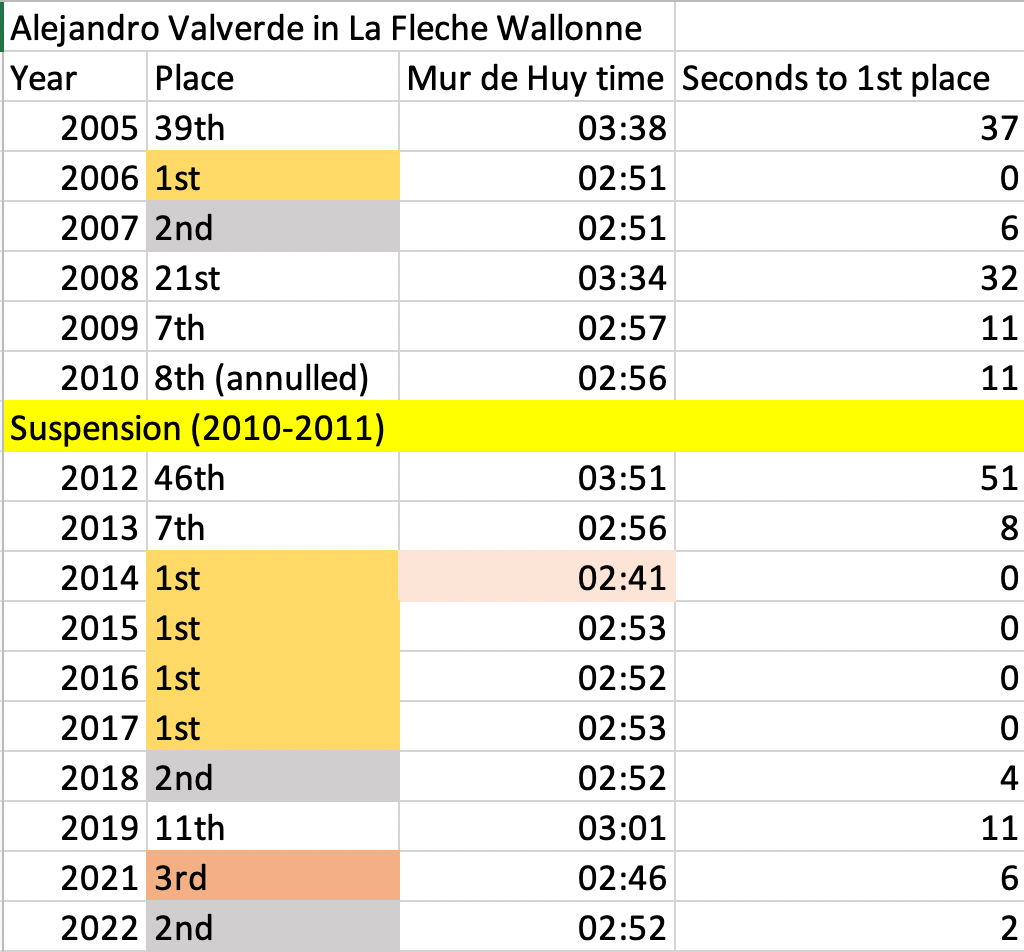
Valverde won his first La Flèche Wallonne in 2006 prior to the Operacion Puerto doping scandal, which rocked the cycling world just a month later in May 2006. In both 2006 and 2007 he climbed the climb in 2 minutes and 51 seconds. In 2007 he was beaten by Davide Rebellin by six seconds, who was riding for the Gerolsteiner team.

Lanterne Rouge x CyclingGraphs – Alejandro Valverde Mur de Huy climbing times

In 2010, Valverde was suspended for two years by the Court of Arbitration for Sport (CAS), with the backdated suspension commencing on January 2010 and ending on 1 January 2012. The CAS panel found that Valverde had committed an anti-doping rule violation but could not conclude that any results obtained by Valverde prior to 2010 were through a doping infraction, however his 8th place in La Flèche Wallonne 2010 was annulled. You can read the CAS press release here.  

The parcours of Fleche has not changed too much since 2005, when Valverde first raced in the hilly race, however in the last years the overall parcours has been made harder with the inclusion of more climbs. The impact of drafting is still present on the Mur de Huy to some degree, despite it being very steep, but it is obviously much less impactful than on a 5-7% climb. The minimum bike weight rule of 6.8kg was established in 2000, which theoretically means that in every La Flèche Wallonne Valverde participated in he was (or should have been) using a 6.8 kg bike. Below you can see Valverde’s Mur de Huy times and distance to 1st place (obviously 0 when he won) throughout the years.

Alejandro Valverde La Fleche Wallonne results and times

From 2008 until 2013, Valverde’s performances were not that impressive in La Fleche Wallonne however in 2014, at nearly 34 years old, he set a new climbing record on the Mur de Huy, climbing it in 2:41. This improved his personal record on Mur de Huy by 10 seconds, which is a significant improvement given how short the climb is.

Alejandro Valverde Belmonte (Team Movistar) – Bauke Mollema (Belkin Pro Cycling Team) – Jelle Vanendert (Team Lotto – Belisol) pictured in action during the 78th Fleche Wallonne with start in Bastogne – finish in Huy 2014 – photo VK/JB/PN/Cor Vos © 2014

The previous record (2:44) was owned by Philippe Gilbert in 2011, when he won every Ardennes classic. Valverde in 2014 could have set an even faster time, but he started to celebrate six seconds before the finishing line.

Valverde celebrating early in 2014 La Fleche Wallonne

In 2021, thanks to Primož Roglič’s early attack, Julian Alaphilippe broke Valverde’s record by 1 second. Valverde himself finished 3rd, losing to Alaphilippe by six seconds, but with a faster Mur de Huy time by over 5 seconds than in four of his five Fleche victories.

Valverde’s performance this week in the 2022 edition was closer to victory but a slower time than in 2021, being edged out by Dylan Teuns late. The time of 2:52 was in line with his 2006-2007 and 2015-2018 level.

Valverde’s consistency at Fleche Wallonne is remarkable, achieving podium placings nearly 17 years apart. Despite turning 42 years old on Monday, the Murcian is still at an elite puncheur level, setting a time on the Mur de Huy last Wednesday that has been good enough to win the race in many other editions in the last two decades. Whether La Ultima Bala is actually the case remains to be seen, as he is still more than capable of winning a stage at La Vuelta later this year which may change his mind.


Teuns Shocks Valverde | La Flèche Wallonne 2022

La Flèche Wallonne is a race that in the modern era of cycling ends always the same. Everything is decided on the extremely steep Mur de Huy (1km, 11.2%), which is perfectly suited for puncheurs like Alejandro Valverde, who has won this race five times. At age 41 Valverde still was one of the main favourites with Movistar teammate Enric Mas providing a leadout for him, but that did not help the Spaniard as he could not challenge Dylan Teuns, who took the surprise win.  

La Flèche Wallonne 2022 profile by La Flamme Rouge

La Flèche Wallonne is a unique race. Most people find it boring if they start to watch it early with 70 km to go, but usually it is worth to start watching in the last 5 kilometres to see the battle for the position before the Mur de Huy and some attacks from non-favourites.

This year it was Søren Kragh Andersen, who attacked late and caught Mauri Vansevenant who had been in a previous attack. DSM did not send a strong puncheur to this race and Kragh Andersen was their best option. He was doing the most of the work as Vansevanant was already tired and his teammate, reigning champion Julian Alaphilippe, was one of the main favourites.

Kragh Andersen and Vansevenant chased by the peloton

They both were caught at the start of the Mur de Huy by Movistar, who was pacing for Alejandro Valverde. This was the last chance for Valverde to win La Flèche Wallonne as he is retiring after this season. Enric Mas was doing a good job and was looking back as Valverde was not on his wheel. He was deep in the peloton with Julian Alaphilippe. Terrible initial positioning by both of them, and instead it was Dylan Teuns who was sitting right behind Mas.

Enric Mas pacing for Valverde

After Mas finished his turn, Aleksandr Vlasov was the first to launch his attack. He was quickly followed by Teuns and Valverde. The main favourite of the race, Tadej Pogačar was struggling early and could not do anything on Mur de Huy. It was surprising to see that Pogačar was the favourite of the race, where his best result was 9th in 2020. Whilst Pogačar is undoubtedly the best GC rider in the world, the Mur de Huy is a very specific finish requiring outstanding 2-3 minute power on steep gradient, where he is not head and shoulders above the rest of his competitors like in other terrain.

Vlasov, Teuns and Valverde launches

Teuns was drilling hard with Valverde sitting on his wheel. At the final straight it was looking like Valverde would pass the Bahrain-Victorious rider, but in the end he could not do it. Maybe he would have won with better positioning before the climb as he needed to move up while Mas was pacing. 

Valverde cannot beat Teuns

This arguably is the biggest win of Teuns’ career. This was the 8th time he started La Flèche Wallonne, with his previous best result being 3rd in 2017. Teuns was not the main favourite, but his form was looking good as he finished in Top 10 in Amstel Gold Race, De Brabantse Pijl and Ronde van Vlaanderen. Definitely he will have a decent chance to win Liege-Bastogne-Liege later this week with a strong team at Bahrain-Victorious.

Teuns time up Mur de Huy was 2 minutes and 50 seconds, which was 10 seconds slower than Alaphilipe’s time last year, when he set the record on the climb.

Valverde finished 2nd for the third time in La Flèche Wallonne. Vlasov and Daniel Martinez, who were already showing great punch in early races, finished 3rd and 5th, while Alaphilippe was only 4th, disappointing by his high standards in this race. This was his worst result for him, as he had won this race three times and finished second twice. The main favourite Pogačar was only 12th, perhaps showing he is losing some form after not taking more than 20 days off from racing since the start of the UAE Tour back in February. Liege-Bastogne-Liege on Sunday should suit him much better.

The Difference between Wet and Dry Paris-Roubaix | Power Analysis

The 2021 edition of Paris-Roubaix took place in October, featuring extremely muddy Autumn conditions whilst the 2022 edition in its normal April slot was bone dry. This year’s race was the fastest ever edition, won by INEOS’ classics specialist Dylan van Baarle. After the big win, the Dutch rider surprisingly uploaded all of his data on Strava, including power and heart rate, which he usually hides. Let’s look deeper into what it took to win the fastest Paris-Roubaix ever and how that compares to the wet edition of last year.

Van Baarle’s Winning Move

Paris-Roubaix is not usually the race where riders’ power records are broken, which is clearly visible when comparing Mathieu van der Poel’s Ronde van Vlaanderen and Paris-Roubaix power data from 2022. Probably it is due to the sapping effect of the cobbles in Roubaix, which drain energy out of riders when they hit hard sectors at full-speed. There are cobbles also in Ronde van Vlaanderen, but they are not as harsh and it is easier to produce big watts on the cobbled climbs.

Van Baarle averaged his biggest watts during the last hour of the race. He attacked with 29 km to go from the chasing group, slipping away from Van der Poel, Van Aert and other favourites. When Van Baarle bridged to Mohorič, Devriendt and Lampaert, he needed to push an enormous 437 watts for almost 5 minutes to do so. 

Van Baarle attacks and bridges to leaders, then goes solo

After he completed the bridge across, he briefly rested to save some energy prior to the Camphin-en-Pevele sector, where dropped Matej Mohorič and Yves Lampaert, averaging 438 watts for 2:39. He quickly got a big gap and went into time-trial mode pushing 390 watts until the Roubaix velodrome. It is interesting to see that Van Baarle did not need to do any huge acceleration to go clear as his maximum power during the last part of the race was 500 watts.

Van Baarle Strava data

This suggests two possible things. Firstly, Van Baarle’s timing of his attack on the asphalt section was impeccable, carrying speed from behind whilst the group slowed down and secondly, he is efficient on the cobbled sectors, being able to ride away from other strong riders like Lampaert and Mohoric without a huge acceleration.

2022 vs 2021 Paris-Roubaix

2022 Paris-Roubaix was the fastest edition in the race’s history due to dry and hot conditions and a crosswind/tailwind. Dylan van Baarle averaged 45.792 km/h for 257.2 kilometres. On the other hand, the 2021 edition, which was extremely muddy and in rainy conditions, was way slower. Sonny Colbrelli averaged 42.719 km/h for 257.7 kilometres.

Paris-Roubaix 2021 mud fest

If we compare the data of 2022 winner Van Baarle and 2021 runner up Florian Vermeersch, we can see the huge divergence in speeds as the riders reached the hardest cobbled sectors of the race. Van Baarle was more than 13 minutes quicker from the Arenberg cobble sector to Roubaix, which is 93.5 kilometres:

  • Van Baarle (77 kg): 2:08:00, 353w, 377w NP, 43.9 km/h
  • Vermeersch (85 kg): 2:23:39, 350w, 374w NP, 39.1 km/h
VERMEERSCH Florian (BEL) of LOTTO SOUDAL pictured during 118th Paris-Roubaix (1.UWT) A one day race between Compiegne and Roubaix (257KM) – photo NV/PN/Cor Vos © 2021

Below is a side by side comparison between both rider’s time and power on every cobble sectors. In 2021 there were four different sectors at the start, so the data from those sectors is not included.

Dylan van Baarle 2022 vs Florian Vermeersch 2021 on the cobble sectors
  • Troisvilles – Inchy (3*). Van Baarle (77 kg): 3:05, 300 watts (3.9 w/kg) vs Vermeersch (85 kg): 3:42, 358 watts (4.21 w/kg)
  • Viesly – Quievy (3*). 2:23, 239w (3.10 w/kg) vs 3:03, 366w, (4.31 w/kg)
  • Quievy – Saint Python (4*). 6:11, 324w (4.21 w/kg) vs 6:07, 399w (4.69 w/kg)
  • Saint Python (2*). 1:59, 451w (5.86 w/kg) vs 2:13, 470w, (5.53 w/kg)
  • Vertain – Saint Martin sur Ecaillon (3*). 3:02, 456w (5.92 w/kg)
  • Haussy (2*). 1:13, 368w (4.78 w/kg)
  • Saulzoir – Verchain Maugre (2*). 2:00, 229w (2.97 w/kg)
  • Verchain Maugre – Querenaing (3*). 2:44, 366w (4.75 w/kg)
  • Querenaing – Maing (3*). 3:12, 224w (2.91 w/kg) vs 3:56, 358w (4.21 w/kg)
  • Maing – Monchaux sur Ecaillon (3*). 2:09, 337w (4.38 w/kg) vs 2:38, 437w (5.14 w/kg)
  • Haveluy – Wallers (4*). 3:49, 307w (3.99 w/kg) vs 4:24, 433w (5.09 w/kg)
  • Trouee d’Arenbeg (5*). 3:26, 383w (4.97 w/kg) vs 3:48, 457w (5.38 w/kg)
  • Wallers – Helesmes (3*). 2:18, 336w (4.36 w/kg) vs 2:37, 432w (5.08 w/kg)
  • Hornaing a Wandignies (4*). 5:29, 352w (4.57 w/kg) vs 5:45, 369 watts (4.34 w/kg)
  • Warlaing a Brillon (3*). 3:31, 368w (4.78 w/kg) vs 3:52, 398w (4.68 w/kg)
  • Tilloy a Sars-et-Rosieres (4*). 3:25, 459w (5.96 w/kg) vs 4:19, 379w (4.46 w/kg)
  • Beuvry-la-Foret a Orchies (3*). 2:03, 341w (4.43 w/kg) vs 2:20, 464w (5.46 w/kg)
  • Orchies (3*). 2:18, 376w (4.88 w/kg) vs 2:37, 409w (4.81 w/kg)
  • Auchy-lez-Orchies a Bersee (4*). 3:54, 430w (5.58 w/kg) vs 5:24, 397w (4.67 w/kg)
  • Mons-en-Pevele (5*). 4:43, 427w (5.55 w/kg) vs 5:55, 412w (4.85 w/kg)
  • Merignies a Avelin (2*). 0:51, 301w (3.91 w/kg) vs 1:01, 339w (3.99 w/kg)
  • Pont-Thibaut a Ennevelin (3*). 2:00, 423w (5.49 w/kg) vs 2:07, 374w (4.4 w/kg)
  • Templeuve (L’Epinette) (1*). 0:24, 367w (4.77 w/kg) vs 0:28, 376w (4.42 w/kg)
  • Templeuve (Moulin-de-Vertain) (2*). 0:47, 308w (4.00 w/kg) vs 0:57, 265w (3.11 w/kg)
  • Cysoing a Bourghelles (3*). 1:58, 425w (5.52 w/kg) vs 2:23, 357w (4.2 w/kg)
  • Bourghelles a Wannehein (3*). 1:41, 412w (5.35 w/kg) vs 1:55, 414w (4.87 w/kg)
  • Camphin-en-Pevele (4*). 2:39, 438w, (5.69 w/kg) vs 3:19, 435w (5.12 w/kg)
  • Carrefour de l’Arbre (5*). 3:12, 416w (5.40 w/kg) vs 3:53, 400w (4.71 w/kg)
  • Gruson (2*). 1:23, 376w (4.88 w/kg) vs 1:49, 359w (4.22 w/kg)
  • Willems a Hem (3*). 2:05, 397w (5.16 w/kg) vs 2:13, 387w (4.55 w/kg)
  • Roubaix (Espace Crupelandt) (1*). 0:23 vs 0:25, 134w (1.58 w/kg)

Van Baarle was faster on almost every sector except Quievy – Saint Python (Van Baarle 6:11 vs Vermeersch 6:07).

The biggest differences were on the Auchy-lez-Orchies a Bersee (3:54 vs 5:24) and Mons-en-Pevele (4:43 vs 5:55), which follow each other, which is understandable given that Auchy-lez-Orchies is where Van Baarle attacked and on Mons-en-Pevele Wout van Aert launched a huge offensive.

It is worth pointing out the Beuvry-la-Foret a Orchies sector. Despite pushing 341 watts, Van Baarle did it in 2:03, while Vermeesche with 464 watts, was 17 seconds slower. The dry conditions allowed riders to ride in the faster non-cobbled gutters much more frequently, including in some of the hardest sectors. This is visible in the video above when Van Baarle attacked. In contrast, many of the gutters last year contained standing water, with just mud beneath them, a recipe for crashing if the riders dared try and escape the cobbles.

Both editions of Paris-Roubaix are special in their own right, with INEOS coming close to winning last year with Moscon before his mechanical misfortune. They were deserved winners this year, with brilliant tactics from Van Baarle as well as legs strong enough to win the fastest ever edition of the race.

One of the Greatest Sundays in Hell | Paris-Roubaix 2022

It will be hard to beat the hot and dry Paris-Roubaix 2022, in our view the most exciting race of 2022 so far. INEOS made the race very hard from the beginning, putting pressure on big favourites Van Aert and Van der Poel, who were sleeping in the peloton, while the big split happened in the crosswinds. Everything came back together and in the end only the strongest riders made the split after Jumbo-Visma’s acceleration with just over 50km to go. Dylan van Baarle was once again left to bridge to a dangerous move, joining Mohoric and Lampaert then dropping them, giving INEOS the first Paris-Roubaix victory in the team’s history. This was also the fastest ever edition of the legendary race, where so many things happened that it is worth watching almost from the beginning.

Paris-Roubaix 2022 profile by La Flamme Rouge

It was a full-gas race practically from the start. With 210 kilometres to go, INEOS made the race difficult in the crosswinds, punishing many big favorites like Van der Poel, Van Aert, Asgreen and Pedersen. The big group was created with almost 100 riders. Something you rarely see in cycling. INEOS with all riders present was pacing hard and making life hard for Alpecin-Fenix and Groupama-FDJ in particular, gaining an 80-second lead before even the first cobble sector. 

Roubaix – France – cycling – Sheffield Magnus (USA) of INEOS Grenadiers – Van Baarle Dylan (NED) of INEOS Grenadiers leading escape pack pictured during 2nd Paris-Roubaix (1.WWT) a one day race from Compigne to Roubaix(257,2km – Photo: Nico Vereecken/PN/Cor Vos © 2022

Unfortunately for INEOS, their pre-race team leader Filippo Ganna punctured. They had to choose to wait or continue to pace, but INEOS seemingly chose to wait for Ganna letting the second group with Van Aert and Van der Poel reduce the gap by 30-40 seconds. It was a little bit weird to see INEOS put so much trust in Ganna, who was riding his first cobble classic since 2019. He has participated in Paris-Roubaix twice, in 2018 (OTL) and 2019 (DNF). In 2016, Ganna won the u23 edition of the race. Bookmakers also were rating him very highly. After making the split in the crosswind he was the 2nd favourite to win in the markets, only behind Van der Poel. 

Ganna chasing back the first group

The action did not end there as there was a big crash in the first group, involving INEOS riders Magnus Sheffield and Cameron Wurf. The crash slowed down the Van der Poel and Van Aert group who lost around 40 seconds because it was extremely hard to get through the mess. There was also a big crash in the 2nd group, which involved Denmark’s biggest stars Asgreen and Pedersen.

Big crash in the first group

With Alpecin-Fenix pacing for Van der Poel, the second group was holding the gap to around one-minute. Paris-Roubaix is a perfect race for long-range attacks in-between cobbled sectors. The breakaway master Matej Mohorič knows this well and followed an attack in the first group, making a 5-man move, with Davide Ballerini, Casper Pedersen, Tom Devriendt and Laurent Pichon. Entering the hardest cobble segment of the race, La Trouée d’Arenberg, Mohorič already had almost a two minute gap over the favourites. Ballerini punctured on the Arenberg cobbles and Pedersen later dropped out, which thinned down this group to only three riders.

Mohorič in the leading group

Van Aert entered the Arenberg sector as one of the first riders in the group behind, but suffered a badly timed mechanical. It took the Belgian two bike changes and almost 10 kilometres to catch the peloton after briefly borrowing Timo Roosen’s dutch national champion painted bike.

Van Aert dropped in the Arenberg sector due to a mechanical

Mohorič’ odds to win looked great. At one point in the live betting his implied odds were around 60% for the win. INEOS was actively chasing in the peloton, but not enough hard to reduce the gap to Mohorič and Devriendt.

INEOS chasing Mohorič group

On the Orchies three star segment Jumbo-Visma took over with Nathan Van Hooydonck burning himself for Van Aert. The gap melted to one-minute in only 7 kilometres as Jumbo-Visma’s classics revelation Van Hooydonck launched the Belgian champion.

Van Hooydonck and Van Aert riding full-gas

After the acceleration, only 12 riders were left in the elite group. Van der Poel, Van Keirsbulck, Van Aert, Kung, Turner, Van Baarle, Lampaert, Senechal, Stuyven, Petit, Trentin and Van der Hoorn. Quick-Step, INEOS, Alpecin-Fenix and Intermarche each had two riders in this group. Intermarche looked very good as they even had Devriendt with Mohorič in the lead. Mohorič needed to do the most work as he was the favourite and Devriendt had leverage with teammates Taco and Petit behind.

A 12-man elite chasing group

Van Baarle with 51 kilometres remaining showed that he had great legs and attacked on the Auchy à Bersée 4 star segment. It was a sign for something later. The chasing group was not cooperating well and Van Aert tested his rivals on Mons-en-Pévèle, another 5 star sector. With this move it was clear that Van Aert had the strongest legs, while Van der Poel was distanced and barely was holding on with Kung frequently being the rider to close down Van Aert’s attacks.

Van Aert gaps Van der Poel

Van Aert with Kung and Van der Poel caught Van Baarle and Pichon from the first group and were slowly closing the gap to Mohorič and Devriendt. But then, as usually happens in Paris-Roubaix, Van Aert punctured for at least the second time. Fortunately for Van Aert, a few moments later the same thing happened to Mohorič in the front group, leaving Devriendt alone at the front and less need for urgent pacing in the second group of favourites.

Van Aert, Van der Poel & Co chasing Mohorič and Devriendt

No one was pacing hard in the second group, which made Van Aert’s life easier. Mohorič also joined the group after the puncture as well as Van Aert returning as easily as he could have hoped. The tactical games started as it was 10 riders with Devriendt alone at the front and many riders without a sprint to rely on. Kung, who helped a lot in chasing, attacked as he cannot win a sprint. Van Aert was controlling everything and after that even tried to attack himself multiple times, but no one was letting him go, as he is Van Aert. 

Van Aert and Mohorič joins the chasing group after punctures

After unsuccessful attempts, the group slowed down. It looked like it would be a classic race, where Van der Poel and Van Aert would cancel each other out, while a non-favourite would win with a solo attack. That started to happen as Mohorič with Lampaert attacked. Ben Turner started to chase after them, but when no one was willing to help him, INEOS countered with Van Baarle, while Van Aert was at the front of the group watching back at others to chase.

Mohorič reunited with Devriendt, who was riding alone for 15 kilometres and the front four quickly took a 40-second gap. Meanwhile, in the dysfunctional chasing group, Stuyven attacked as he had saved something in his legs and only Van Aert and Kung were able to follow, which meant that Van der Poel was done. He already had spent a lot of energy chasing and today was not his day. It looked like Van Aert & company might catch the leaders, but Stuyven punctured at the worst moment, reducing the chase group’s prospects. Trek-Segafredo’s Pirelli tires were not reliable in the men’s and women’s races as many of their team riders punctured.

Van Baarle attacking with Mohorič and Lampaert and joining to Devriendt

Van Baarle made his race-winning move on the Camphin-en-Pévèle 4-star sector, riding away from a spent Mohorič and Lampaert. No one was going to catch the Dutchman, who was riding after his biggest win of his career. Everyone else was fighting for minor places. Lampaert and Mohorič were for a podium, but then an unexpected happened and Lampaert, while riding on the asphalted gutter, was caught by an irresponsible spectator and crashed, ending his fight for a podium.

Van Baarle soloed into the Roubaix velodrome. He won the race by 107 seconds, the biggest margin since Fabian Cancellara’s 2010 win, when his margin was 120 seconds. Right after the finish Van Baarle hugged the boss of INEOS Dave Brailsford. Van Baarle’s current contract with the team will end this year. There were rumours that he might join Jumbo-Visma, but he has certainly increased his negotiating leverage with both teams after today’s result. The Dutchman’s consistency has been incredible in the last few big races. He finished 2nd in Ronde van Vlaanderen in 2022 and World Championships in 2021. The previous biggest victory of Van Baarle’s career was Dwars door Vlaanderen last year. I

Roubaix – France – cycling – Dylan Van Baarle (Netherlands / Team INEOS Grenadiers) pictured during Paris-Roubaix (1.UWT) a one day race from Compigne to Roubaix (257,2km) – Photo: POOL/Cor Vos © 2022

Van Aert caught Mohorič and Devriendt and won the sprint for 2nd place. Another silver medal in Wout van Aert’s collection, after finishing 2nd in Tokyo Olympic Road Race, World Championships ITT and Road Race in 2020 and Ronde van Vlaanderen 2020. Van Aert was probably the strongest rider, despite missing Ronde van Vlaanderen two weeks ago due to a Covid infection. Next week he will be riding Liege-Bastogne-Liege. It is still crazy to think that he has not won Paris-Roubaix or Ronde van Vlaanderen at age 27. Always something is missing for the Belgian at the end of the big races, where everyone is riding against him because he is Wout van Aert as well as frequent ill-timed mechanical.

It was also the fastest Paris-Roubaix ever. Van Baarle completed the 257.2 kilometres long course in 5 hours and 37 minutes with an average speed of 45.792 km/h.

We must note another great performance by Intermache-Wanty-Gobert. Six riders from the team finished in Top 25 – Devriendt (4th), Petit (6th), Kristoff (12th), Van der Hoorn (16th), Pasqualon (19th) and Planckaert (23rd). They earned a total of 593 UCI points in Paris-Roubaix alone. Their relegation situation looks very safe after a great performance in the cobble races.

Magnus Sheffield is The Next American Superstar | De Brabantse Pijl

It was another exciting De Brabantse Pijl edition, one of the most underrated races on the UCI calendar. After making an elite 10-man group, Magnus Sheffield looked very strong as he was pacing on the climbs, making others suffer. The American attacked late as INEOS had multiple options, Ben Turner and Tom Pidcock, in the group, and won his first classic only at age 19.

De Brabantse Pijl – La Flèche Brabançonne 2022 profile by La Flamme Rouge

It was a rainy day in Belgium. It made the race harder as riders in the peloton were riding full-gas with at least 75 km to go. Before the big attacks, Remco Evenepoel pushed Ben Turner whilst trying to claim the wheel of Victor Campenaerts which earned the Belgian a warning.

The big split did happen after the Moskesstraat (0.5 km, 6.7%). Ben Turner got a gap after the climb and Remco Evenepoel decided to attack, which shattered the peloton. Victor Campenaerts was struggling to hold on to his wheel, but they bridged to Turner with multiple riders following them.

Evenepoel bridging to Turner

A strong 10-man group was formed with INEOS having strength in numbers with Pidcock, Sheffield and Turner in the leading group. Lotto-Soudal had Campenaerts and Wellens, while Evenepoel was isolated with Alaphilippe sitting in the peloton. Other remaining riders were Teuns, Barguil, Cosnefroy and Stannard. 

They quickly gained a 30-second lead over the peloton where Israel-Premier Tech were actively chasing with Nizzolo, Impey, Neilands and Houle. Unfortunately, Teuns had a front wheel puncture and returned to the peloton. That meant Bahrain-Victorious also started to work at the front.

The leading 10-man group

Evenepoel, Barguil and Campenaerts were dropped on the second last Hertstraat (700 m, 4.7%) with Magnus Sheffield pacing hard. It was an ideal situation for INEOS as they had 3 out of 6 riders in the leading group.

Evenepoel dropped

Evenepoel caught the leaders at the base of the Moskesstraat, doing a lot of chasing on the flat section. He was holding at the back of the group. Pidcock who paced at the start of the climb, struggled hard at the end and was a few metres behind the group. After the Moskesstraat Evenepoel went full-gas and attacked with Sheffield and Wellens on his wheel but Cosnefroy, who was looking strong, brought them back. After that INEOS used their numbers and countered with Turner, but Evenepoel’s legs were great and he closed the Clock’s attack. The tempo was too hard for Stannard and Campenaerts, who were dropped, thinning down the group to seven riders.

The gap to the peloton was slightly growing as it reached over a minute going into the last lap. Unfortunately, going into the last lap a team Quick-Step car slightly hit a Cofidis rider.

Quick-Step hits a Cofidis rider

That ended up in a big crash, with Alaphilippe going down hard too. The cars were passing the peloton as the gap to the leading group was over a minute.

Julian Alaphilippe (France / Team Quick-Step Alpha Vinyl) pictured during 7th De Brabantse Pijl – La Flche Brabanonne a one day race between Leuven and Overijse (205.1km) – Photo: Vincent Kalut/PN/Cor Vos © 2022

19-year-old American Magnus Sheffield was looking very strong. He again paced hard on the Hertstraat and rode away together with Cosnefroy. Again, it was Evenepoel’s job to catch them on the flat section, which he did successfully practically with no help. 

Sheffield pushing big watts on the Hertstraat

Sheffield was strongest on the last cobbled climb of the day, the Moskestraat, with Pidcock struggling badly again like last year. It was clear that Sheffield and Turner were feeling better than Pidcock, who has not shown great form this year relative to his 2021 classics season.

It was weird seeing that Evenepoel would not try to attack as he had 0% chance to win a sprint against faster guys like Cosnefroy on the finish and it was clear INEOS would work him over with attacks from their strong rouleurs, which is what eventually happened.

With 3.5 km to go Sheffield, who had looked like thee strongest rider on climbs, attacked. When Sheffield attacked, Evenepoel was at the back of the group, while Cosnefroy did not want to chase him. Sheffield immediately got a big gap and Evenepoel was already cooked and could not bring him back alone. Wellens, Cosnefroy and Barguil, who had previously dropped and completely cooked, were not going to bring back the American powerhouse.

Sheffield attacks

Sheffield will turn 20 on the 19th of April. He already won a stage in Vuelta a Andalucia with a late attack, after his teammates crashed. The INEOS classics squad looks very promising as Pidcock and Turner are only 22 year-olds, while Sheffield is not old enough to drink beer in the United States.

Magnus Sheffield (USA / Team INEOS Grenadiers) pictured during 7th De Brabantse Pijl – La Flche Brabanonne a one day race between Leuven and Overijse (205.1km) – Photo: Tim van Wichelen/Cor Vos © 2022

There was a big deviation in the sprint for 2nd place as Wellens deviated into Cosnefroy, which caused the Frenchman to ride into Evenepoel. Wellens was relegated to 9th place after the finish, while Cosnefroy won this chaotic sprint and again finished 2nd, after losing by a few centimetres in Amstel Gold Race.

Wellens deviates into Cosnefroy

Wellens relegation meant that Lotto-Soudal lost 85 UCI points as the Belgian originally finished 3rd, but was relegated to 9th place.